


June 16, 2026 – A miner turned AI cloud host borrowed billions at investment-grade rates. The trick was simple: it pledged its customers’ credit, not its own.
In Summary
IREN closed a $3.65B GPU financing facility on June 1 at a 6.00% blended cost.
Microsoft prepayments and the loan covered roughly 96% of a $5.81B chip bill.
Fitch rated the facility A, firmly placing it in investment-grade territory.
CoreWeave’s $8.5B deal set the template, and rivals now chase similar backing.
Bitcoin miners usually raise cash one way. They print new shares, and existing holders watch their slice shrink. IREN just broke that pattern. The company raised $3.65 billion in debt without issuing a single new share.
Moreover, it borrowed at an investment-grade rating. That detail matters far more than the headline number. It signals that AI infrastructure has become a fundable asset class. The deal closed on June 1, and the structure deserves a closer look.
What IREN actually did
IREN now calls itself an AI cloud provider rather than a miner. The shift followed a $9.7 billion, five-year contract with Microsoft. To serve it, the company needed roughly $5.81 billion worth of Nvidia GB300 chips.
Therefore, IREN arranged a $3.65 billion facility through Goldman Sachs and J.P. Morgan. The debt is secured against the GPUs and the cash Microsoft is contracted to pay. Microsoft also prepaid $1.94 billion toward the bill.
Consequently, the loan and the prepayment together covered about 96% of the chip cost. IREN barely touched its own balance sheet. The chart below breaks down who funded what.
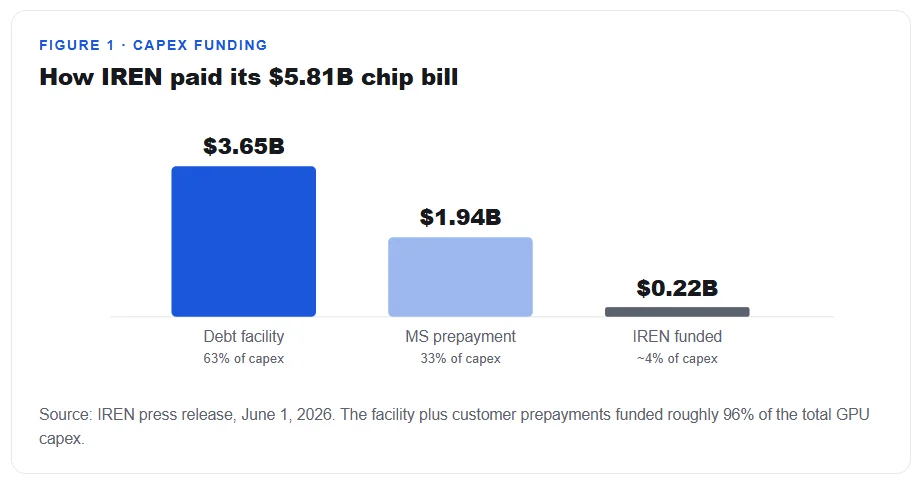
Management says it “essentially got the GPUs for next to nothing”. It quoted an all-in cost of 3.31%. However, that figure treats the prepayment as free money. In truth, IREN repays that advance later in compute. The honest borrowing cost stays at 6.00%.
How the deal earned an investment-grade rating
A credit rating simply grades a borrower’s likelihood of repaying. The facility earned an A from Fitch and an A (low) from DBRS. Both sit comfortably inside the investment-grade band.
Yet IREN, on its own, would not rate that highly. The lenders were not really betting on IREN. Instead, they were betting on Microsoft, which holds a top-tier AAA rating. Because the debt is secured by Microsoft’s contracted payments, the agencies graded that promise.
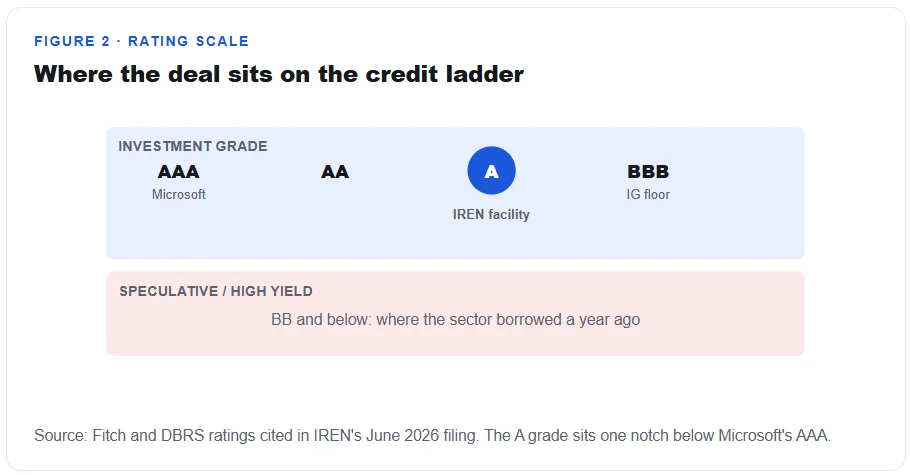
That single notch below perfect is the agencies’ price for risk. GPUs lose value fast. IREN could also stumble on delivery. Strip it all down, and IREN borrowed against Microsoft’s balance sheet.
Why the rating unlocks cheap money
An investment-grade stamp does more than look good. It decides who is allowed to lend. Insurers and pension funds hold huge long-term pools of capital. Their rules largely forbid them from buying anything below investment grade.
Clear that bar, and you reach the deepest, cheapest capital available. Miss it, and you face private-credit funds charging near double digits. That is exactly where the sector sat a year ago. The rating is the door, and Microsoft’s credit is the key.
“What now decides which firms fund themselves cheaply is not megawatts. It is whether they signed a customer whose credit can carry a rating.”
IREN is not the first
CoreWeave reached this milestone first. In March, it closed an $8.5 billion GPU-backed facility at a nearly identical rating. That deal leaned on a roughly $19 billion backlog of contracts from Meta.
IREN’s rating sits a notch higher. It also owns its data centers, while CoreWeave mostly rents. You might expect cheaper money as a result. Yet both are priced at almost the same spread. The chart below compares the two deals side by side.
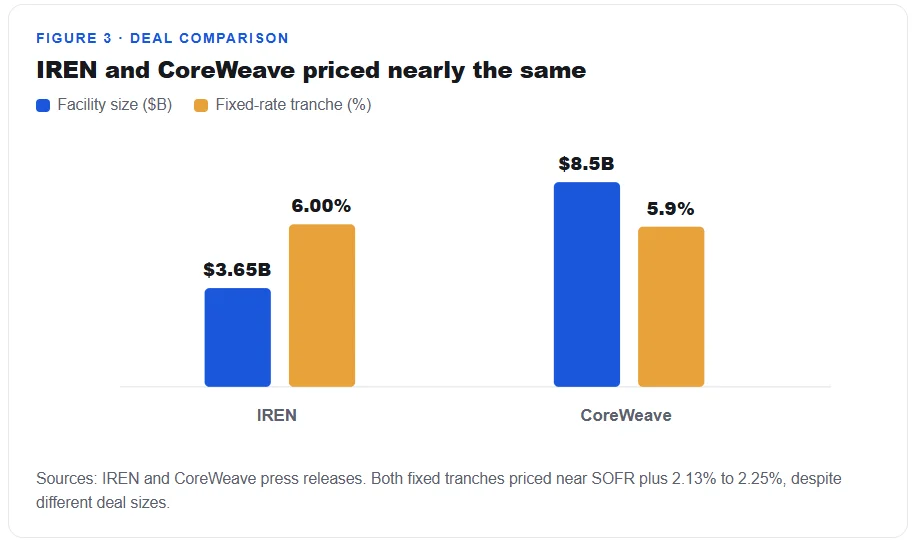
The rating edge and the owned buildings were nice to have. Still, what got both deals done was the same thing. Each had a customer who was creditworthy enough to rate. Everything else was a tiebreaker.
The catch is leverage
The upside is real. Funding a buildout with debt and a customer’s cash beats printing shares. Holders avoid dilution, and the capital costs less than alternatives.
However, equity holders now stand behind these lenders. The lenders hold first claim on the GPUs and the Microsoft payments. If the contract underperforms, the debt gets repaid before shareholders see a cent. The timeline below shows the core mismatch.
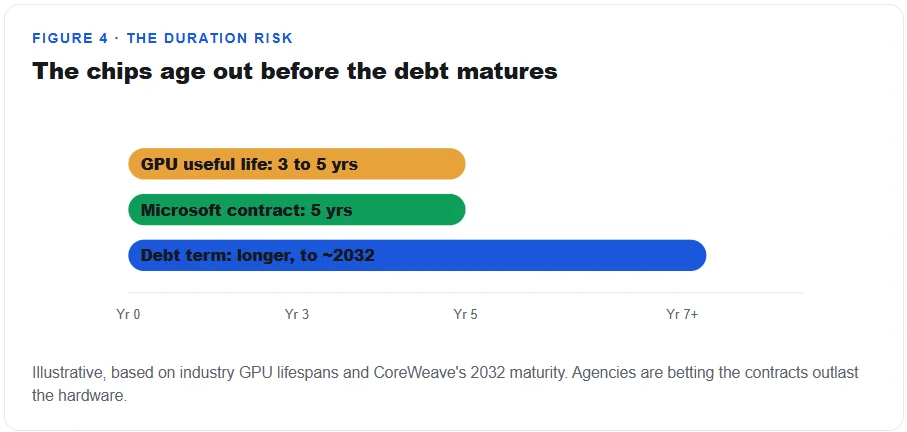
Then zoom out, because the rule here outlasts IREN. TeraWulf, Cipher, and Applied Digital all chase the same prize. Land an investment-grade anchor, and you can borrow like IREN. Failing to land an anchor means you keep selling shares to survive.
Some skepticism still helps. The chips age out in three to five years, while the debt runs longer. Much of this demand also comes from hyperscalers’ funding capacity they plan to rent. So far it works. The question worth asking stays the same: who is the customer, and how good is their credit?