

June 08, 2026 – A war that began on Feb. 28 has reshaped oil, equities, crypto and bonds. Here is a data-led look at where each market stands after 100 days.
In Summary
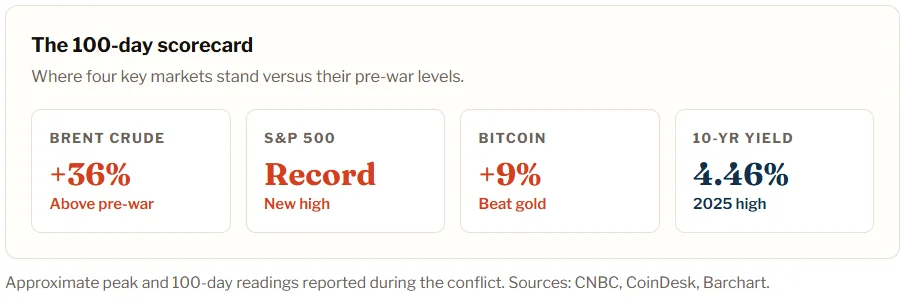
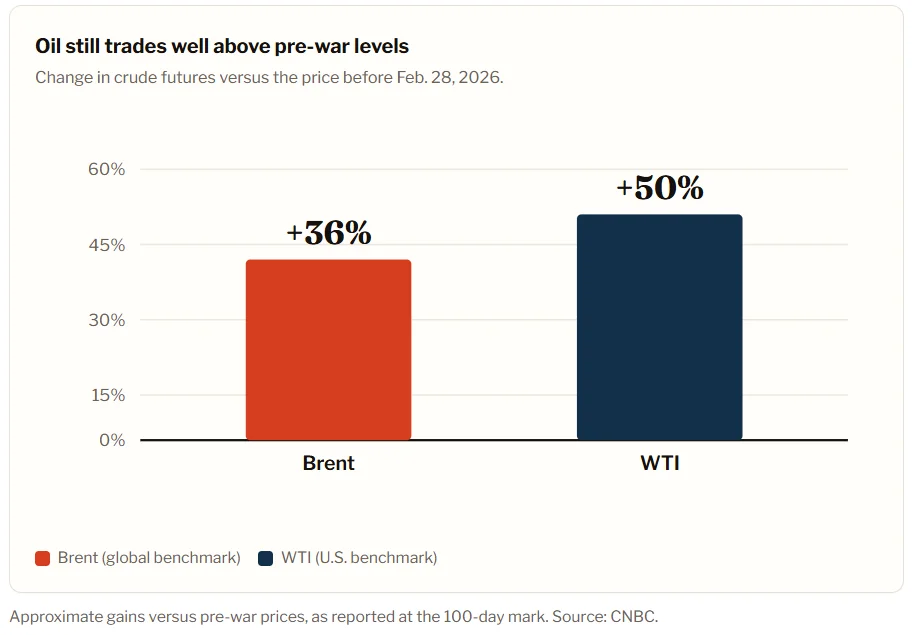
Brent crude trades roughly 36% above its pre-war price, while WTI sits nearly 50% higher.
The S&P 500 has climbed to record highs, gaining about 7% since the conflict began.
Bitcoin fell first, then rebounded, and has since outpaced both gold and stocks.
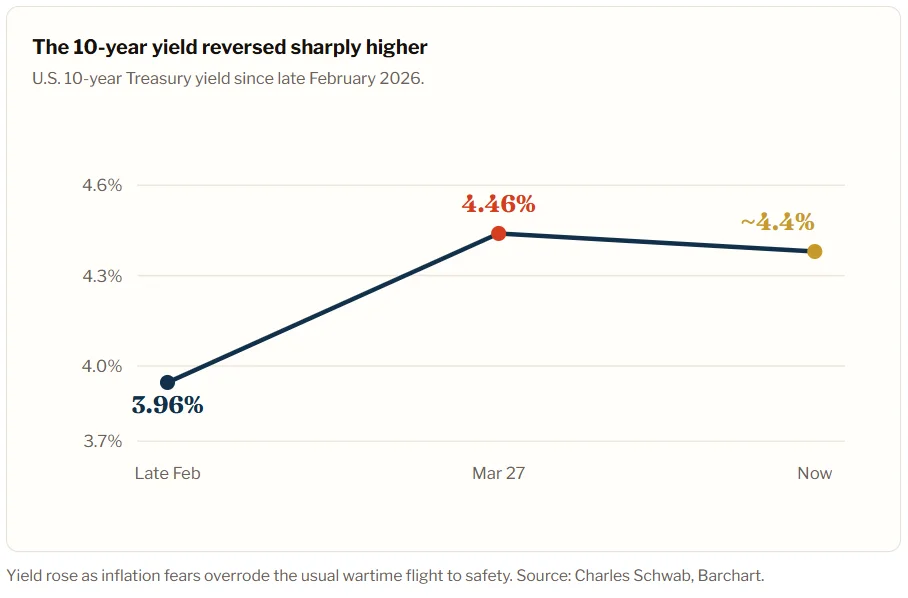
Treasury yields jumped sharply, with the 10-year hitting its highest level since July 2025.
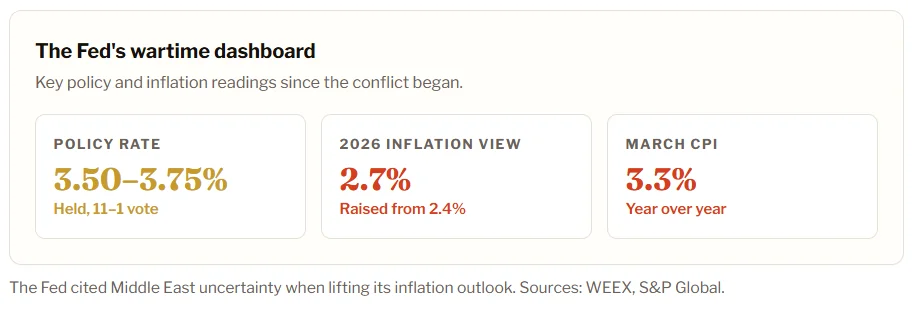
The Federal Reserve held rates and lifted its 2026 inflation forecast to 2.7%.
Sunday marks 100 days since war erupted in the Middle East. The United States and Israel struck Iran on Feb. 28, 2026. That opening salvo, code-named Operation Epic Fury, launched a conflict that still grips markets today. According to CNBC, the war has moved asset prices across every region.
Investors first reacted with fear. Stocks sold off sharply around the globe. Oil prices then surged as supply fears took hold. Meanwhile, bond yields climbed on rising inflation worries. However, that early panic proved short-lived for equities.
A war that rattled every asset class
The conflict touched commodities, equities, crypto and debt at once. Inflation has since begun to rise in several major economies. Higher energy costs and pricier commodities explain much of that climb. Therefore, central banks now face a harder balancing act.
The opening strikes also killed Iran’s supreme leader. Tehran answered with hundreds of missiles and thousands of drones. As a result, the violence quickly spread across the Gulf region.
Oil tells the clearest story
Energy markets felt the war first and hardest. The Strait of Hormuz handles about one-fifth of global oil flows. That route has stayed effectively shut throughout the conflict, per the Congressional Research Service. Consequently, prices have swung violently on every headline.
Brent crude now trades about 36% above its pre-war price. WTI sits nearly 50% higher, CNBC reports. Prices have eased from their wartime peaks, yet they remain far above earlier levels. Furthermore, the blockade has forced importers to hunt for new suppliers. U.S. crude exports have therefore risen during the standoff.
Wall Street shrugged off the shock
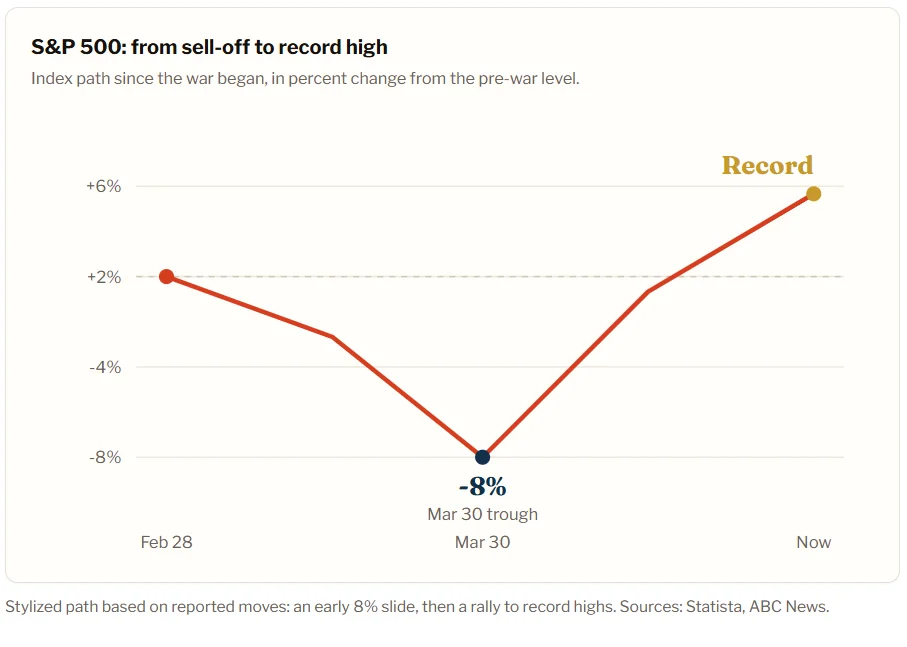
Stocks took the opposite path. Equities first tumbled when the strikes began. Between Feb. 28 and March 30, the S&P 500 fell by almost 8%, according to Statista. The index briefly flirted with correction territory.
Then sentiment flipped. On March 31, reports suggested both sides wanted a quick exit. Stocks rallied hard through April as hopes for peace grew. The benchmark later closed above 7,000 for the first time. Remarkably, it has since notched fresh record highs.
Why have stocks proved so resilient? Many investors expect Trump to retreat once economic pain bites. Traders call this the “TACO” trade, short for “Trump always chickens out.” Markets therefore keep buying on any hint of de-escalation, as ABC News notes.
Crypto rewrote its crisis playbook
Crypto produced the most surprising story of all. Bitcoin was the only major market open when strikes hit. The attack landed on a Saturday, so the token repriced the shock instantly. That timing made crypto the first gauge of investor fear.
The opening move was brutal. Bitcoin dropped about 8.5% from its session high. It slid from near $67,000 toward $63,000 within hours, CoinDesk reported. Ethereum slipped too, dipping below $1,900. Risk-off selling clearly dominated those first hours.
Then the rebound began. Bitcoin reclaimed $67,000 to $68,000 the same day. Buyers stepped in fast across the 24/7 market. Therefore, the token recovered far quicker than equities did.
From laggard to leader
The longer trend has stunned analysts. Since Feb. 28, Bitcoin has gained roughly 7% to 10%. It has outperformed both gold and the S&P 500 over that span. The Bitcoin-to-gold ratio has jumped about 36%, crypto.news reports.
Why has Bitcoin held firm this time? Institutional ownership has deepened through spot ETFs. BlackRock’s IBIT alone held about $57.7 billion by early April. Moreover, steady inflows have built a patient base of holders.
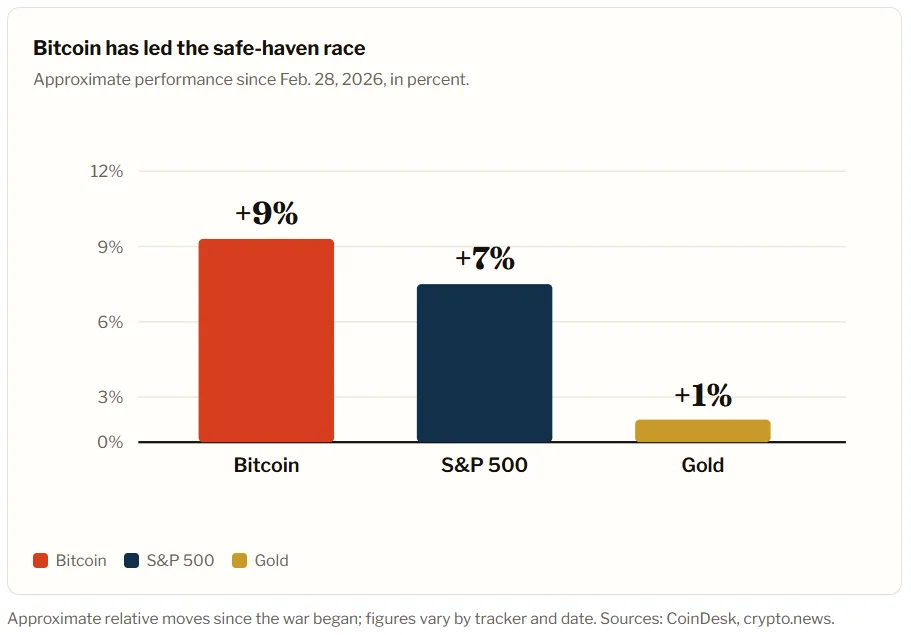
Still, Bitcoin is no clean safe haven yet. It sold off again after the Fed held rates in March. The token slipped nearly 4% to around $71,600 that day. In short, crypto now trades like a fast, liquid risk asset.
Bitcoin behaved less like digital gold and more like a 24/7 liquidity pool for global shocks.
Bonds stayed under pressure
Government bonds offered little shelter. Yields jumped as the war stoked inflation fears. Bond prices and yields move in opposite directions. Elevated yields therefore signal continued pressure on bond values.
The reversal was swift and severe. The 10-year yield sat near 3.96% in late February. By March 27, it had climbed to 4.46%, Charles Schwab noted. That marked its highest level since July 2025. Meanwhile, the 30-year yield touched 5.13%, the lowest level since 2007.
War usually sparks a flight into Treasuries. This time, the opposite happened instead. The conflict acted as an inflation shock, not a safety trade. Consequently, bonds fell rather than rallied.
Capital markets feel the strain
The shock reshaped the wider capital markets too. Higher yields lifted borrowing costs for companies. Bond investors also grew wary of corporate credit risk. Pimco’s Daniel Ivascyn trimmed corporate credit and raised cash, Bloomberg reported.
The Federal Reserve sits at the center of that strain. On March 18, policymakers held rates at 3.50%-3.75%. The vote split 11 to 1, with one member favoring a cut. The Fed also raised its 2026 inflation forecast to 2.7%.
Inflation refuses to cool
Fresh data backs up the central bank’s caution. March headline CPI rose 3.3% from a year earlier. Energy prices jumped 10.9% in a single month. Gasoline alone surged 21.2% over that period.
Markets have since abandoned hopes of rate cuts. Traders had widely expected easing before the war. Now some even price in a possible hike by December, per S&P Global. Higher-for-longer rates therefore weigh on growth-sensitive assets.
The great divergence
A striking split now defines global markets. Stocks signal optimism, while bonds flash caution. The S&P 500 has gained about 7% since the war began. Yet bond yields continue to price in stubborn inflation, CNBC reports.
Some strategists warn this gap cannot last. Rising yields could eventually drag equities lower. Several major banks have already flagged the risk of a correction. Furthermore, a surprise drop in payrolls revived stagflation talk.
Winners and losers by sector
Sector performance clearly shows the uneven pain. Semiconductors and materials fell hard in the early sell-off. Airlines dropped due to the spike in jet fuel costs. By contrast, energy producers gained from pricier crude.
The core tension is simple to state. Investors are betting on a fast, clean resolution. The bond market is hedging against a longer, costlier war. One of those two views will prove wrong.
What comes next
A lasting peace deal still looks elusive. Talks between Washington and Tehran have stalled repeatedly. Both sides keep sending mixed signals on progress. Moreover, sporadic attacks continue to unsettle traders.
The next leg depends heavily on oil. A reopened Strait would ease prices and inflation. A prolonged blockade would do the opposite. Either path will ripple through stocks, bonds and crypto alike.
For now, investors are betting on a swift resolution. Yet the longer the Strait stays shut, the greater the danger. The next 100 days may test that optimism hard.




