

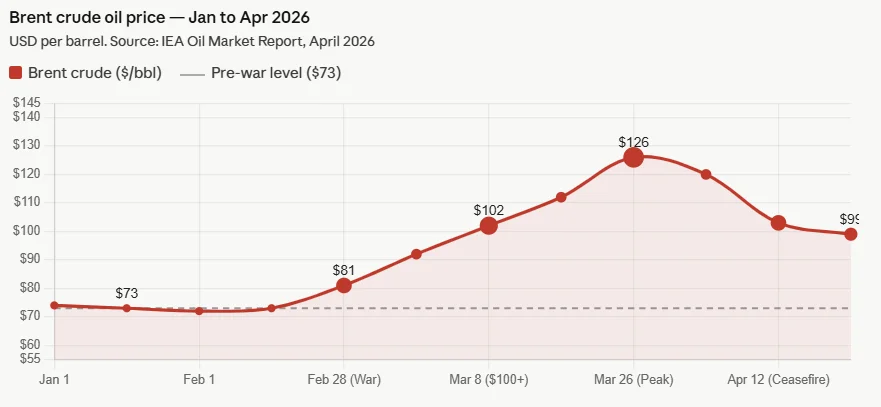
April 19, 2026 – The Strait of Hormuz closure triggered the largest oil supply disruption in recorded history. Brent crude peaked at $126/bbl. U.S. consumers are now absorbing the shock.
In Summary
Brent crude peaked at $126/bbl in March 2026, the fastest oil price surge in modern conflict history.
U.S. headline CPI hit 3.3% annually in March, its highest in nearly two years, driven by a 10.9% monthly energy spike.
Global supply dropped 10.1 million bpd in March, the largest disruption in oil market history, per the IEA.
The Fed is holding rates at 3.5%–3.75%, with markets now pricing in no cuts until mid-2027.
Goldman Sachs raised the 12-month probability of a U.S. recession to 30%, with unemployment forecast to reach 4.6% by year-end.

On February 28, 2026, joint U.S.-Israeli airstrikes targeted Iranian leadership in “Operation Epic Fury.” Iran’s Supreme Leader Ali Khamenei was killed. Iran retaliated with missiles and drones. Then it closed the Strait of Hormuz.
That chokepoint carries roughly 20% of the world’s seaborne oil trade. Its closure triggered the largest energy supply disruption in global history. The economic consequences are rippling across continents.
The energy shock, by the numbers
The IEA’s April 2026 Oil Market Report paints a stark picture. Global oil supply plunged 10.1 million bpd in March. OPEC+ production fell 9.4 million bpd month-on-month. Strait shipments collapsed from 20 million bpd to just 3.8 million bpd.
Alternative routes via Saudi Arabia and the UAE carried only 7.2 million bpd. The overall supply loss exceeded 13 million bpd. Physical crude prices briefly touched $150 per barrel.
The IEA estimates cumulative supply losses exceeded 360 million barrels in March and are projected to reach 440 million barrels in April, with outages peaking at 9.1 million bpd.
Inflation bites American consumers
The March CPI was the worst inflation report of Trump’s second term. Headline CPI rose 0.9% monthly, lifting the annual rate to 3.3%. Energy prices surged 10.9% in a single month. Gasoline crossed $4 per gallon, the highest since late 2023.
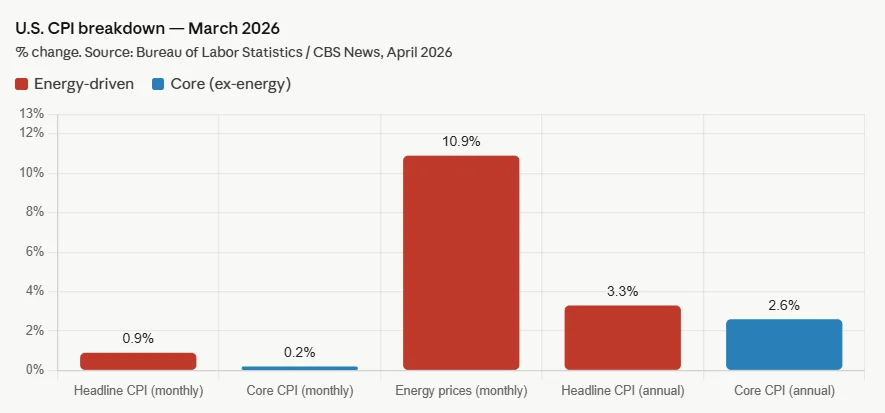
Core CPI, stripping out food and energy, rose only 0.2% monthly and 2.6% annually. That is still above the Fed’s 2% target but below worst-case forecasts. Analysts called it a sign that energy costs have not yet fed into broader categories.
“As long as the increase in gasoline prices is not translating into an increase in the core measures of inflation, then the Fed is probably not going to react to the noise in the headline measures.”
— Eugenio Aleman, Chief Economist, Raymond James
The Fed waits markets price in pain
The Federal Reserve held rates at 3.5%–3.75% at its March meeting. It is pencilled in just one cut for 2026. Current market pricing pushes any cut to mid-2027 or beyond. The Fed meets again April 28–29.
Goldman Sachs economists project two cuts, in September and December. But that hinges on limited inflation pass-through and a weakening labour market. The bank raised its 12-month U.S. recession probability to 30%.
Europe and Asia face deeper exposure
The ECB warned of stagflation risk. Germany and Italy face a potential technical recession by year-end. Chemical and steel firms imposed surcharges of up to 30% on clients. Asia is even more exposed. In 2024, 84% of Hormuz crude went to Asian markets. China receives one-third of its oil through the strait.
Ceasefire holds, but risks remain
A two-week ceasefire was announced in mid-April. But peace talks in Pakistan collapsed. The U.S. Navy imposed a blockade on Iranian ports. The EIA revised its 2026 Brent average to $96 per barrel, up from a pre-war estimate of $78.84.
Oxford Economics warns that April CPI will be “uncomfortably strong.” The key wildcard remains the duration and intensity of the conflict. That single variable will shape inflation, monetary policy, and global growth for the rest of 2026.




