

June 10, 2026 – Finland’s radar-satellite leader quadrupled its value in six months as Europe races to fund sovereign space intelligence.
In Summary
ICEYE raised €450 million in a primary Series F round led by General Atlantic.
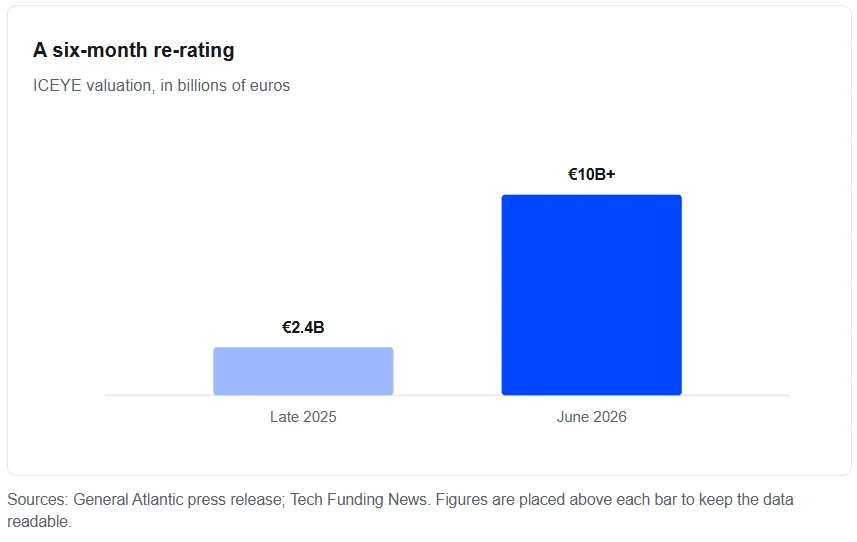
The deal values the company above €10 billion, roughly four times its level six months ago.
Including a secondary placement, the full round tops €1 billion.
Nokia and the Qatar Investment Authority joined as new strategic backers.
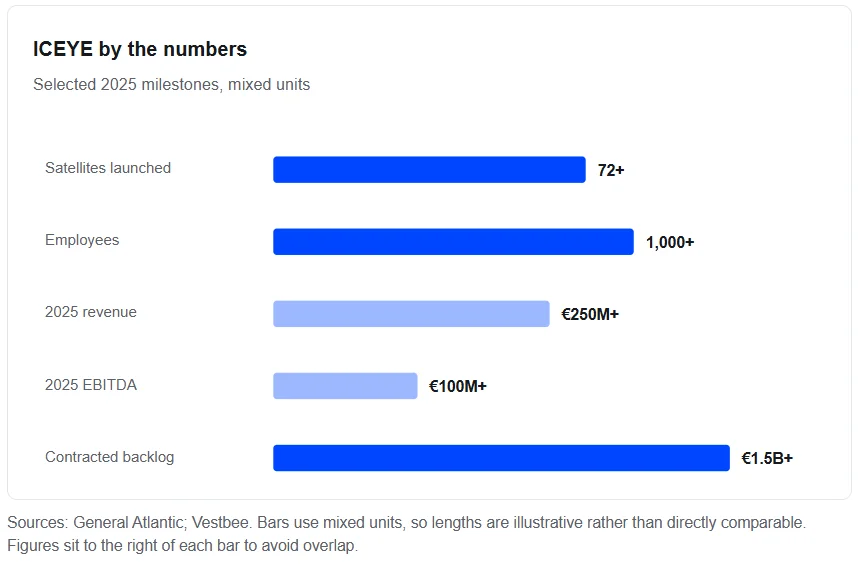
ICEYE crossed €250 million in 2025 revenue and €100 million in EBITDA.
Finnish satellite firm ICEYE has reached a new milestone. The company raised €450 million in a primary Series F round. General Atlantic led the financing. As a result, the company is now valued at more than €10 billion, or about $12 billion.
This figure is striking for one clear reason. The valuation has roughly quadrupled in just six months. According to Tech Funding News, ICEYE was worth about €2.4 billion late last year. Therefore, the new round marks one of Europe’s sharpest recent re-ratings in defence and space technology.
Moreover, the headline number understates the full scope of the deal. The primary raise covers €450 million in fresh capital. However, a secondary placement lifts the total transaction above €1 billion. Consequently, this ranks among Europe’s largest private space and defence financings.
Why investors are paying up
ICEYE builds and operates synthetic aperture radar satellites. These satellites image the Earth through clouds and darkness. In contrast, optical satellites cannot see at night or through heavy weather. This all-weather capability makes the data valuable for defence and intelligence buyers.
Furthermore, the financials now support the premium. The company says 2025 revenue exceeded €250 million. In addition, EBITDA topped €100 million. The contracted backlog also passed €1.5 billion. Therefore, ICEYE is profitable and growing.
“Sovereign intelligence from space is entering a new era,” said ICEYE chief executive Rafal Modrzewski.
How ICEYE makes money
The business model is easier to grasp as a flow. First, ICEYE builds and runs its own radar satellites. Next, those satellites produce a single core product: Earth observation data. Finally, the company sells that data in three different ways.
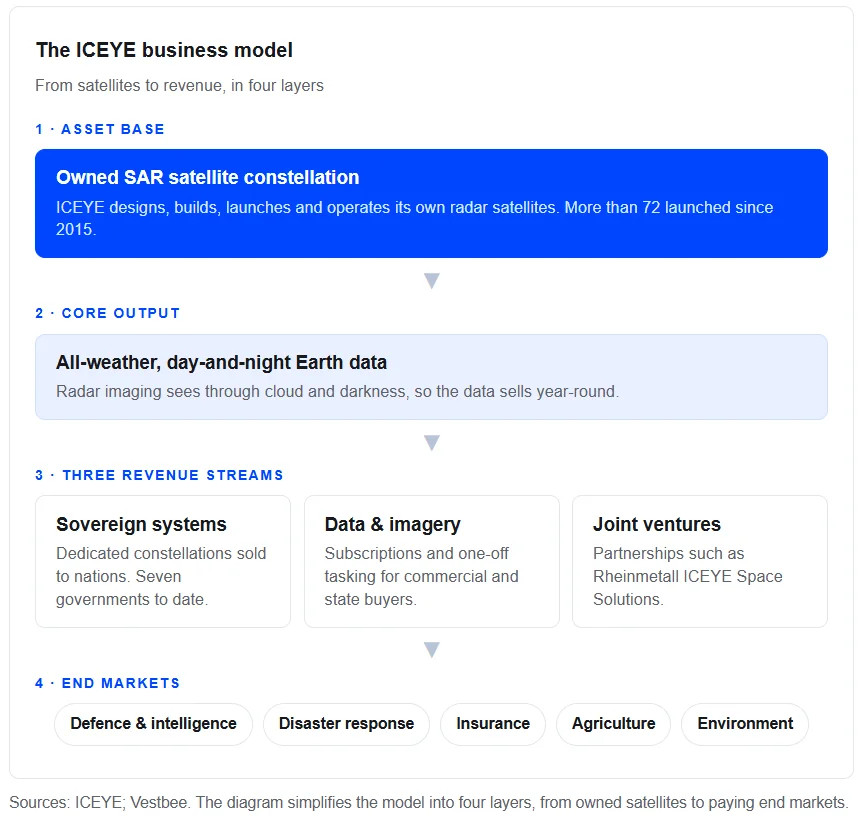
This structure explains the premium. ICEYE owns the hardware, the data and the customer relationship. As a result, it captures value at every layer rather than just one.
A broad and strategic investor group
The round drew an unusually wide group of backers. General Atlantic led it. Meanwhile, Finnish state investor Solidium and growth fund Tesi joined in. Pension insurers Varma and Ilmarinen also took part, alongside Lifeline Ventures and TCV.
Two names stand out, though. Nokia entered as a new strategic investor. The Qatar Investment Authority also joined the round. Their presence signals where the technology is heading next.
Nokia’s role is especially telling. Radar satellites generate intelligence data. By comparison, communication networks deliver that data to decision-makers in real time. Nokia chief executive Justin Hotard framed the partnership around Europe’s push for technological sovereignty.
Riding the defence-spending wave
The timing is no accident. European governments have boosted defence budgets sharply since 2022. Demand for sovereign space intelligence has climbed alongside that spending. As a result, ICEYE has won large national contracts.
The clearest example came in December. German group Rheinmetall and ICEYE won a contract worth about €1.7 billion. The deal supplies space-based reconnaissance to Germany’s armed forces. It runs through to the end of 2030, with extension options.
That contract carries strategic weight. The data will primarily protect the Bundeswehr’s Lithuania Brigade. In turn, it helps secure NATO’s eastern flank. Seven European governments have now bought sovereign systems from ICEYE.
How ICEYE stacks up
ICEYE leads its niche by a wide margin. The company has launched more than 72 satellites since 2015. It now employs over 1,000 people. By contrast, rivals such as Capella Space, Umbra and Japan’s Synspective operate at a smaller scale.
Production scale is the next frontier. ICEYE is targeting up to 100 satellites per year by 2028, per Vestbee. Such volume would widen its lead further. It would also support more sovereign constellations for individual nations.
What happens next
The deal still needs regulatory approvals. These are expected to close in the third quarter of 2026. After that, ICEYE plans to accelerate satellite production. It also aims to deepen its intelligence software and analytics.
The wider signal matters most, however. Investors are treating space intelligence as critical national infrastructure. Governments increasingly agree. For ICEYE, that shift has turned a niche radar specialist into a €10 billion company.




