

May 15, 2026 – A $2.7 billion net loss marks the end of Honda’s aggressive electrification era. EV writedowns, cancelled models, and shifting US policy delivered a historic blow.
In Summary
Honda posted a ¥423.9 billion ($2.7B) net loss for FY2026, its first in nearly 70 years.
Total EV-related charges reached up to ¥2.5 trillion ($16B) across two fiscal years.
Three North American EV models were cancelled; a $11B Canada battery project was suspended.
Honda’s adjusted operating profit (ex-EV costs) remained strong at ¥1,039.3 billion.
Honda is now pivoting to hybrids, scrapping earlier EV volume targets entirely.

Honda Motor Co. has posted its first annual net loss as a publicly listed company in nearly 70 years. Specifically, the official financial results for the fiscal year ended March 31, 2026, reveal a net loss of ¥423.9 billion. That translates to approximately $2.7 billion. Consequently, this figure marks a dramatic reversal for Japan’s second-largest automaker.
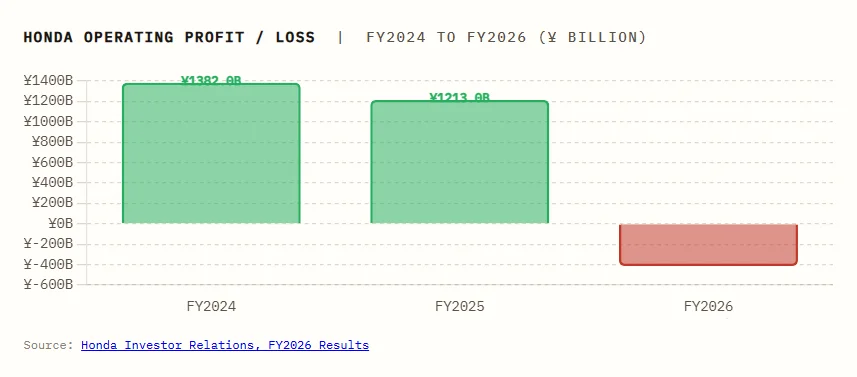
Just one year prior, Honda reported an operating profit of ¥1.213 trillion. In FY2026, however, that figure swung to an operating loss of ¥414.3 billion. The shift represents one of the sharpest reversals in Honda’s corporate history. Notably, revenue held relatively firm throughout the chaos. Sales grew 0.5% to ¥21.797 trillion, as strong hybrid and motorcycle results offset EV damage.
The EV Charges That Broke the Bank
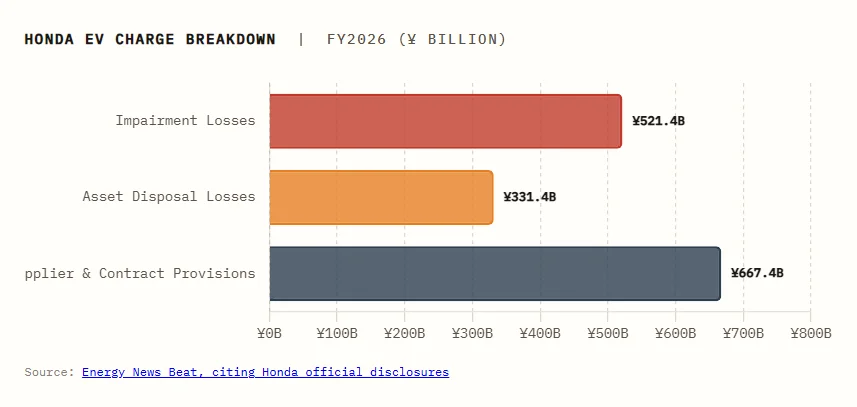
Honda’s EV-related charges totalled ¥2.5 trillion ($16 billion) over two fiscal years. Notably, impairment losses on cancelled EV assets formed the largest single item. That figure alone reached ¥521.4 billion.
Furthermore, losses on disposed intangible assets contributed another ¥331.4 billion. In addition, provisions for supplier compensation and onerous contracts added ¥667.4 billion. Equity-method losses, mostly from Chinese joint ventures, compounded the damage further. As a result, EV-related operating impacts reached ¥1,454 billion for the fiscal year.
Nevertheless, Honda’s underlying performance tells a different story. The company’s adjusted operating profit, excluding EV costs, reached ¥1,039.3 billion. Therefore, the core motorcycle, hybrid, and combustion engine businesses remain fundamentally healthy. In short, EV ambition nearly buried an otherwise strong operation.
Three Models Cancelled, Two Markets Abandoned
In March 2026, Honda scrapped three North American EV models. Specifically, these included the Honda 0 SUV, Honda 0 Saloon, and the Acura RSX. Honda originally scheduled all three for production at its retooled Marysville, Ohio, facility. Moreover, the company positioned that plant as the centrepiece of its U.S. electrification push.
Honda also suspended an $11 billion EV and battery project in Canada. Beyond that, Honda abandoned all long-term electrification targets entirely. The company had aimed for EVs to form 20% of global sales by 2030. Honda also targeted a full shift to electric or fuel-cell vehicles by 2040. Both goals now no longer exist.
“EV demand has declined considerably due to the rollback of environmental regulations in the United States.”
-Toshihiro Mibe, CEO, Honda Motor Co. (May 14, 2026)
Policy Shifts and Chinese Competition
Honda’s CEO pointed to several external forces behind the retreat. Primarily, U.S. EV demand slowed sharply after policy changes under the Trump administration. The administration cut federal EV incentives and eased emissions regulations. As a result, these shifts drained demand for battery-electric vehicles in America’s largest auto market.
Meanwhile, China presented a different challenge. Local automakers outpaced Honda with software-defined, connected EVs. Consequently, Honda struggled to compete in a market where it once led. The company’s China joint ventures recorded significant equity-method losses as a result.
Industry-Wide Pain: Honda Is Not Alone
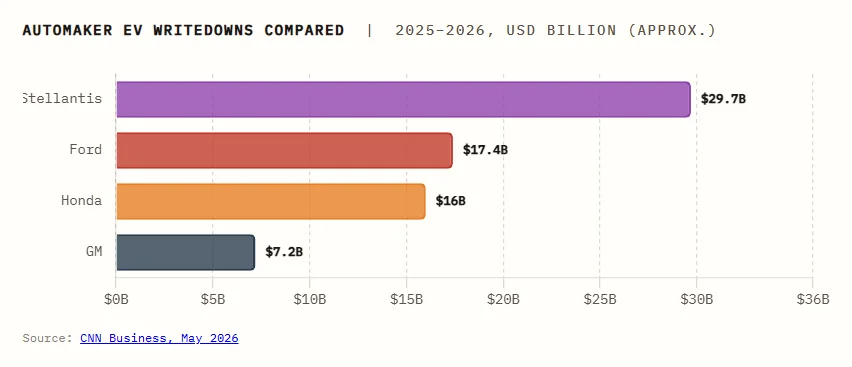
Honda’s predicament reflects a sector-wide reckoning with EV costs. According to CNN Business, General Motors booked a $7.2 billion EV-related charge in 2025. Similarly, Ford recorded a $17.4 billion writedown for the same period. Furthermore, Stellantis reported the largest charge: 25.4 billion euros, or roughly $29.7 billion.
In contrast, General Motors managed to stay profitable despite its charge. Ford and Stellantis, however, both joined Honda in reporting net losses. This pattern clearly signals that the pace of EV adoption has broadly outpaced industry readiness.
Honda’s New Strategy: Hybrids First
Honda now firmly pivots toward hybrid-electric vehicles. Specifically, the company accelerates next-generation hybrid development across North America and India. Moreover, battery investment, including a US joint venture with LG Energy Solution, continues. However, Honda now reviews all capital spending for efficiency before committing funds.
For fiscal year 2027, Honda forecasts sales revenue of ¥23.15 trillion. That represents a 6.2% increase over FY2026. Additionally, the company targets an operating profit of ¥500 billion, alongside another ¥500 billion in residual EV charges. On an adjusted basis, excluding EV costs, Honda aims for ¥1 trillion in operating profit. Furthermore, Honda pledges at least $5 billion in shareholder returns over the next three years.
CEO Mibe reaffirmed the company’s commitment to carbon neutrality by 2050. However, Honda now pursues the path in a fundamentally different way. Instead of rigid EV volume targets, the company adopts a profitability-first, flexible approach. Therefore, Honda will pursue future EV investments only where financial returns are certain.
Ultimately, Honda’s story serves as a cautionary tale for the entire auto industry. Aggressive electrification targets, without matching consumer demand, carry enormous financial risk. Indeed, for Honda, the cost of moving too fast has arrived in full: a $2.7 billion loss and 70 years of consistent profit wiped out in a single fiscal year.




