

July 31, 2026 – Bonds, equities and digital assets read the same Fed statement three different ways. The long end of the curve delivered the most honest verdict of all.

In Summary
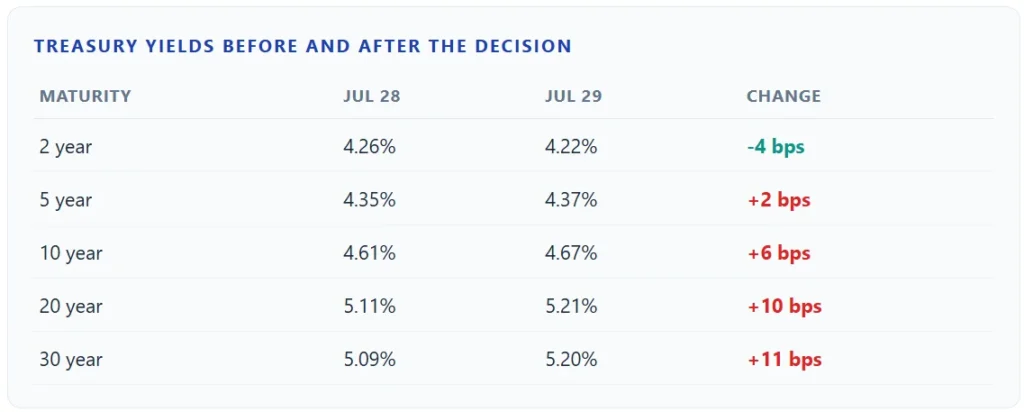
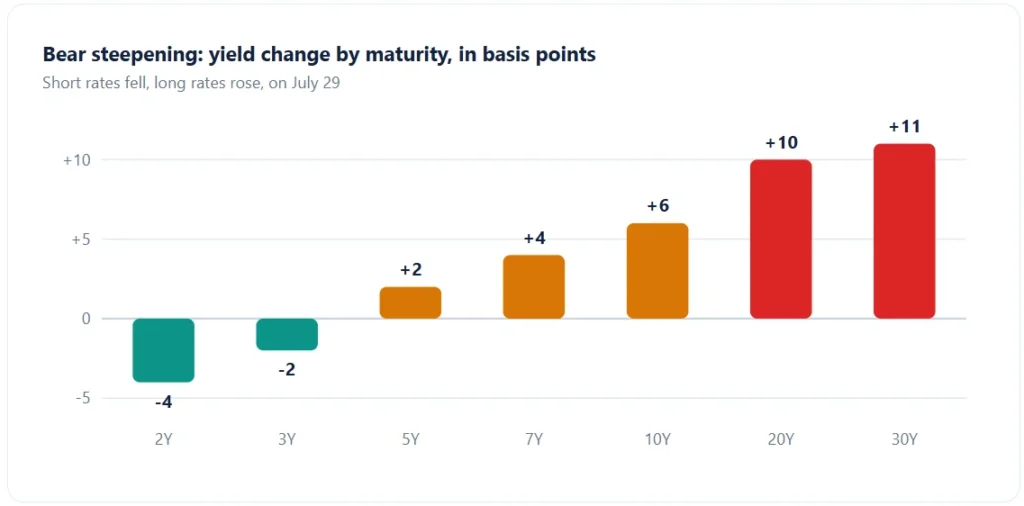
The Treasury curve bear-steepened: two-year yields fell 4 bps while thirty-year yields rose 11 bps.
Long rates near 5.20% signal doubt about the inflation endgame, not about the July pause.
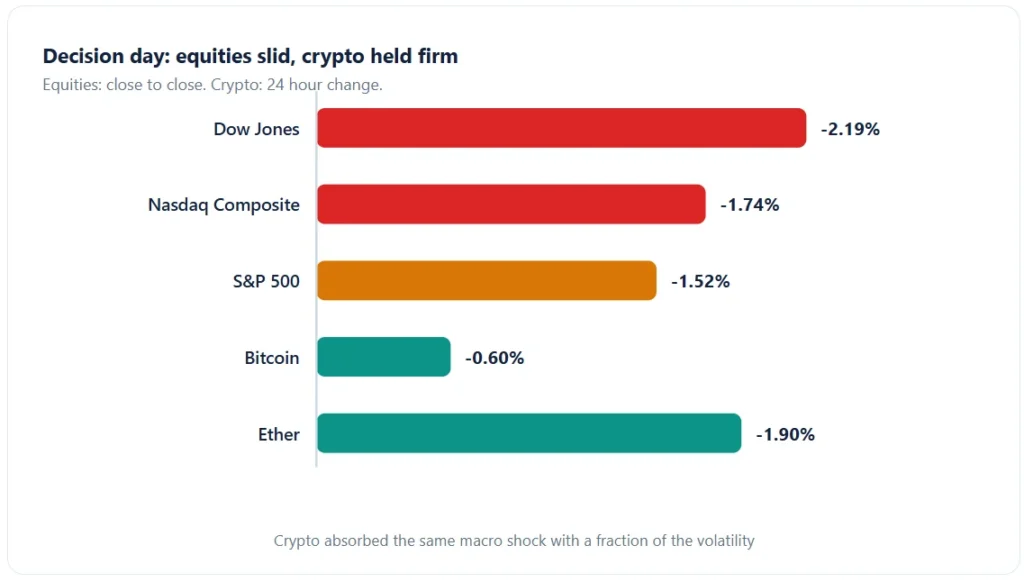
The Dow lost 2.19% and the Nasdaq 1.74%, with chipmakers and industrials leading declines.
Bitcoin held near $64,800, and total crypto value stayed around $2.30 trillion, a striking decoupling.
Asia and Europe largely shrugged, suggesting investors read this as a US credibility question.
Global markets delivered a split verdict on the Fed rate decision, and the bond market spoke loudest. Equities tumbled hard on Wednesday. Yet crypto barely flinched. Meanwhile, long-dated Treasury yields surged toward levels last seen before the financial crisis.
That divergence matters more than any single index close. The Federal Reserve held its target range at 3.50% to 3.75% by a 9 to 3 vote. Three regional bank presidents wanted an immediate quarter-point hike. Consequently, traders spent the afternoon repricing not just September, but the next decade.
Bond Market Delivers the Real Verdict
Treasury data shows a textbook bear steepening. The two-year yield actually fell, sliding from 4.26% to 4.22%. However, the ten-year climbed from 4.61% to 4.67%. The thirty-year jumped hardest, rising from 5.09% to 5.20%.
That pattern carries a precise message. Short rates eased because traders unwound bets on an immediate hike. Long rates rose because investors demanded more compensation for future inflation. In other words, the market accepted the pause but questioned the endgame.
Our platform calculation sharpens the point. The gap between two- and thirty-year yields widened from 83 to 98 basis points. That is a 15 basis point steepening in one session. Furthermore, the two-to-ten-year spread widened by 10 basis points.
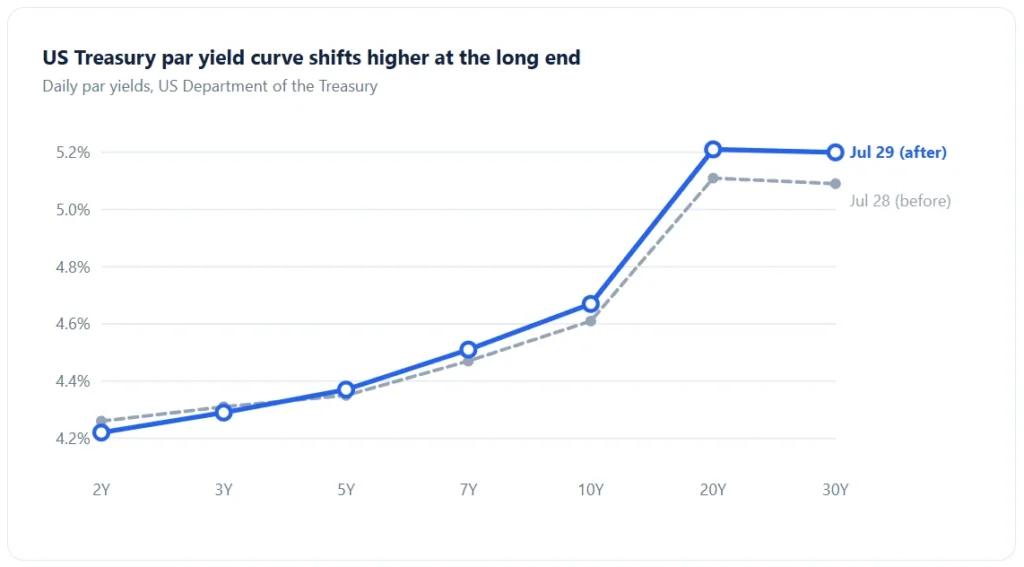
Bond investors, therefore, issued a polite vote of no confidence. They are not worried about July. Instead, they worry the committee waits too long and lets inflation settle in. Long yields near 5.20% price that risk directly. Indeed, the thirty-year now trades at its highest level since 2007.
Wall Street Suffers a Brutal Session
Equities read the same signal and panicked. The Dow Jones Industrial Average fell 1,153 points, or 2.19%, closing at 51,594. That marked its worst single day since April 2025. Additionally, the S&P 500 lost 1.52% to finish at 7,316.
Technology took the heaviest damage. The Nasdaq Composite dropped 1.74% to 24,443. Moreover, the index now sits more than 10% below its record high. Chipmakers led the retreat as an AI-driven selloff deepened. Notably, that slide began well before the Fed spoke.
The sector split was revealing. Industrials fell more than 3%, while technology shed over 2%. Conversely, energy and defensive names finished higher. Rising crude prices lifted oil majors even as the broader tape sank.
Notably, the damage came from rates rather than the rate itself. A hold was already priced in at roughly two to one odds. Traders instead reacted to the long end of the curve. Higher discount rates hurt long-duration growth stocks most of all. Therefore, the selloff hit expensive tech hardest.
Crypto Shrugs Off the Fed Rate Decision
Digital assets told a completely different story. Bitcoin traded near $64,800, essentially flat through the announcement. Meanwhile, the total crypto market capitalisation held around $2.30 trillion. That figure edged higher over the following 24 hours. Bitcoin dominance, meanwhile, held near 57% of the total.
Ether tracked a similar path, holding close to $1,920. Both assets moved less than 2% while the Dow lost more than 2%. Liquidations stayed modest at roughly $400 million across the market. For a macro event of this size, that is remarkably quiet. By comparison, equity volatility spiked across the afternoon.
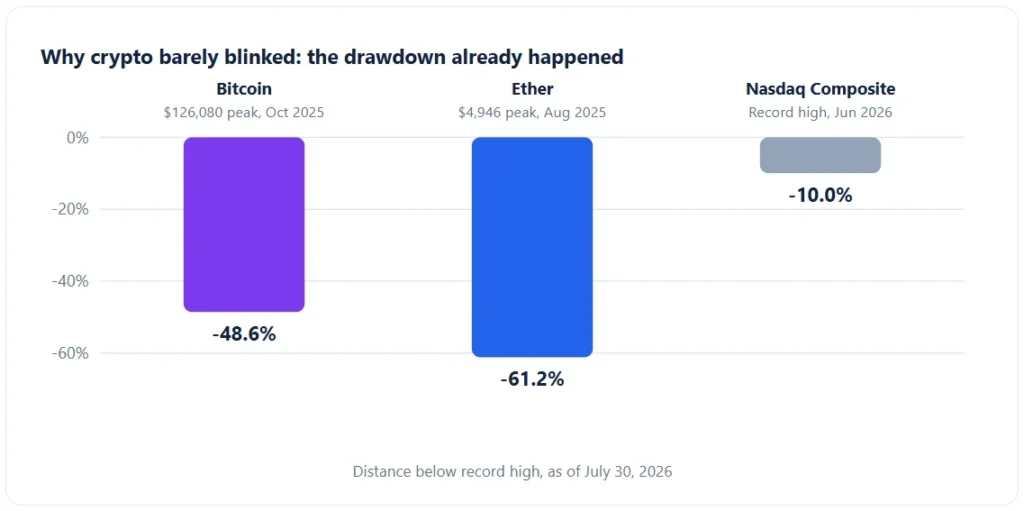
This calm deserves scrutiny rather than celebration. Crypto has spent 2026 in a deep drawdown already. Bitcoin sits about 49% below its October 2025 peak near $126,000. Ether trades roughly 61% under its own record.
Hence, the muted reaction has a simple explanation. Leverage had already washed out before the meeting. Positioning was light, and speculative froth had largely evaporated. Assets that have already repriced tend to absorb bad news better. Consequently, the downside surprise simply had less fuel.
Still, the decoupling looks genuine on the numbers. Crypto has tracked the Nasdaq closely for years. This week that relationship loosened noticeably. Bitcoin ignored a chip-led equity rout that pulled the Nasdaq 100 into correction.
Investors should not overread one session, though. A sustained hawkish path would eventually bite digital assets too. Higher real yields raise the opportunity cost of holding non-yielding assets. For now, however, crypto is trading on its own supply and demand.
Asia and Europe Absorb the Shock
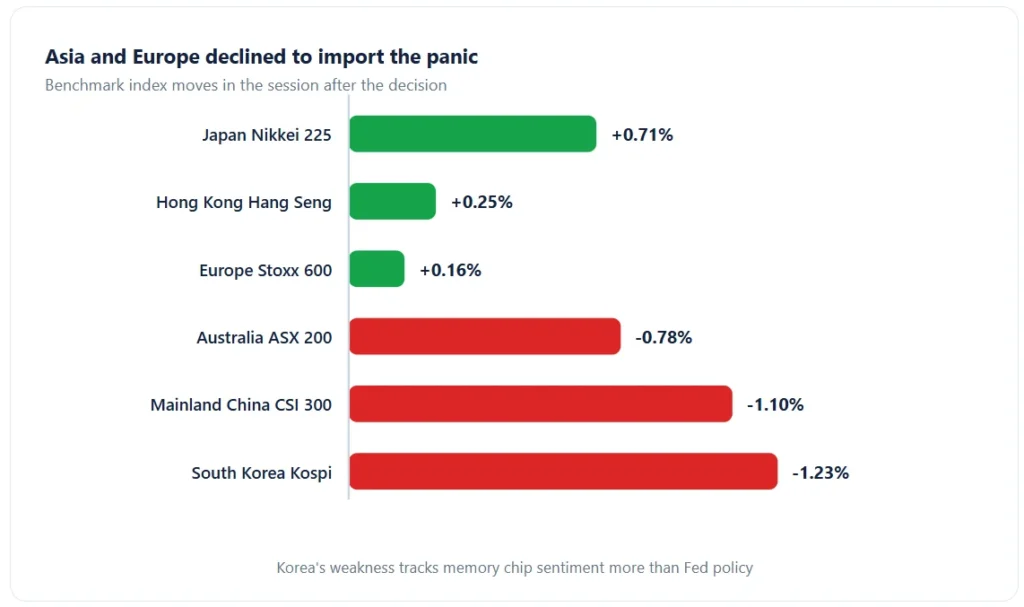
The global handoff proved calmer than Wall Street feared. Japan’s Nikkei 225 actually rose 0.71% to 61,867 on Thursday. Technology and consumer names supported the advance. Hong Kong’s Hang Seng also edged up modestly. Clearly, Asian investors declined to import Wall Street’s panic.
South Korea remained the region’s problem child. The Kospi slipped a further 1.23% to 5,594 in choppy trade. That followed a brutal stretch that triggered circuit breakers twice in one week. Samsung Electronics closed lower despite a record quarterly operating profit.
The Korean story, importantly, is not really about the Fed. Memory chip valuations drove that selloff long before Wednesday. Semiconductors have become the epicentre of the global AI trade. Consequently, Seoul now swings on capex sentiment more than on rate expectations.
Elsewhere, the mood steadied. Mainland China’s CSI 300 eased 1.10%, while Australia’s ASX 200 fell 0.78%. Europe opened almost unchanged, with the Stoxx 600 barely positive. That resilience suggests investors saw a US-specific inflation problem.
Currency markets reinforced that reading. A steeper US curve normally supports the dollar against funding currencies. Yet the reaction stayed contained across major pairs. Global investors, it seems, treated the decision as a domestic credibility question. Thus, the shock stayed largely contained within US rates.
What the Fed Rate Decision Means Next
Wall Street recovered quickly, which complicates the bearish narrative. Stocks rebounded on Thursday as strong technology earnings landed. The Nasdaq climbed roughly 2%, led by chip names and cloud results. Therefore, the equity damage looks more like a repricing than a rout.
The bond market, by contrast, has not reversed its verdict. Thirty-year yields remain near multi-decade highs. Until that changes, the long end stays the honest signal. Watch it more closely than any daily equity move. After all, bonds price inflation risk with far less noise.
Three catalysts now dominate the calendar. First, July and August inflation prints will test the energy shock thesis. Second, Chair Kevin Warsh speaks at Jackson Hole in late August. Third, the committee reconvenes on September 15 and 16.
Warsh gave markets little to work with on Wednesday. He offered no rate path and no timetable. Instead, he insisted there is no soft inflation target, only the 2% goal. That language explains why long yields climbed rather than fell. Ultimately, credibility gets tested in the long end first.
For crypto investors, the setup remains delicate but not hostile. A hawkish Fed limits liquidity and caps risk appetite broadly. However, digital assets have already absorbed a punishing 2026. The marginal buyer now responds to flows and adoption more than to policy. Nevertheless, a September hike would still tighten conditions.
Our read stays consistent with this week’s earlier analysis. The hold was never the story. Rather, the committee’s split and the curve’s shape define the outlook. Global markets have now priced a Fed that talks tough and waits.
The risk, of course, runs in both directions. A hot inflation print would convert three dissents into a majority. Conversely, a labour market stumble would vindicate the patient camp. Either outcome will show up in thirty-year yields first. Accordingly, that is where disciplined investors should look now.