

May 07, 2026 – The world’s borrowing hit an all-time high in the first quarter of 2026. Investors are beginning to look away from US Treasuries. Here is what the numbers reveal.
In Summary
Global debt reached $353 trillion by the end of March 2026, a new all-time record.
$4.4 trillion was added in Q1 2026, the fastest quarterly pace since mid-2025.
This marks the fifth consecutive quarterly rise in global debt.
The US and China are the two biggest contributors to the surge.
Investors are shifting toward Japanese and European bonds, away from US Treasuries.
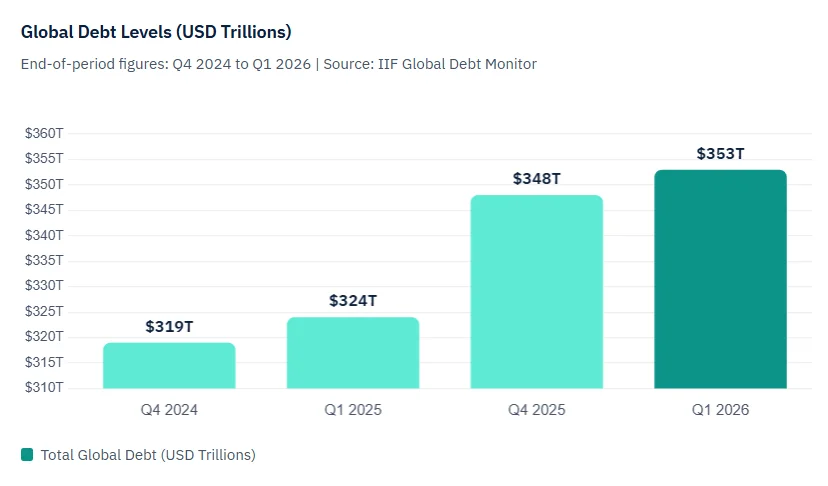
The world’s debt pile has never been bigger. Global debt climbed to nearly $353 trillion by the end of March 2026, according to the Institute of International Finance. That is a new all-time record. Debt grew by more than $4.4 trillion in Q1 alone. That marks the fastest single-quarter growth since mid-2025. It is also the fifth consecutive quarterly rise in a row. Two forces are driving this surge. One is rising US government spending. The other is a sharp jump in Chinese corporate borrowing. Together, they have reshaped the global debt landscape.

Record Numbers: What the Data Shows
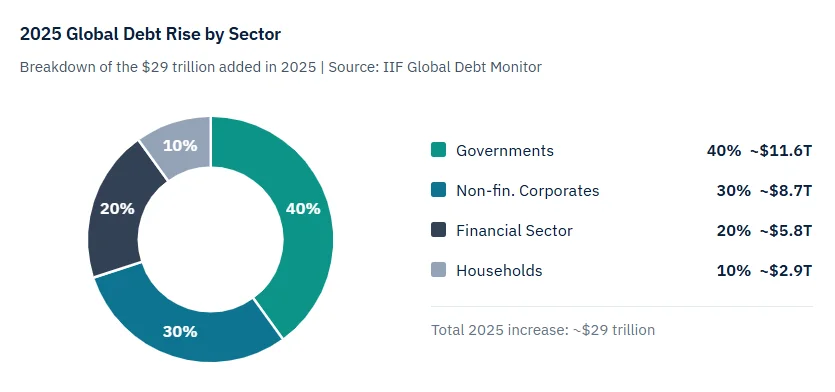
At the close of 2025, global debt already stood at $348 trillion. That figure had grown by nearly $29 trillion during the year. The IIF’s Global Debt Monitor called it the fastest yearly build-up since the pandemic. The Q1 2026 increase of $4.4 trillion then pushed the total past $353 trillion.
The global debt-to-GDP ratio stood at around 308% in 2025. That figure edged down slightly from prior years. However, the absolute dollar level remains dangerously high. Emerging markets face a more difficult picture. Their debt-to-GDP ratio hit a record high above 235% in 2025. That is the highest level on record for developing economies.
Who Is Borrowing the Most?
The United States leads global borrowing. Increased government spending has been Washington’s main fiscal lever. This pushed US-related debt to the top of the global rankings. China is the second major contributor. According to IIF data, China’s borrowing growth came mainly from non-financial corporate entities. These are largely state-owned firms. Notably, this corporate growth outpaced the Chinese government’s borrowing.
Together, the US, China, and the euro area drove roughly 75% of the $29 trillion added in 2025. Outside these three regions, trends were more mixed. Mature markets saw debt levels edge slightly lower. Emerging markets excluding China recorded a modest rise. That group reached a record $36.8 trillion in debt by the end of Q1 2026.
Investors Are Shifting Away From US Bonds
One of the most significant trends in this debt cycle is a change in investor behaviour. The IIF report highlights a growing gap in global demand for government bonds. Investors now show a stronger appetite for Japanese and European government bonds. Demand for US Treasuries has remained broadly stable. That sounds neutral, but in context, it is a meaningful shift.
“These trends partly reflect diverging debt trajectories, which are increasingly influencing investor allocation decisions.
-“Emre Tiftik, Director of Global Markets and Policy, IIF
The key driver is a widening gap in fiscal outlooks between major economies. Under current US policy, the debt-to-GDP ratio is expected to keep rising. Congressional Budget Office projections signal a further deterioration ahead. This divergence is reshaping global capital flows. It signals a subtle but growing loss of confidence in US fiscal management.
Experts Warn of a Coming Bond Crisis
The risk is not going unnoticed at the highest levels of finance. JPMorgan CEO Jamie Dimon issued a stark warning earlier this year. He predicted that “there will be some kind of bond crisis” as debt levels climb. Dimon stressed the importance of early action. “I just think the prudent thing is to deal with it,” he said, “rather than let it happen.” His concern stems from a cluster of risks. These include geopolitical tensions, oil price volatility, and widening budget deficits. He warned that the timing of a potential crisis is impossible to predict.
Emerging markets face more than $9 trillion in debt maturities in 2026. Advanced economies must refinance over $20 trillion in bonds and loans. This creates a heavy refinancing burden in an already fragile environment.
The 2026 Refinancing Challenge
The debt mountain is not just growing. It is becoming harder to service. The IMF projects global growth at around 3.3% in 2026. That rate is too slow to meaningfully reduce rising debt ratios. Advanced economies are projected to grow at just 1.8%. Emerging markets are expected to grow at just above 4%. Neither pace is sufficient to dilute the existing debt stock at current borrowing rates.
If borrowing continues at the 2025 pace, debt-to-GDP ratios could begin climbing again. This risk is sharpest in emerging markets, where leverage is already at all-time highs. Strong demand in the bond market has kept funding orderly so far. However, that calm may not persist. Any sudden tightening of financial conditions could trigger instability quickly.
The Bottom Line
The global debt clock is ticking. At $353 trillion and rising, the world’s borrowing burden has never been greater. Government spending is the primary engine of this growth. Capital is quietly shifting away from US Treasuries toward European and Japanese bonds. This trend reflects deep concern about US fiscal sustainability. Experts from JPMorgan to the IIF are sounding alarms. The combination of high debt, slow growth, and rising refinancing costs creates a fragile environment. Policymakers need to act before pressure builds into a full crisis. The data is clear. The question is whether decision-makers are listening.




