

April 13, 2026 – ClearBank Europe completed the MiCAR notification process. No Dutch bank had done it before. The move unlocks access to EURC and USDC for EU institutional clients.
In Summary
ClearBank Europe is the first Dutch credit institution to complete the MiCAR CASP notification, confirmed by the AFM on April 9, 2026.
The bank will immediately offer EURC and USDC stablecoins via Circle’s Mint platform to EU institutional clients.
ClearBank Group holds £18 billion in customer deposits and serves Revolut, Coinbase, and Wealthify.
The MiCAR notification route is open to all EU credit institutions, but most have not yet used it.
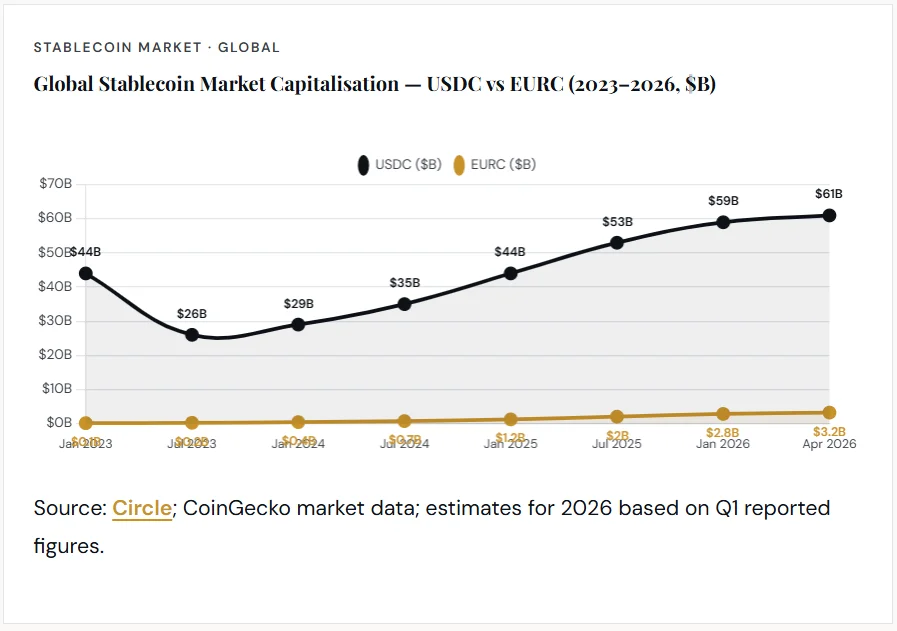
USDC’s market cap exceeded $60 billion in early 2026; EURC is growing as a euro-denominated settlement asset.

ClearBank Europe is now a licensed Crypto-Asset Service Provider (CASP). Specifically, the Dutch Authority for the Financial Markets (AFM) confirmed the status on April 9, 2026. Notably, no Dutch credit institution had completed this process before.
The approval comes through a specific route under the Markets in Crypto-Assets Regulation (MiCAR). Under this framework, EU credit institutions can notify regulators directly. As a result, a separate CASP licence is not required. ClearBank used this path, moving faster than its peers.
Consequently, the bank will integrate Circle’s Mint platform to offer two regulated stablecoins. EURC is pegged to the euro, while USDC is referenced to the US dollar. Both are available immediately to EU institutional clients.
Why the MiCAR Notification Route Matters
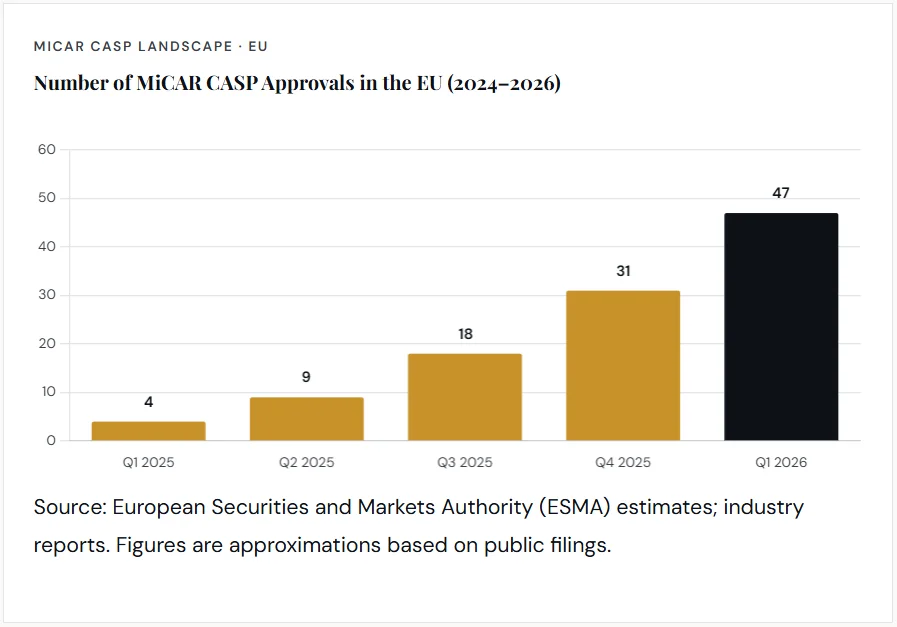
MiCAR came into full effect across the EU in December 2024. It created two distinct paths for crypto services. Standalone crypto firms must apply for a full CASP licence. Credit institutions like ClearBank can, however, notify their home regulator instead. The notification route is faster and less capital-intensive. Yet most banks have still not used it. Consequently, ClearBank is the first in the Netherlands to do so.
Furthermore, ClearBank is authorised by the European Central Bank and supervised by De Nederlandsche Bank. That dual oversight gives its digital asset services strong regulatory credibility.
“This confirmation marks our entry into regulated digital clearing, the beginning of a broader phase of expansion across Europe.”
— Tristan Kirchner, CEO, ClearBank Europe
Building the Infrastructure Layer
The MiCAR notification did not appear in isolation. Indeed, ClearBank has been assembling its digital asset stack for over a year. In January 2026, it selected Taurus-PROTECT as its institutional wallet infrastructure provider. Taurus is a regulated Swiss custodian serving major European banks.
Moreover, the group holds £18 billion in customer deposits. Clients include Revolut, Coinbase, and Wealthify. ClearBank provides clearing and embedded banking infrastructure to these firms. Adding stablecoin services, therefore, extends that foundation directly into digital assets.
In the UK, ClearBank also deepened its partnership with Coinbase. This supports a savings account where eligible deposits carry FSCS protection. Similarly, the European CASP approval mirrors that strategy across the continent.
What Comes Next for European Banks
ClearBank’s move is a clear reference point for the EU banking sector. Although the notification route is open to all EU credit institutions, few have taken it. As a result, compliance teams at peer banks in Germany, France, and Spain are likely reviewing the process now.
Meanwhile, the stablecoin market is growing fast. USDC’s market cap exceeded $60 billion in early 2026. EURC is smaller but, notably, is gaining traction as a euro-denominated settlement asset. Furthermore, banks that offer stablecoin access to institutional clients gain a competitive edge in cross-border payments.
MiCAR also applies passporting rules. Specifically, a CASP registered in one EU member state can operate across all 27 EU member states. Therefore, ClearBank’s Netherlands base is a highly strategic choice that delivers EU-wide reach from a single regulatory foundation.
The Bottom Line
ClearBank Europe moved first. Rather than waiting, the bank used a regulatory tool that all EU peers have access to. It also built the custody infrastructure well in advance. Finally, it partnered with Circle to launch with two credible, widely used stablecoins.
For institutional clients, this is a meaningful shift. They can now access EURC and USDC through a regulated European bank, remaining within a supervised framework. As a result, there is no longer a need to rely on standalone crypto exchanges to access these assets.
In essence, the broader implication is straightforward. Regulated stablecoins are entering mainstream European banking infrastructure. Indeed, ClearBank has just opened that door.