


May 31, 2026 – JPMorgan’s CEO unloads on Brian Armstrong over stablecoin yield. Banks vow to fight the bill. Here is what this means for U.S. crypto law.
In Summary
JPMorgan CEO Jamie Dimon called Coinbase CEO Brian Armstrong “full of shit” in a live Fox Business interview.
Banks and crypto firms are fighting over stablecoin yield rules inside the CLARITY Act.
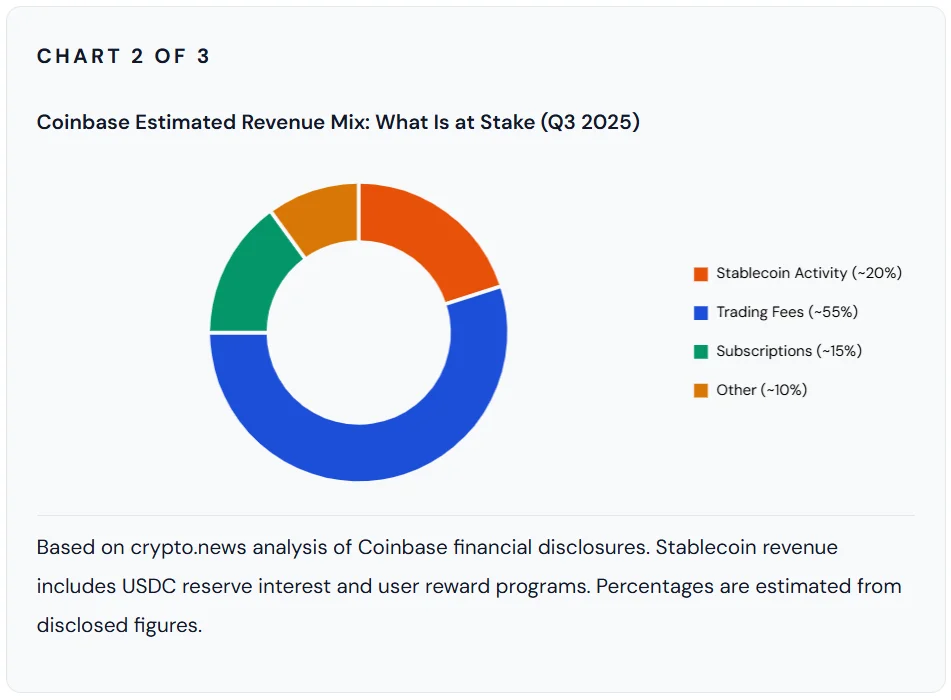
Coinbase earned $355 million in stablecoin revenue in Q3 2025, roughly one-fifth of its total income.
JPMorgan warns that unregulated stablecoin yield could put $6.6 trillion in bank deposits at risk.
The bill currently has a 59% chance of becoming law in 2026, per Polymarket data.
Jamie Dimon does not mince words. On May 29, 2026, JPMorgan’s CEO appeared on Fox Business for a live interview. He directed sharp criticism at Coinbase CEO Brian Armstrong. Dimon accused Armstrong of spending “hundreds of millions” to shape the CLARITY Act. This sweeping bill would regulate most U.S. crypto activity.
“He’s full of shit,” Dimon stated when the anchor raised Armstrong’s name directly. The remark was unusually candid for a major banking executive. Furthermore, it signals deep tension between Wall Street and crypto over one central question: who gets to offer yield on stablecoins?

Dimon’s Blunt Warning to Congress
Dimon set a firm tone from the opening of the interview. Banks “will not accept” the CLARITY Act in its current form, he declared. Dimon then vowed the financial industry would fight the bill to the end. “If we lose, we lose,” he added. Therefore, his position is clear: no compromise on this version.
“No one is going to bow down to this guy, or that company.”
-Jamie Dimon, Fox Business, May 29, 2026
His frustration links to an earlier stance from March 2026. Then, Dimon argued that stablecoin issuers paying interest should face bank-equivalent oversight. He said then: “If you want to be a bank, become a bank.” On Friday, he escalated that position. He predicted the current yield structure would “eventually blow up on its own.”
The Stablecoin Yield Dispute, Explained
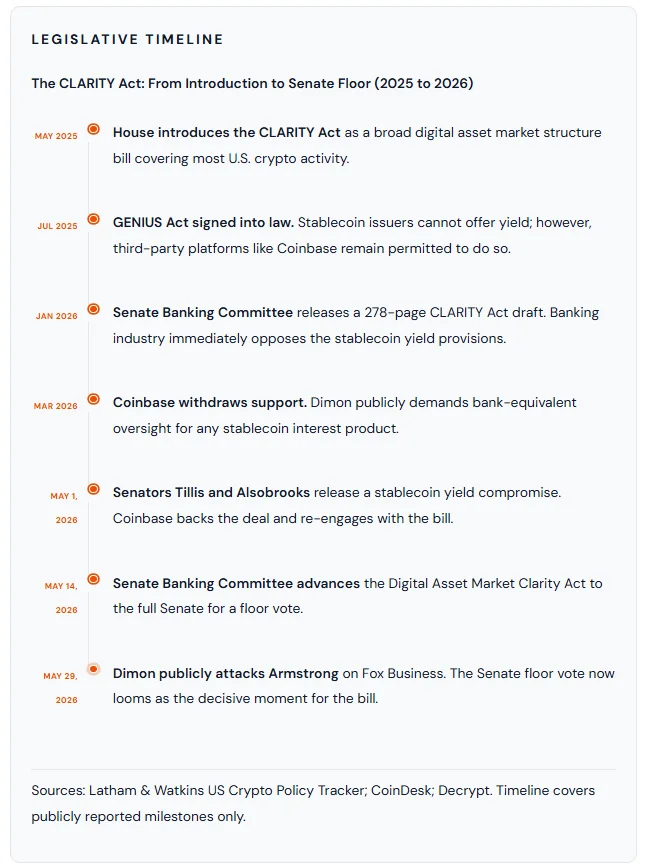
The CLARITY Act debate centers on one core issue: stablecoin yield. The GENIUS Act, signed by President Trump in July 2025, created the initial framework. Under that law, stablecoin issuers such as Tether and Circle cannot offer yield directly to users. However, third-party platforms like Coinbase remain permitted to do so. Banks want the CLARITY Act to close this loophole entirely.
JPMorgan has quantified the stakes clearly. Its analysts warned that yield-bearing stablecoins could put up to $6.6 trillion in U.S. bank deposits at risk. The logic is straightforward: consumers may shift savings to crypto platforms offering higher, less-regulated returns. Consequently, banks argue that this threatens financial stability and undermines regulated lending.
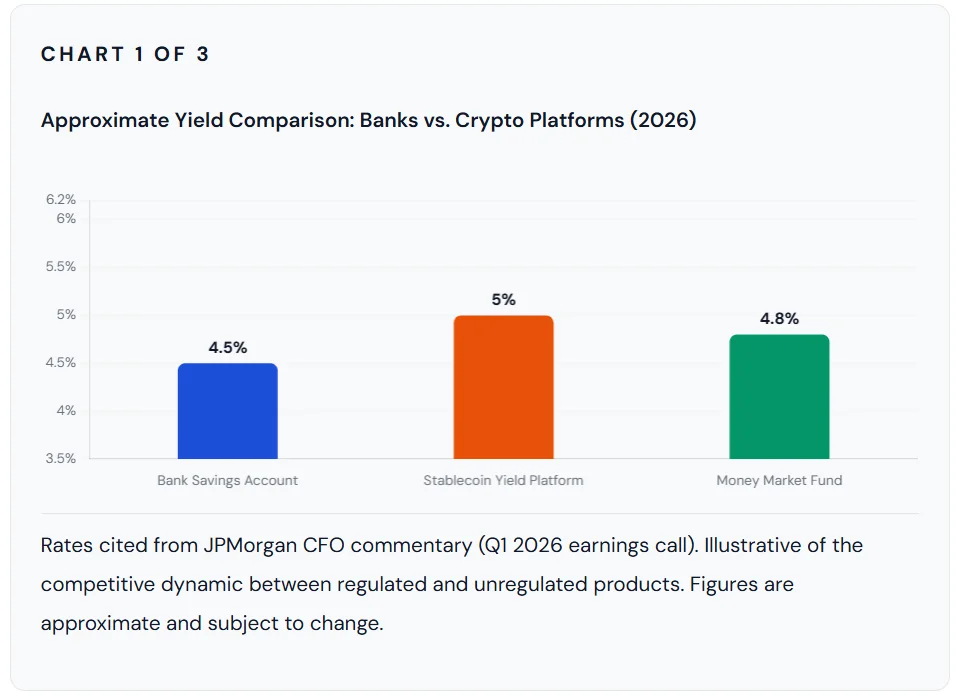
The compromise bill from Senators Thom Tillis and Angela Alsobrooks attempts a middle path. It prohibits yield that is economically equivalent to a bank deposit. However, it permits rewards tied to “bona fide activities” such as payments and transfers. Additionally, firms must shift from a “buy and hold” model to a “buy and use” model to qualify.
Coinbase’s Revenue Hangs in the Balance
Coinbase has a concrete financial reason to fight this battle hard. Stablecoin activity generated $355 million in revenue for Coinbase in Q3 2025. This figure represents approximately one-fifth of the company’s total quarterly income. The CLARITY Act directly threatens this revenue stream. Moreover, Coinbase has invested heavily to defend it in Washington.
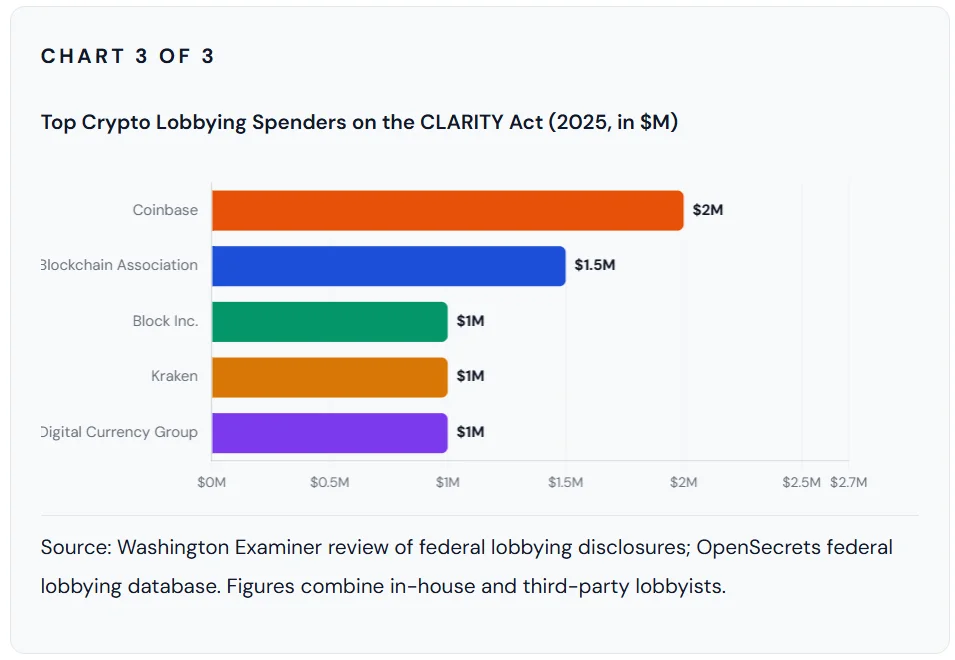
Dimon’s claim that Armstrong spends “hundreds of millions” covers a broad range of political activities. The precise lobbying figures are significant but more specific. OpenSecrets data shows Coinbase spent $2.9 million on federal lobbying in 2025. This made Coinbase the top crypto lobbying spender that year. In Q1 2026 alone, the company spent another $1.07 million. However, Coinbase’s total political spending extends well beyond direct lobbying. The company pledged $25.5 million to the Fairshake super PAC for the 2026 midterms. Fairshake’s total commitments have now reached over $116 million across the election cycle.
Where the CLARITY Act Stands Today
Despite the conflict, the bill is moving forward. The Senate Banking Committee advanced the Digital Asset Market Clarity Act on May 14, 2026. The legislation now heads to the full Senate floor for a final vote. However, the tight Senate calendar creates real pressure. Most observers agree that a vote before July is essential for the bill to survive this legislative cycle.
What Happens Next
Prediction markets currently price the CLARITY Act at a 59% chance of passing in 2026, per Polymarket data. However, Galaxy Investment Partners estimates the odds at roughly 50-50 or lower. This divergence reflects genuine uncertainty about the road ahead. Additionally, the approaching 2026 midterm elections may reshape congressional priorities altogether.
President Trump has remained publicly committed to passing the bill. He posted this week that he aims to “codify a future-proof digital asset market structure.” Therefore, executive pressure on Congress continues to build. The Senate floor vote now stands as the decisive battleground.
For Coinbase, the outcome is binary. A bill preserving activity-linked stablecoin rewards protects hundreds of millions in annual revenue. A bill banning them outright forces a major restructuring of the business. Furthermore, it would set a global precedent for how crypto platforms interact with financial law.
For traditional banks, the stakes are existential. They argue that allowing crypto platforms to offer deposit-like returns without equivalent oversight is fundamentally unfair. JPMorgan and BNY Mellon have already launched competing tokenized deposit products. However, both institutions want a level playing field before these products scale further.
The CLARITY Act has grown beyond a crypto industry story. It is a contest over the future of American financial infrastructure. Dimon’s candid words on Friday signal that banks will not soften their position before the Senate vote. Consequently, the floor debate promises to be as contentious as the months of negotiations that preceded it.