


May 08, 2026 – Citigroup targets a 3.5x jump in prime balances over six years. The strategy challenges Goldman Sachs and Morgan Stanley for dominance in hedge funds.
In Summary
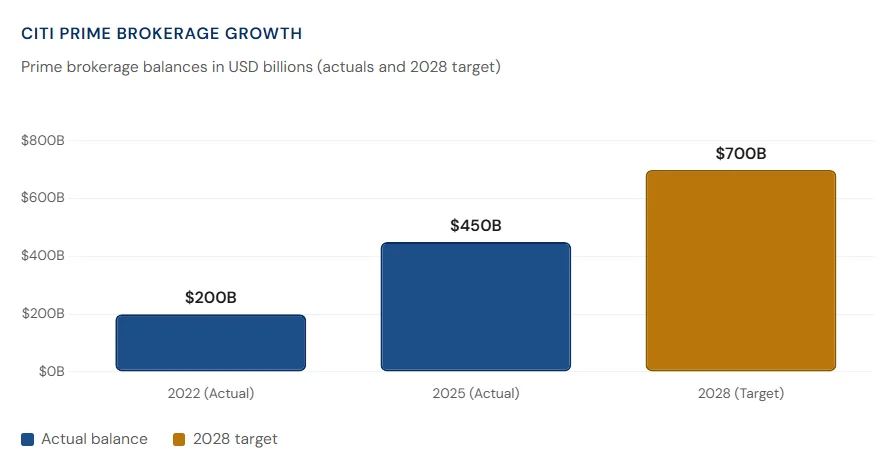
Citi targets over $700 billion in prime brokerage balances by 2028.
That is 3.5 times the $200 billion the bank held in 2022.
Prime balances already surged 125% from 2022 to 2025, reaching $450 billion.
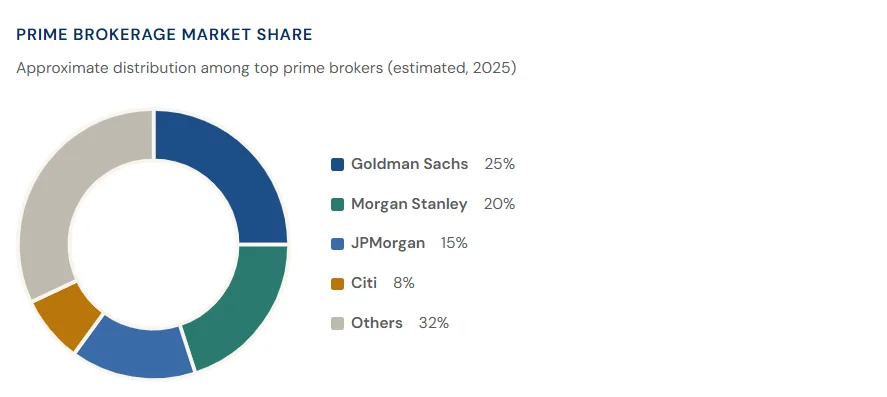
Goldman Sachs, Morgan Stanley, and JPMorgan hold nearly 60% of the market.
Citi plans $5 billion in investments through 2028 to accelerate growth.
Citigroup revealed an ambitious hedge fund strategy at its 2026 investor day on May 7. The bank set a target of $700 billion in prime brokerage balances by 2028. That figure is more than triple the $200 billion held in 2022. The announcement marks Citi’s most assertive push yet into the lucrative prime brokerage sector.

From $200B to $700B in Six Years
Citi’s prime brokerage growth tells a compelling story. The bank held $200 billion in prime balances in 2022. By 2025, that figure had more than doubled to $450 billion. The 2028 target of $700 billion would represent a further 56% jump.
This growth has not been accidental. Citi has expanded its product offering significantly. New initiatives include systematic FX trading, e-trading in rates, and margin lending. The bank is also entering North American power and gas trading. These moves target the most profitable category of hedge fund client: multi-strategy funds.
Multi-strategy funds trade across multiple asset classes simultaneously. They require prime brokers with deep balance sheets and broad capabilities. Citi is positioning itself to meet these demanding needs.
Why Prime Brokerage Is a Prize Worth Chasing
Prime brokerage is one of Wall Street’s highest-margin businesses. Banks lend capital to hedge funds against their investment portfolios. They also deliver trade execution, clearing, and custody services. According to IFR, prime revenues at the top 30 banks more than doubled between 2005 and 2023.
The business rewards scale and loyalty. Hedge funds are sticky clients. Once a fund integrates with a prime broker’s systems, switching becomes costly and complex. This creates stable, recurring revenue that is difficult for rivals to disrupt.
“Prime started as an equity-centric product. Now, as clients have evolved to become more cross-asset, the breadth of financing and clearing capabilities has become increasingly relevant.”
Source: IFR, Prime Brokerage Report
Citi sees prime brokerage as a gateway to deeper relationships with hedge funds. Winning a prime mandate often unlocks additional trading revenue across equities, fixed income, and derivatives. This cross-selling logic is central to Citi’s strategy.
Competing Against Prime Brokerage Titans
The competitive landscape is demanding. Goldman Sachs, JPMorgan, and Morgan Stanley together hold close to 60% of the prime brokerage market. Each is approaching $1 trillion in client balances. Citi must close a significant gap to reach elite status.
According to With Intelligence, Goldman Sachs alone covers 61% of all billion-dollar hedge funds. Goldman and Morgan Stanley are the only prime brokers with more than 50% penetration in this elite segment. Citi is still establishing itself in these upper tiers.
Competition is also intensifying from other challengers. Barclays and BNP Paribas are both investing aggressively in prime brokerage. BNP Paribas absorbed Deutsche Bank’s prime finance business in early 2022. The race for hedge fund relationships shows no sign of slowing.
Yet the opportunity is real. The top 25 prime brokers grew their combined market share from 83% in 2023 to 92% in 2024. More hedge fund capital is entering the system. Challengers like Citi can win meaningful share as multi-strategy funds scale up.
Inside Citi’s Wider Transformation
The prime brokerage push sits inside a broader overhaul at Citi. CEO Jane Fraser has led the bank since March 2021, focusing on simplifying operations and improving returns. Citi’s return on tangible common equity (ROTCE) was 7.7% in 2025. The bank now targets a 11%-13% ROTCE for 2027 and 2028. A more ambitious range of 14% to 15% is set for 2029 to 2031.
Citi plans $5 billion in incremental investments through 2028. Much of this capital will fund technology upgrades and talent acquisitions. The bank has already hired senior bankers from rivals, including JPMorgan.
Fraser has rebuilt the leadership team. Head of banking Vis Raghavan is building what he calls a corner store mindset: relentless efficiency and maximum impact from every investment. This cultural reset is essential for competing on service quality against established prime brokers.
How Investors Reacted
Markets greeted the investor day with caution. Citi shares edged lower on May 7. Some analysts had expected more aggressive near-term ROTCE targets. Bank of America maintained a Buy rating with a $150 price target. Their 2028 ROTCE forecast of 13% aligns with Citi’s guidance.
Piper Sandler noted that investors wanted a credible, specific, and quantifiable roadmap. The $700 billion prime brokerage goal is ambitious. Delivering it will require flawless execution across three years of intense competition.
Bottom Line
Citi is making a serious play for hedge fund dominance. The $700 billion prime brokerage target by 2028 reflects clear momentum and real strategic intent. Whether Citi can break through the dominance of Goldman Sachs and Morgan Stanley remains the defining test of Jane Fraser’s transformation. The next three years will determine whether Citi is a credible challenger or remains a distant follower.




