

May 12, 2026 – The USDC issuer beat Q1 earnings estimates. It also unveiled a star-studded presale for its institutional-grade Layer 1 network.
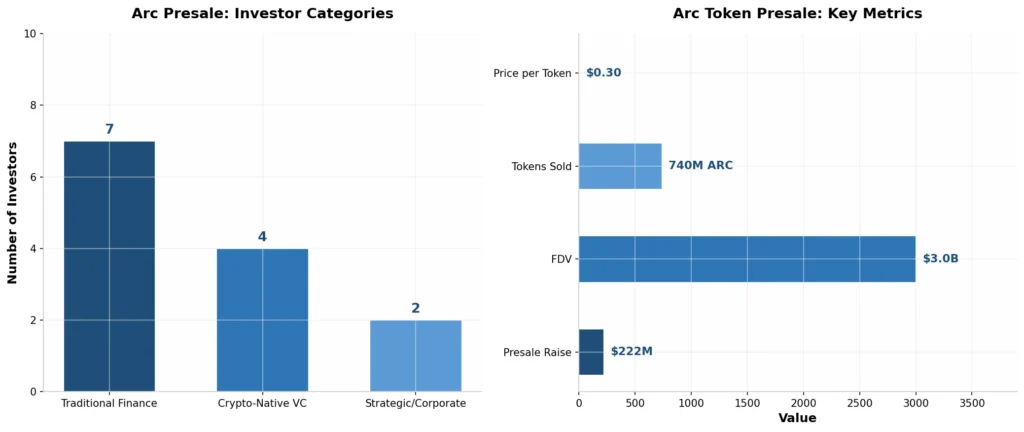
Circle Internet Group has closed a $222 million presale for its Arc blockchain token. The round values the stablecoin-native Layer 1 at a $3 billion fully diluted valuation. BlackRock, Intercontinental Exchange, and Apollo Funds joined crypto heavyweights a16z and ARK Invest. The rise signals a deepening conviction among TradFi that regulated on-chain infrastructure is the future.
Wall Street Bets on Stablecoin Rails
Institutional capital is flowing into blockchain infrastructure. Circle announced the ARC token presale on May 11 alongside its Q1 2026 earnings. Andreessen Horowitz led the round with a $75 million commitment. Other backers include Bullish, Haun Ventures, Standard Chartered Ventures, SBI Group, and Marshall Wace.
The investor roster blends legacy finance with crypto-native venture capital. This mix underscores a broader trend. Traditional asset managers now view stablecoin networks as core infrastructure. Not as speculative assets.
Arc is designed as an “Economic Operating System” for the internet. It targets sub-second finality and USDC-denominated gas fees. The network also offers configurable privacy and institutional-grade validators. Circle sold 740 million ARC tokens at $0.30 each. The total supply is capped at 10 billion tokens.
Q1 Earnings Beat Expectations
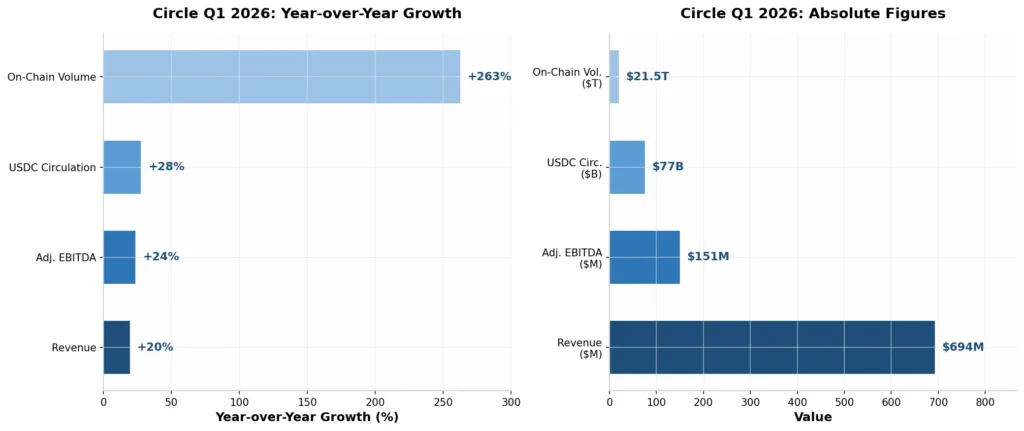
Circle posted strong first-quarter results. Revenue rose 20% year-over-year to $694 million. Adjusted EBITDA climbed 24% to $151 million. Earnings per share hit 21 cents. Analysts had expected 17 cents.
USDC on-chain transaction volume surged 263% to $21.5 trillion. Stablecoin circulation grew 28% to $77 billion. These figures highlight accelerating adoption. USDC now powers treasury management, cross-border payments, and AI-agent commerce.
Reserve income reached $653 million. Other revenue doubled to $42 million. The company affirmed full-year guidance. It expects RLDC margins of 38%-40%. However, guidance excludes future Arc token revenue streams.
ARC Token Economics Explained
The ARC token serves as a “native coordination asset”. It supports governance, validator security, and network operations. Unlike USDC, ARC is not a stablecoin. It functions more like ETH on Ethereum or SOL on Solana.
Fees on Arc are paid in USDC. This gives institutions predictable costs. At the protocol level, fees convert to ARC. They are then split between validator rewards, staking yields, and permanent burns. This creates a deflationary mechanism tied to network usage.
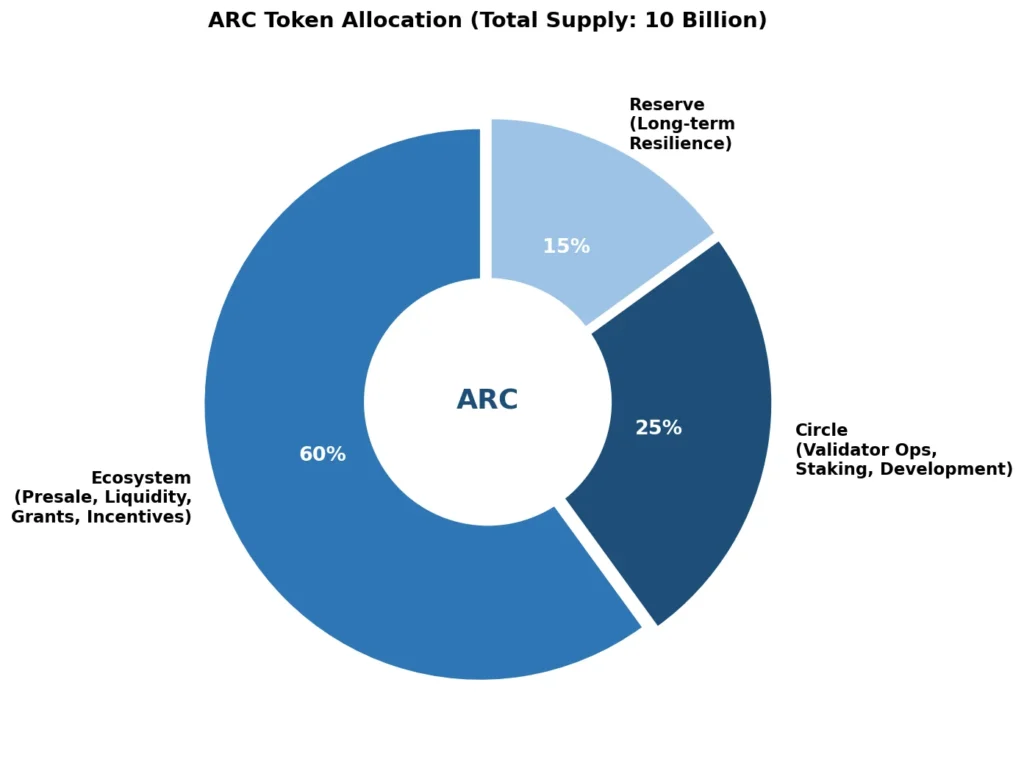
Token allocation favours ecosystem growth. 60% goes to network participants. This covers presale buyers, liquidity providers, developer grants, and incentives. Circle retains 25% for validator operations and protocol development. A 15% reserve ensures long-term resilience.
Investors face multi-year lock-ups. Tokens vest at least one year after Arc transitions to proof-of-stake. Some holds may extend for up to 4 years. Circle must deliver the PoS transition by May 8, 2028. Otherwise, investors hold repayment rights.
Mainnet Timeline and Competitive Position
Arc’s public testnet went live in October 2025. It has already processed 244 million transactions. Over 1.6 million unique wallets have interacted with the chain. More than 100 institutions participated in testing. These include Visa and HSBC.
Mainnet beta is targeted for summer 2026. Circle is positioning Arc as the go-to chain for tokenised assets and regulated finance. The network is fully EVM-compatible. It also features quantum-ready architecture.
Circle is expanding beyond USDC. It unveiled the “Agent Stack” for AI-driven commerce. New tools include Agent Wallets, Nanopayments, and a CLI for developers. These products target machine-to-machine payments. They could unlock new demand for USDC and Arc blockspace.
The Bottom Line
The $222 million raise validates Circle’s infrastructure ambitions. BlackRock’s participation is particularly notable. The world’s largest asset manager is betting on stablecoin-native Layer 1 technology. This follows its broader push into tokenised assets via its BUIDL fund.
Valuation remains a key question. Arc is worth $3 billion before the mainnet launch. Circle’s equity trades around $30 billion. The token model must prove it can capture value from transaction fees. Otherwise, ARC risks becoming a governance-only asset.
Regulatory clarity will also shape outcomes. Circle holds compliance licenses across major markets. Arc’s configurable privacy features are designed to support regulatory compliance. This could attract banks and issuers seeking compliant on-chain rails.
The stablecoin wars are evolving. They are no longer just about issuance volume. They are about who owns the underlying network. Circle wants Arc to be that network.




