

May 12, 2026 – NVIDIA surges on reports of CEO summit trip. Investors eye Beijing talks for relief on export controls, tariffs, and rare earth supplies.
In Summary
Trump and Xi meet in Beijing on May 14 and 15, 2026. It is the most significant bilateral summit in months.
NVIDIA’s stock gained over 2% after reports confirmed CEO Jensen Huang would join the delegation.
NVIDIA holds 0% market share in China’s AI GPU market. Export restrictions wiped out all access.
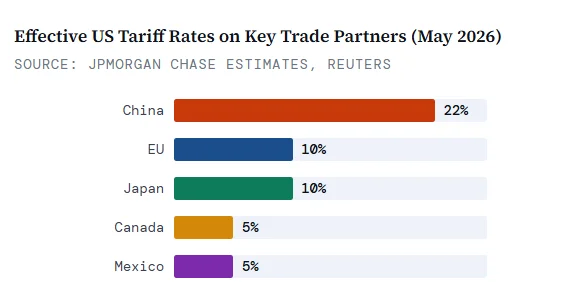
US tariffs on Chinese goods stand at roughly 22%, per a JPMorgan estimate. No rapid reduction is expected.
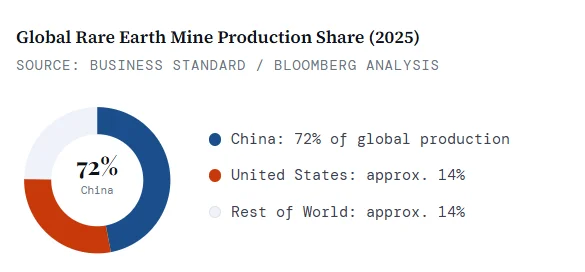
China supplies over 70% of global rare earths. Supply security is a core US negotiating goal.
CEOs from Apple, Boeing, Qualcomm, Blackstone, Citigroup, and Visa were also reportedly invited.

A Summit That Moves Markets
Chip stocks surged last week. The catalyst was clear: reports confirmed that Nvidia CEO Jensen Huang would accompany President Donald Trump to Beijing. Trump meets Chinese President Xi Jinping on May 14 and 15. Consequently, hopes across the semiconductor sector have risen sharply. Indeed, this is shaping up as the most consequential diplomatic meeting for tech markets this year.
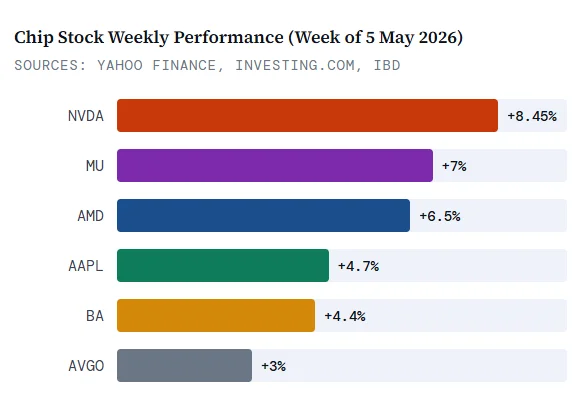
Specifically, Nvidia shares climbed more than 2% in afternoon trading on Thursday, May 7. Reports from Semafor and Reuters confirmed that Huang was on the Trump delegation’s invitation list. As a result, the news extended Nvidia’s already strong weekly run. NVIDIA gained 8.45% for the week, closing at $215.22 per share.
Why This Summit Matters for Chips
US export restrictions have severely hurt Nvidia. NVIDIA currently holds zero share of China’s AI GPU market. The Biden administration launched the restrictions in October 2022. Subsequently, the Trump White House expanded them further. In April 2025, the Trump administration placed an indefinite ban on Nvidia’s H20 chips. This ban forced the company to remove China entirely from its sales projections.
Furthermore, the financial stakes are enormous. NVIDIA is targeting $1 trillion in revenue by 2027. Therefore, regaining access to the Chinese market is critical to achieving that goal. Notably, China remains the world’s largest consumer of semiconductors.
“If the summit can bring a little more certainty to the US-China relationship and drive that risk premium down, that will be very positive for Chinese equities.”
-Christopher Hamilton, Head of Client Solutions, Asia Pacific, Invesco
The Tariff Landscape
Trade tariffs remain a central source of friction. US levies on Chinese goods are at an effective rate of around 22%, according to a JPMorgan estimate. Moreover, these tariffs remain under investigation. China has flagged them as an ongoing source of friction. Additionally, analysts at Macquarie say the base case is for tariffs to hold steady. No meaningful escalation is expected in the near term.
This matters greatly for global supply chains. Eugene Hsiao, Head of China Equity Strategy at Macquarie in Hong Kong, said an absence of tensions “marginally improves visibility for broader China exporters”. He added that it would reduce the risk of escalation and provide greater supply chain certainty. Nevertheless, existing tariffs still cap the upside for exporters.
Rare Earths: The Hidden Bargaining Chip
Beyond semiconductors, rare earth elements are another critical topic. China accounts for more than 70% of the global rare earth supply. These materials are essential for electric vehicles, defence, and electronics. Therefore, Trump plans to press Xi on securing reliable US shipments during the summit.
Meanwhile, the political dynamics here remain delicate. Since late October 2025, both sides have maintained a fragile detente. Xi eased rare-earth export restrictions as part of an informal truce. In return, Trump deferred curbs on Chinese access to US technology. As a result, Chinese rare-earth producers benefited directly. Specifically, shares in China Northern Rare Earth and Xiamen Tungsten more than doubled in the past year.
Market Reaction and Broader Context
The broader market has also rallied on optimism ahead of the summit. The S&P 500 and Nasdaq 100 extended their winning streak to six consecutive weeks. This is the longest such run since October 2024. Furthermore, the Nasdaq 100 gained 5.5% over that period, hitting a fresh record high. Similarly, South Korea’s KOSPI surged 13.6%, breaching 7,000 for the first time.
The delegation heading to Beijing is equally significant. The Trump administration reportedly invited CEOs from Apple, Boeing, Exxon, Qualcomm, Blackstone, Citigroup, and Visa. A source confirmed that Citigroup CEO Jane Fraser accepted an invitation. Qualcomm also confirmed it received an invitation but declined to comment further. Consequently, this business-heavy lineup signals that commercial dealmaking is a top priority.
Yet analysts warn against excessive optimism. Expectations for a concrete breakthrough remain low. JPMorgan’s chief China economist, Feng Zhu, noted that both nations have strong incentives to avoid escalation. However, deep structural disagreements persist on AI supremacy, Taiwan, and military technology. Indeed, any setback at the summit could reignite volatility across tech stocks.
What to Watch After the Summit
Investors should track three key signals after May 15. First, any relaxation of chip export controls will directly affect Nvidia and AMD. Second, a rare earth supply agreement would signal relief for US manufacturers. Third, tariff language on goods will affect broader China-exposed equities.
Additionally, the week after the summit is packed with earnings. Alibaba, Tencent, and JD.com all report results. Applied Materials also reports, and it is deeply tied to chip equipment exports. Together, these results will sharpen the picture of how trade tensions hit actual corporate earnings.