

May 09, 2026 – China’s Q1 2026 exports hit $977.6 billion. The Iran war is amplifying its global market push. Developing economies are absorbing the biggest impact.
In Summary
China’s Q1 2026 exports grew 14% year-on-year to $977.6 billion.
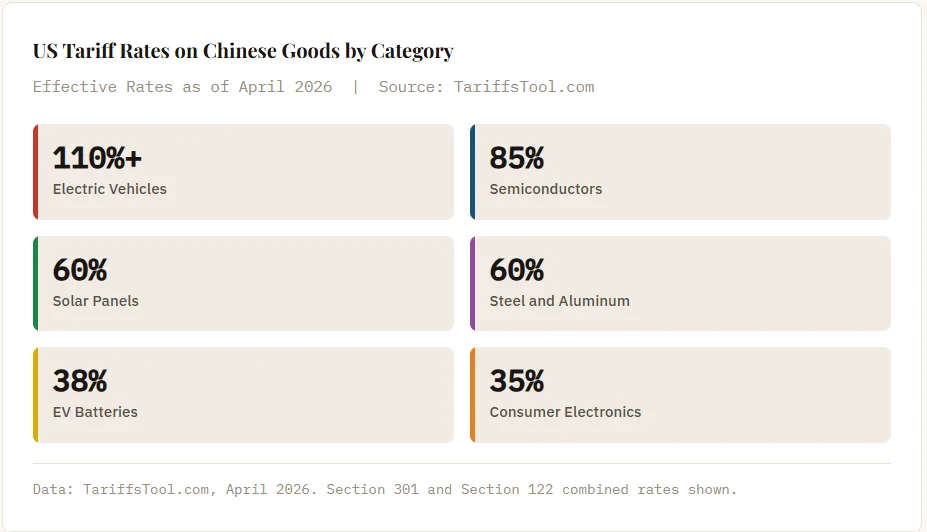
US tariffs on Chinese goods remain at a 35% effective rate for most items. EVs face a punishing 110% combined rate.
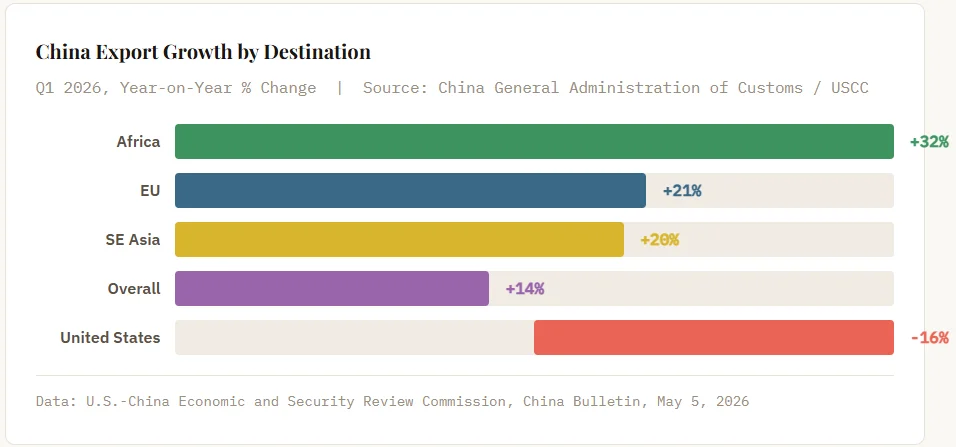
Exports to Southeast Asia rose by 20%, Africa by 32%, and the EU by 21%. US-bound exports fell 16%.
The war in Iran is driving a global energy transition. It is boosting Chinese EV exports, with Morgan Stanley forecasting 88% growth in 2026.
China’s passenger car exports surged 60.6% in Q1 2026. Domestic car sales fell 9.1% in the same period.
China is flooding global markets with goods at a pace not seen in years. Its first-quarter 2026 export total reached $977.6 billion, up 14% from a year earlier. The surge is reshaping trade flows across five continents. Analysts now call it “China Shock 2.0”.

The export boom is not uniform. Goods are flowing away from the United States. They are flooding into Southeast Asia, Africa, and Europe. US tariffs on Chinese products have averaged 35% on most goods. Targeted categories, such as electric vehicles, face a combined rate of 110% or higher. That has effectively shut many Chinese exports out of American shelves.
The Iran War Factor
The ongoing war in Iran has added a new dimension. US and Israeli strikes on Iran began in February 2026. The conflict closed the Strait of Hormuz. That triggered the largest global oil disruption since the 1970s.
Higher oil prices are hurting energy-dependent emerging economies. These are China’s fastest-growing export customers. Inflationary pressure is squeezing their purchasing power. That creates a short-term headwind for Chinese exporters.
“Higher input prices and a weakening prognosis for emerging market growth paint a difficult picture for China in the near term.”
-U.S.-China Economic and Security Review Commission, May 2026
But there is a silver lining for Beijing. Countries with high oil dependency are accelerating their shift to clean energy. China dominates global EV and solar manufacturing. Morgan Stanley raised its 2026 Chinese EV export growth forecast by 50 percentage points to 88%. It cited the energy shock as a structural tailwind.
The Automotive Shock
China’s domestic car market is struggling. Sales fell 9.1% in Q1 2026. Beijing’s “anti-innovation” policy reduced subsidies for cheaper models. That created a glut of lower-priced vehicles. Automakers responded by pushing them overseas.
Chinese passenger car exports jumped 60.6% year-on-year in Q1 2026. China exported 2.34 million vehicles in the quarter alone. BYD, Chery, Geely, and SAIC all set new overseas records in April. Chery alone shipped 177,600 units that month, a 102% annual rise.
An EU-China agreement on EV minimum pricing, signed in January 2026, has opened European roads to more Chinese vehicles. BYD’s European sales more than doubled in Q1. Leapmotor’s European volumes surged over 800%.
Semiconductors and the AI Demand Surge
China’s trade surplus actually shrank in March 2026. It reached a four-year low. The reason: soaring imports. China spent a record $135 billion on semiconductor imports in Q1 2026. Demand for AI computing chips is driving that surge. Electronics and high-tech product imports rose 27% in value over the same period.
That chip appetite is reshaping China’s trade balance. The country is exporting more manufactured goods while importing more advanced components. This reflects China’s push up the value chain. EVs, lithium batteries, and industrial machinery now lead export growth. Low-end goods like footwear and garments are declining as input costs rise.
Consumption: The Missing Engine
China’s headline GDP growth of 5.0% in Q1 2026 looks strong. But the domestic picture is uneven. Retail sales slowed to 1.7% year-on-year in March 2026. That is down from 2.8% earlier in the year.
Consumer spending remains weak. Beijing has repeatedly pledged to rebalance its economy toward domestic demand. It has not yet been delivered. The EU is now raising alarms about a “China Shock” driven by EV imports and Beijing’s record trade surplus with the bloc.
China is relatively shielded from the oil shock of the Iran war. High EV adoption, substantial coal use, and strategic oil reserves provide insulation. But its exporters have little room left to cut prices. Industrial value added grew just 0.3% month-on-month in March. Profit margins are thin. The question is whether China’s export machine can sustain its pace.
The world is watching two forces collide. US tariffs push Chinese goods out of American markets. The war in Iran is drawing emerging economies toward China’s clean-energy exports. The developing world is caught in the middle. It faces a flood of cheap Chinese goods and rising energy costs simultaneously. China Shock 2.0 is only deepening. The IMF warns the Middle East conflict will deepen economic divisions across Latin America and other emerging regions.




