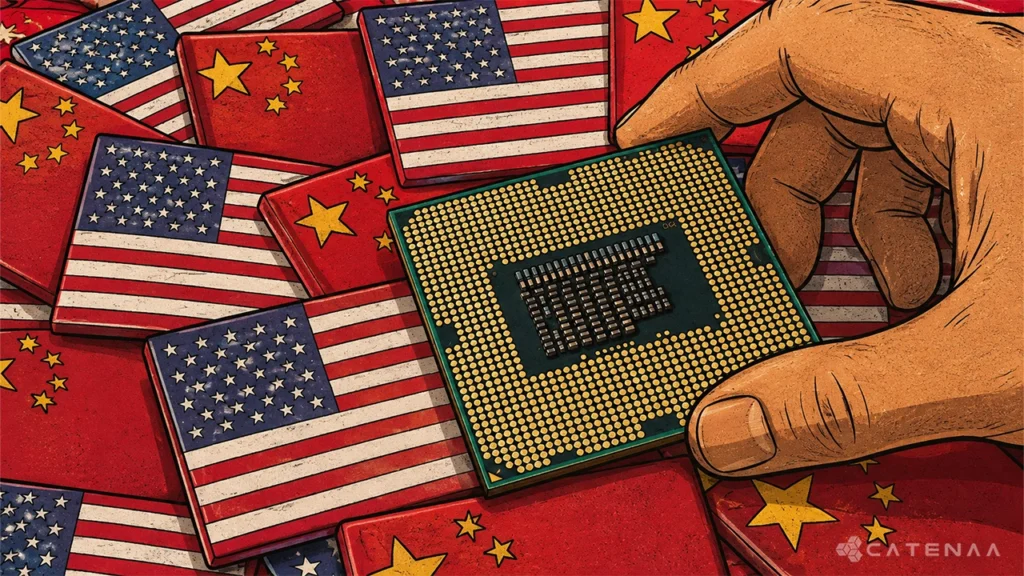


August 12, 2026 – China AI stocks are becoming part of Beijing’s technology strategy. Profits are rising while regulators widen financing routes for advanced technology companies. That shift could reshape China’s competition with the United States.
In Summary
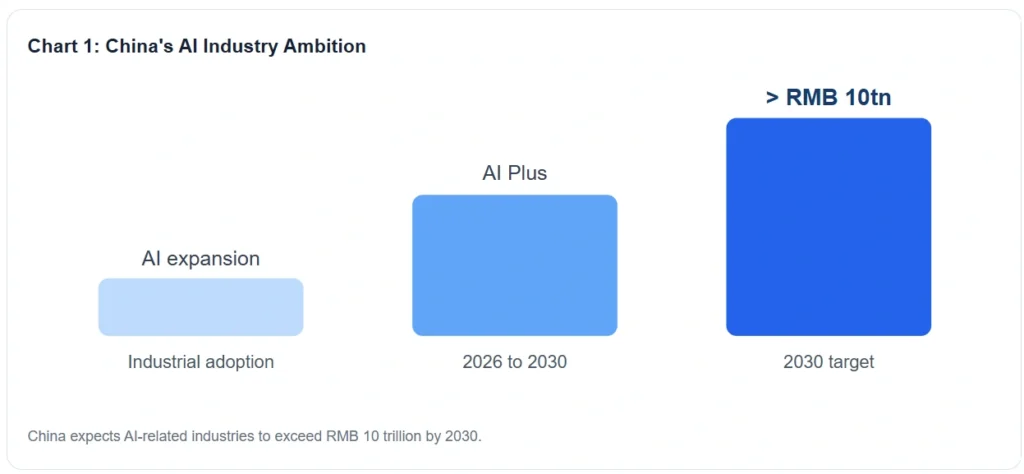
China expects AI-related industries to exceed 10 trillion yuan in value by 2030.
STAR Market AI companies increased combined net profit by 200.8% during 2025.
China is opening domestic equity markets to more early-stage artificial intelligence companies.
U.S. chip controls and manufacturing investments keep the technology contest intense.
China AI Stocks Become Strategic Infrastructure
China is turning its stock market into a financing engine for artificial intelligence and advanced chips. The shift gives private investors a larger role in national technology development.
That matters because computing power now sits near the center of China’s industrial strategy. It also creates a harder question for investors. Can public capital deliver innovation without creating excessive valuations?
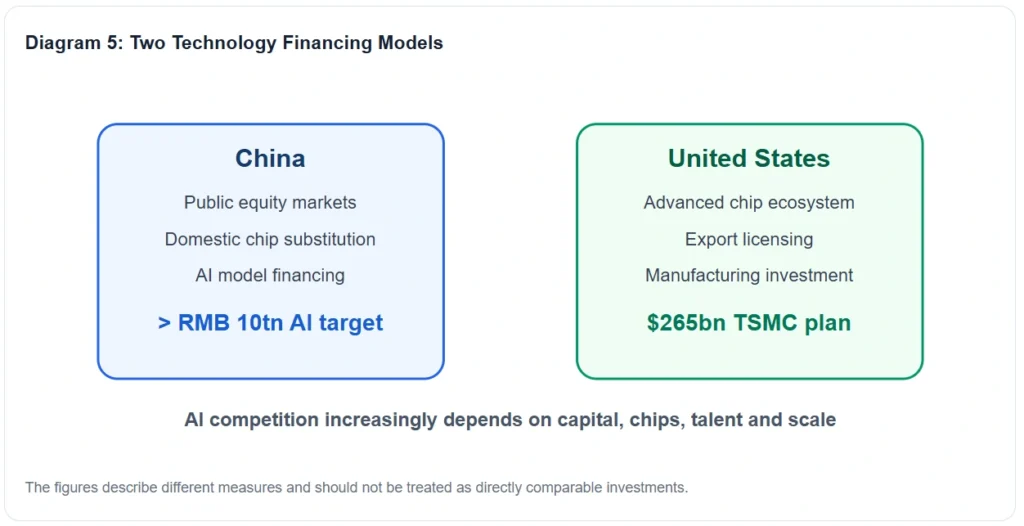
China has placed artificial intelligence at the center of its 2026 to 2030 development agenda. Officials expect AI-related industries to exceed 10 trillion yuan by 2030.
The target gives markets a long runway for financing chips, models, cloud infrastructure, and applications. More importantly, policy now connects national technology goals with equity markets.
Profits Strengthen the Market Story
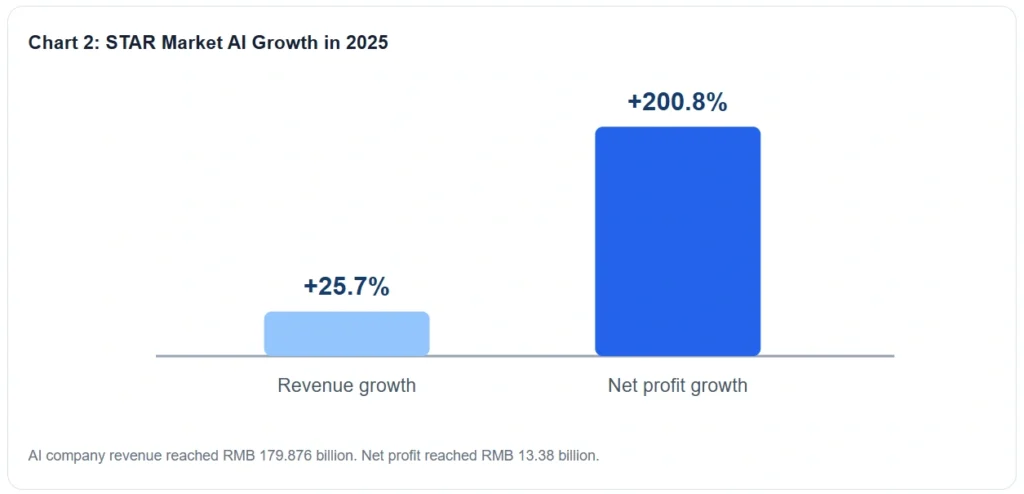
The Shanghai STAR Market shows how quickly this financing model is scaling. More than 30 listed AI companies generated 179.876 billion yuan of revenue during 2025.
Revenue increased 25.7% from the previous year. Combined net profit reached 13.38 billion yuan, rising 200.8% year on year.
That earnings acceleration gives the AI trade stronger fundamental support. It moves part of the investment story beyond policy expectations.
Semiconductors Add Another Growth Engine
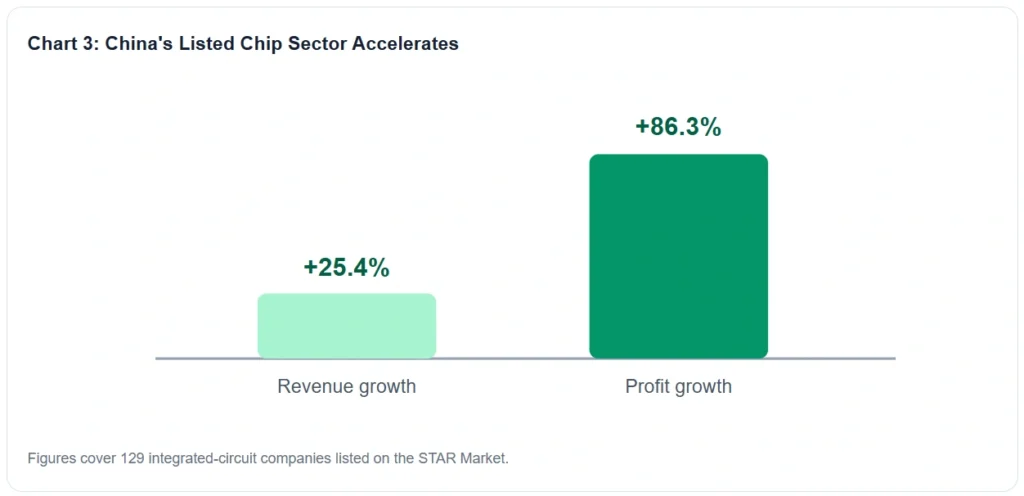
Semiconductors tell a similar story. The STAR Market’s 129 integrated-circuit companies generated 371.851 billion yuan of revenue during 2025.
Revenue increased 25.4%. Combined net profit reached 28.783 billion yuan, jumping 86.3%. AI computing demand and domestic substitution helped drive growth.
Capital Markets Take a Bigger Role
Capital-market reform is widening the financing channel. China’s securities regulator has extended special listing rules to high-quality AI model developers.
Those rules can help businesses with core technologies before conventional profitability arrives. Regulators also want listings from embodied AI, quantum technology, and biomanufacturing.
STAR Market and ChiNext already host more than 2,000 listed companies. Their combined market value exceeds 35 trillion yuan.
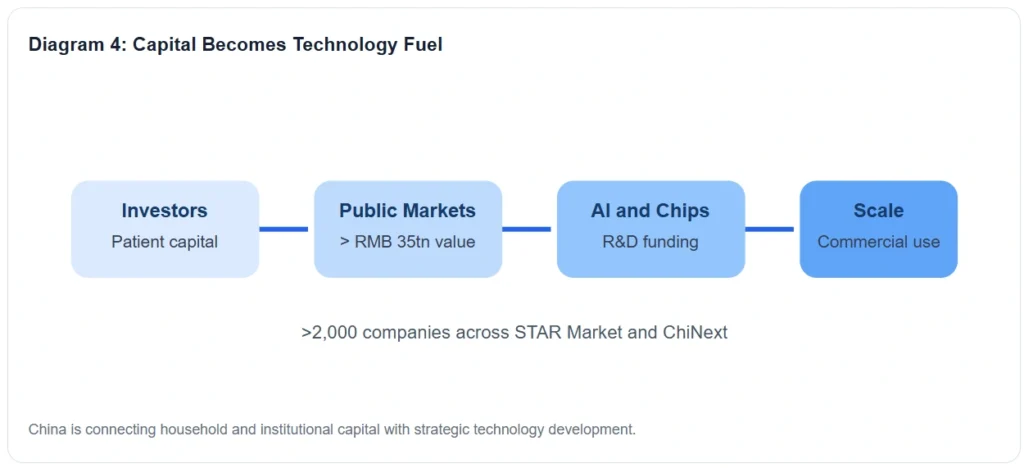
This approach changes the funding equation. Government capital can absorb strategic risk. However, public markets can distribute risk across a much broader investor base.
Listed companies can also refinance and acquire rivals. They can use equity incentives to retain scarce engineers.
In 2025, 45 STAR companies announced refinancing plans worth 47 billion yuan. That amount increased 65% from the previous year.
US Pressure Keeps the Chip Race Strategic
Market financing also creates discipline. Investors will demand revenue growth, margins, and credible paths toward cash generation.
That pressure could favor chip designers with proven commercial adoption. It could punish companies whose valuations move faster than orders or profits.
Geopolitics remains another constraint. The United States still controls access to certain advanced computing technologies through export licensing.
In January, Washington moved Nvidia H200 and AMD MI325X applications to case-by-case review under specific security conditions.
Therefore, China still has strong incentives to develop domestic alternatives. That incentive remains even when selected foreign processors remain available.
Meanwhile, the United States is expanding semiconductor manufacturing. In July, the U.S. Commerce Department said TSMC’s planned U.S. investment reached $265 billion.
What Investors Should Watch Next
For investors, China’s AI equity boom now carries two competing narratives. The bullish case rests on policy support, rising profits, and deeper capital markets.
The bearish case centers on valuation risk, export controls, and uneven technology quality. Strategic importance alone cannot guarantee attractive shareholder returns.
The key indicator is no longer enthusiasm. Investors should watch whether revenue growth converts into profits, cash flow, and stronger domestic technology.
China’s experiment could reshape technology finance. If successful, stock markets may become a central instrument of industrial competition.
However, failure would carry an important lesson. National technology priorities and profitable equity investments are not always the same thing.




