


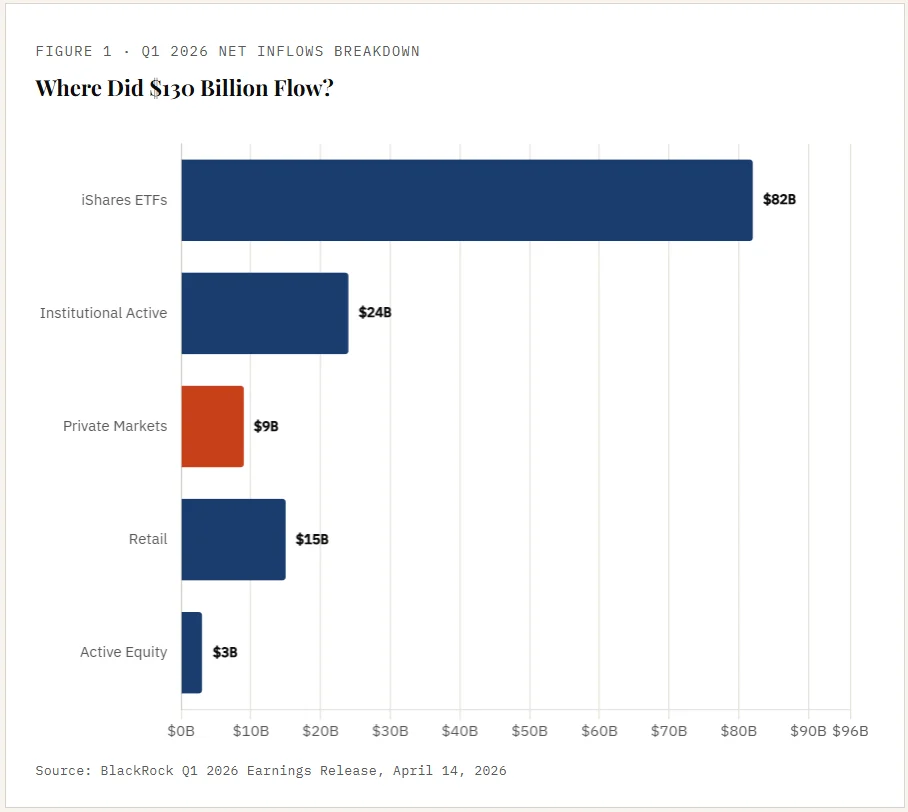
April 17, 2026 – Private credit and infrastructure drove record quarterly momentum. Total net inflows hit $130 billion, the firm’s strongest first quarter in five years.

BlackRock’s Q1 2026 earnings showed the world’s largest asset manager is deepening its hold on private markets. The firm reported $9 billion in private markets net inflows for the quarter. Private credit and infrastructure led the charge.
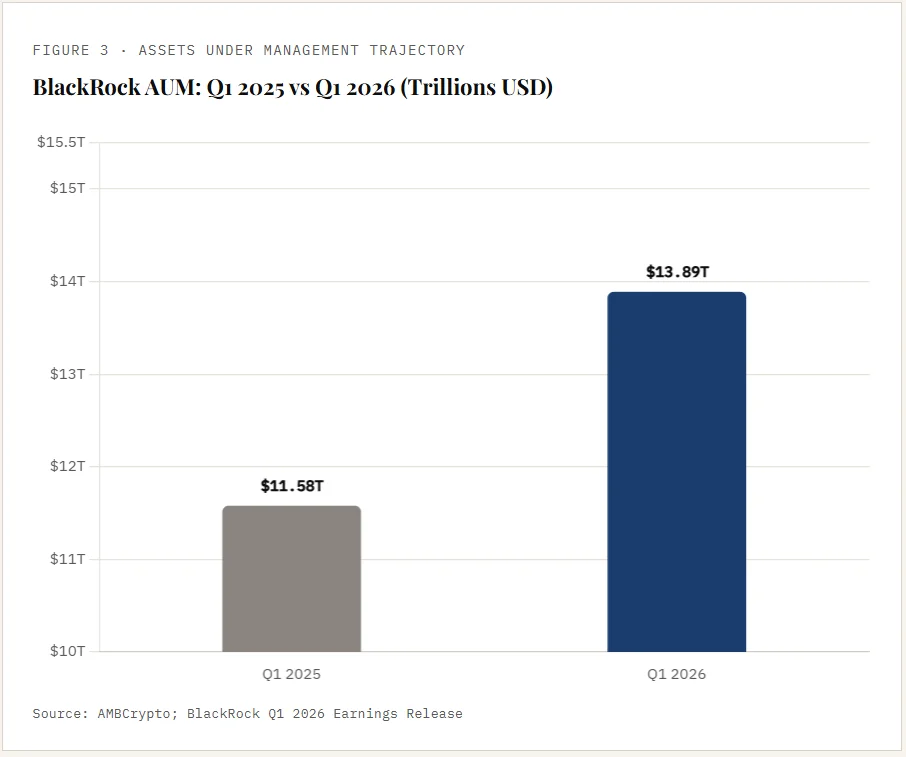
Total assets under management reached $13.89 trillion. That is a 20% jump year-over-year. Meanwhile, total net inflows came in at $130 billion. That marks the strongest first quarter in five years.
Private Markets: The New Growth Engine
Private markets recorded $9.1 billion in net inflows. Deployment activity was the primary driver. Infrastructure and private credit attracted the bulk of capital.
The GIP V fund closed above its $25 billion target. It is already majority committed. This reflects surging institutional demand for real assets.
The HPS Investment Partners deal closed in January 2026. Together with GIP, these acquisitions effectively tripled BlackRock’s private markets footprint. Higher management fees followed.
“BlackRock is a scale operator across public markets, private markets, and technology.”
— Laurence D. Fink, CEO, BlackRock
Despite strong inflows, the firm’s private markets AUM dipped slightly to $320.4 billion. It stood at $322.6 billion at year-end 2025. Returns of capital totaling $8.5 billion and a $2 billion market-value drop explain this gap.
Revenue and Earnings Surge Across the Board
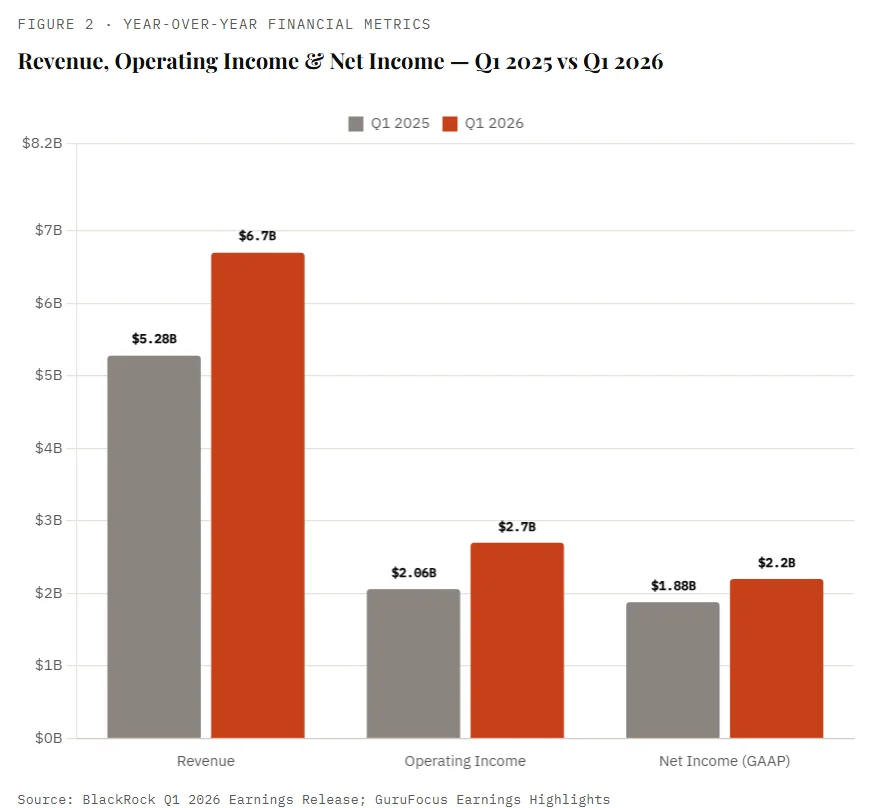
Revenue hit $6.7 billion, rising 27% year-over-year. Operating income climbed 31% to $2.7 billion. Net income (GAAP) reached $2.2 billion, a 17% annual gain.
Diluted EPS on a GAAP basis came in at $14.06. Adjusted EPS stood at $12.53, up 11% compared to the same quarter last year.
Organic base fee growth hit 8%, the highest Q1 reading in five years. Technology services annual contract value (ACV) grew 14%. Adjusted margins expanded by over 100 basis points.
Active Strategies Gain Ground
Active equity generated $3 billion in net inflows. Institutionally active strategies pulled in $24 billion. Retail net inflows reached $15 billion.
The iShares ETF franchise remained the dominant force in public markets. It continues to attract record capital. Active ETFs contributed meaningfully to total platform flows.
One notable drag: the cash management platform recorded $6 billion in net outflows during the quarter. This offset a portion of gains elsewhere on the balance sheet.
What This Means for Investors
BlackRock’s results signal a structural shift in asset management. Institutional capital is moving away from liquid public funds. It is rotating into private credit and real assets.
Management stated that momentum in private markets is broad-based. Investment performance, access to deal flow, and deep client relationships are driving growth. These are not easily replicated by smaller competitors.
The firm’s dual strategy, scaling public ETFs and deepening private alternatives, is paying off. It positions BlackRock uniquely across the full capital spectrum. Few peers can match this breadth.
For investors, the takeaway is clear. BlackRock is no longer just the world’s largest index fund manager. It is rapidly becoming the dominant gateway to private capital markets.




