

August 09, 2026 – Greg Abel’s second quarter as chief executive produced a headline surge. Yet the operating engine and the shrinking cash pile tell the sharper story.

In Summary
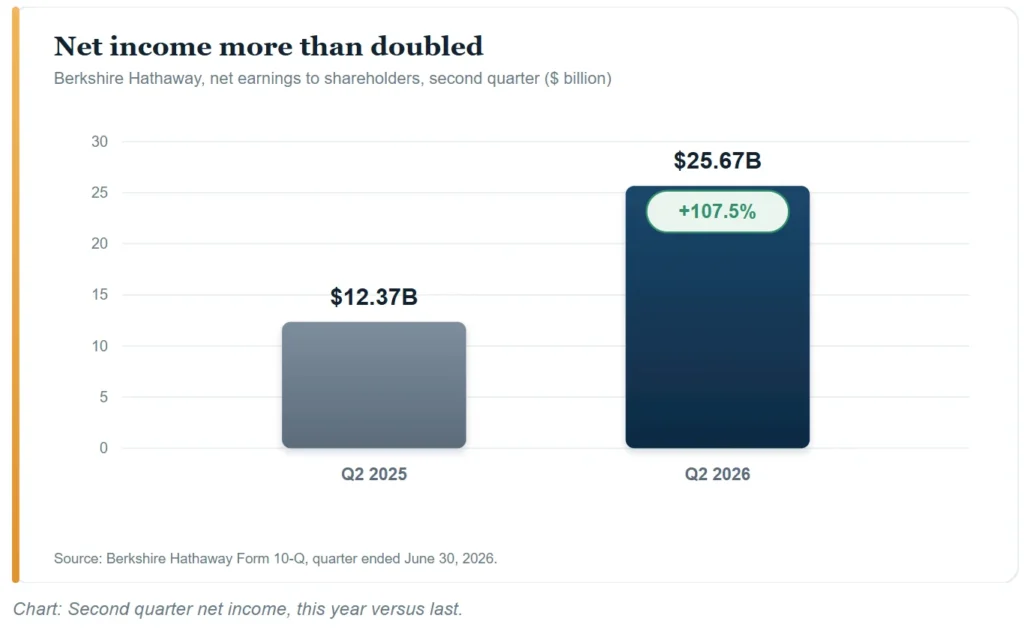
Net income more than doubled to $25.67 billion, yet paper stock gains drove most of the jump.
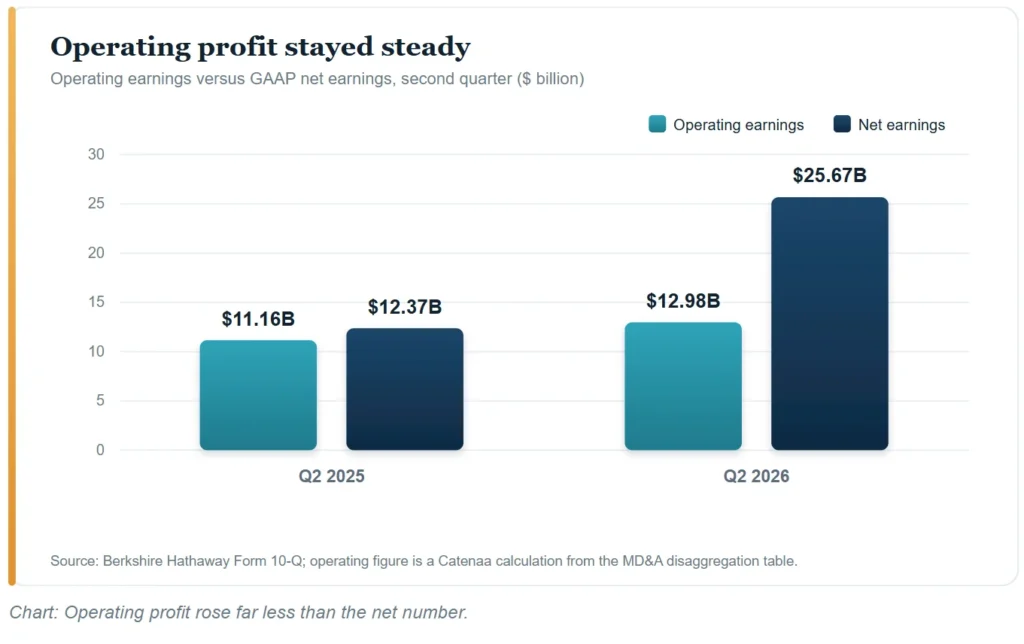
Operating profit rose a steadier 16% to $12.98 billion, a cleaner read on the core business.
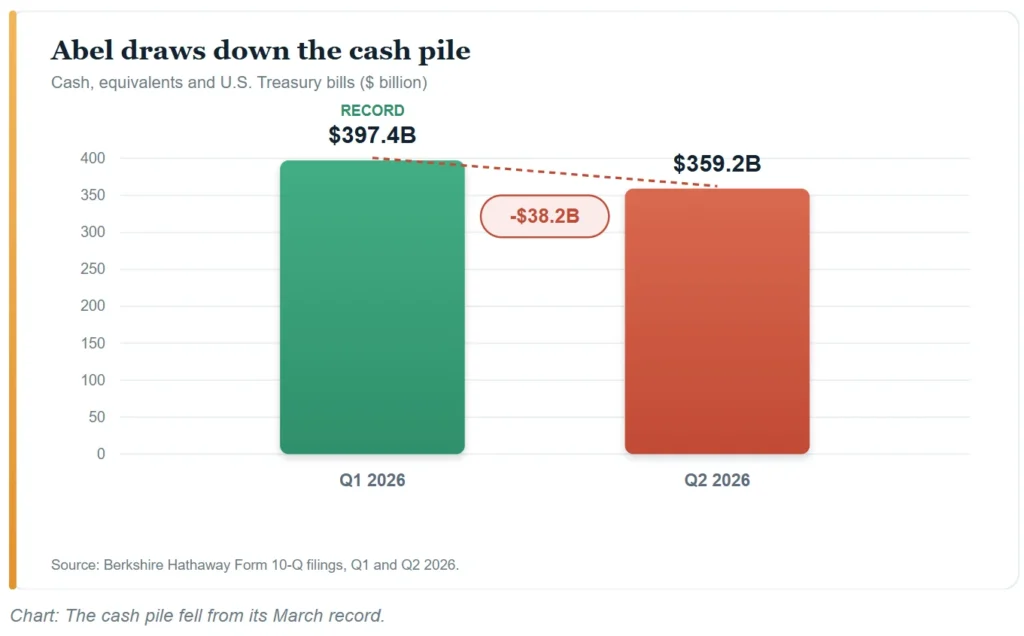
Chief executive Greg Abel cut the cash pile to $359.2 billion and restarted share buybacks.
Alphabet climbed among the five largest holdings, tilting the famously value-driven book toward technology.
Berkshire profit surged in the second quarter of 2026. The group reported net income of $25.67 billion. That result more than doubled the $12.37 billion booked a year earlier. Earnings reached $17,868 per Class A share, up from $8,601. On the surface, the number looks huge. However, the details tell a calmer story. In plain terms, stocks did the work here. Total revenue still rose to $101.8 billion from $92.5 billion.
Stock gains power Berkshire profit
Paper gains drove most of the jump. The income statement showed $16.08 billion in pre-tax stock gains. By contrast, last year gave far smaller figures. Consequently, rising prices flattered the yearly compare. Greg Abel, the new chief since January, inherited this pattern. He now owns the swings that come with it. After tax, those gains added $12.68 billion to profit.
Odd rules create these swings. Since 2018, paper moves in the stock book flow straight through profit. Therefore, the headline rarely tracks the real business. Buffett himself often warned owners about this quirk. Because of it, one good quarter can double the profit line. The market, not the firm, did the lifting.
Operating profit tells the steadier story
Strip out the paper gains, and a calmer trend shows. Operating profit rose to $12.98 billion from $11.16 billion. That gain works out near 16%, not a doubling. Moreover, last year held a $3.76 billion Kraft Heinz writedown. That charge cut the 2025 base and widened the jump.
Many units carried the load this time. Making, service and retail earned $4.47 billion after tax. The BNSF railroad added $1.56 billion. Meanwhile, the energy arm gave $891 million. However, insurance weakened as GEICO faced costlier claims. Its loss ratio rose to 76.6% on more claims. Even so, insurance income still gave $3.06 billion. Its float, or held premiums, neared $177.5 billion.
Abel starts to spend the cash pile
The bigger signal sits on the balance sheet. Cash, equivalents and Treasury bills fell to $359.2 billion. Notably, that pile had peaked near $397.4 billion in March. In short, Abel spent about $38 billion of dry powder. That is a large sum by any measure. A higher tax rate also nipped profit a bit. It rose to 19.6% from 15.5% last year.
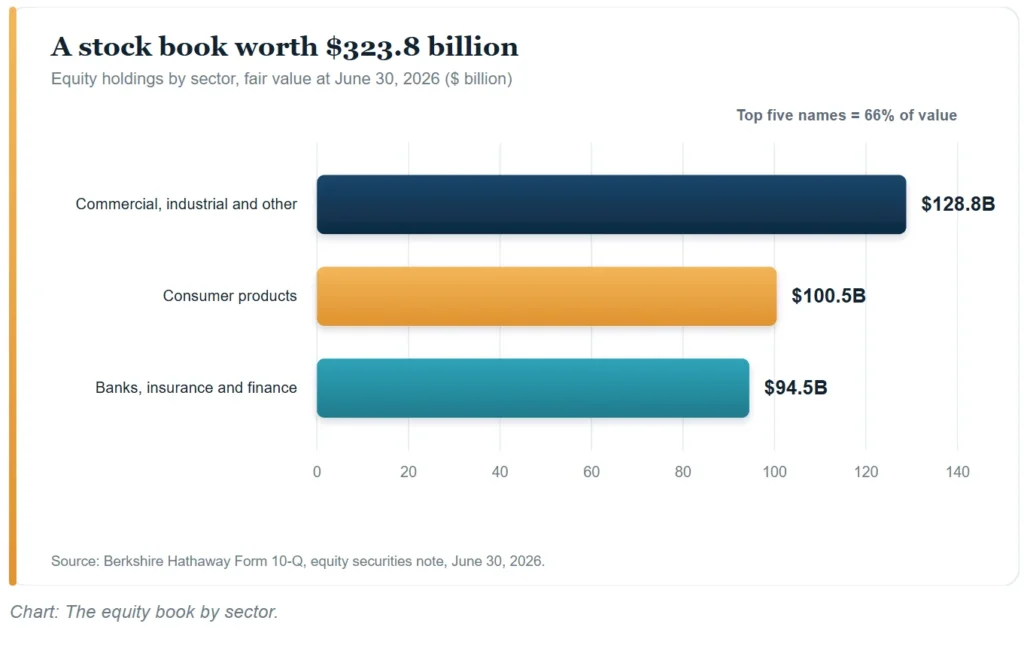
The new chief is clearly acting now. Berkshire grew its stock book to $323.8 billion by June. Furthermore, it bought chemical maker OxyChem in January for about $9.4 billion. It later added homebuilder Taylor Morrison for roughly $6.8 billion. Together, those deals break from recent caution. Buffett had sat on cash for years instead.
Buybacks also came back after a long freeze. The firm bought $4.8 billion of its own shares in six months. Most of that fell in the second quarter. Additionally, these were the first big buybacks in nearly two years. Meanwhile, shareholder equity still swelled to $747.9 billion.
A tech tilt reshapes the book
The holdings now lean harder toward tech. Its five largest bets were Alphabet, American Express, Apple, Bank of America and Coca-Cola. Together, those names made up 66% of stock value. Meanwhile, that share edged up from 65% at year end.
Alphabet’s climb stands out the most. The stake grew after a direct $10 billion buy from the search firm. As a result, a tech giant now anchors this value-tilted book. For a group built on old-line names, that shift feels big. Such heavy concentration also raises the stakes on each pick.
What the report signals
Berkshire still holds a huge cash cushion. Yet Abel plainly looks readier to spend than Buffett was. This report marked only his second quarter in charge. For risk-asset watchers, that pivot carries real weight. After years of caution, the group leans forward at last. Investors took clear note of the change. Cash still runs deep at this group.
So read past the doubling itself. That figure reflects market swings, not real strength. Instead, the steady 16% operating gain shows the true trend. Unrealized stock gains alone now near $217 billion. Buffett built that base with patience and cash. Now Abel adds fresh drive to that same frame. In the end, quiet nerve defines his early start.




