


July 31, 2026 – Three policymakers wanted higher rates. The Bank’s own July forecast still shows inflation dropping under target by early 2028.

In Summary
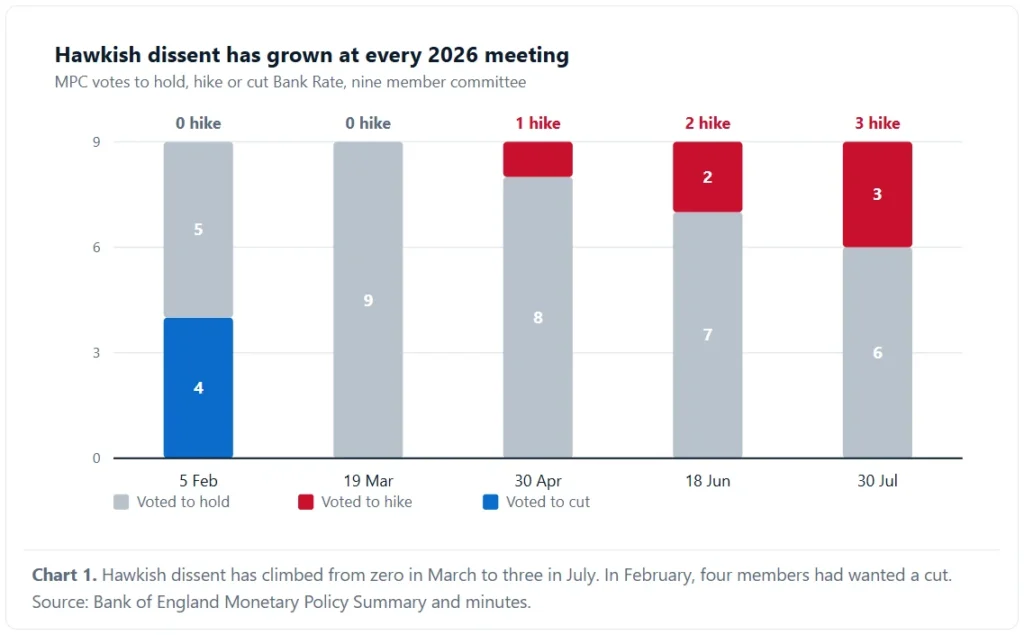
The MPC held the Bank Rate at 3.75% by six votes to three, a fifth straight pause.
Greene, Mann and Pill wanted an immediate quarter-point rise to 4%.
The July projection peaks at 3.2% in late 2026, then falls to 1.7% by early 2028.
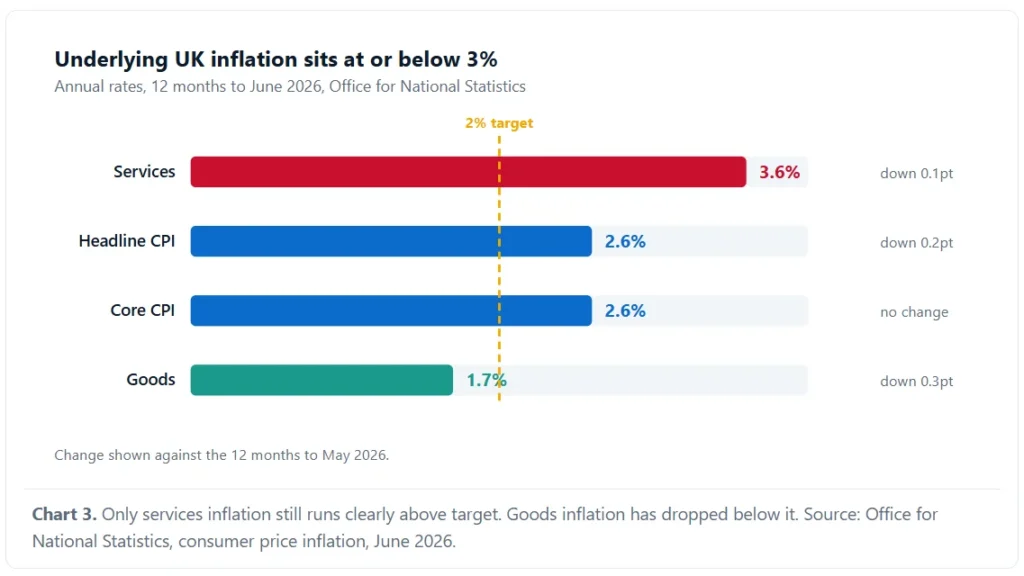
UK CPI slowed to 2.6% in June, while services inflation eased to 3.6%.
Ofgem lifted the household energy cap 13% on 1 July, driven by a 24% gas jump.
The Bank of England rate hold on 30 July 2026 looked hawkish on the surface. Underneath, the message leaned the other way. Policymakers kept Bank Rate at 3.75% for a fifth straight meeting. However, three of the nine members wanted an immediate rise to 4%.
Megan Greene, Catherine Mann and Huw Pill formed that hawkish bloc. Their numbers keep growing. In April, only Pill dissented. By June, Greene had joined him. Now Mann makes three.
Yet the Bank’s own forecast quietly undercuts their case.
Why the Bank of England rate hold still reads dovish
The July projection assumes markets get roughly what they price. Traders currently expect about two quarter-point hikes by the third quarter of 2027. On that tighter path, inflation still peaks near 3.2% in the final quarter of 2026. Afterwards it falls hard. By early 2028, the central projection puts CPI at just 1.7%.
That number matters more than the vote split. It sits 0.3 percentage points below the 2% target. Put simply, the Bank shows what happens if markets get their hikes. The answer is an undershoot. Inflation then creeps back to only 1.9% by late 2029.
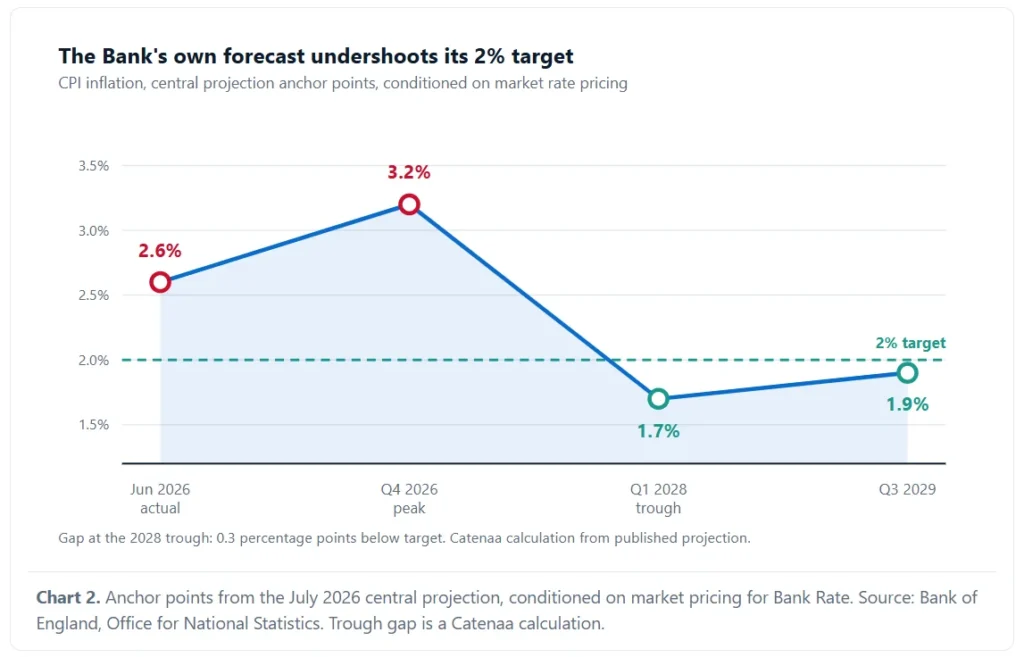
Therefore, the forecast acts as a soft warning to rate-setters and traders alike. Tighten as priced, and the target slips out of reach from below.
Consider the arithmetic another way. Two quarter-point moves would lift Bank Rate to 4.25%. The Bank’s own model then delivers that 1.7% trough. Holding steady, or even easing later, would arguably fit the profile better. Naturally, the Committee stopped well short of saying so.
Disinflation is already doing the work
Recent data supports the majority view. CPI inflation slowed to 2.6% in June, down from 2.8% in May. Services inflation, the Bank’s favourite persistence gauge, eased to 3.6%. Core inflation held at 2.6%, while goods inflation cooled to 1.7%.
Governor Andrew Bailey pointed to that trend directly. He noted that underlying disinflation seen before the conflict remains in train. Moreover, he flagged a softer demand backdrop and an easing labour market.
The Bank’s regional agents told a similar story. Pay settlements for 2026 average 3.5%. For 2027, most firms able to answer expect a lift of zero to one percentage point. In short, wage pressure looks contained rather than explosive.
Energy prices remain the real wild card
Every dovish argument still runs into one obstacle. Middle East supply disruption keeps crude and gas prices volatile. Ofgem lifted the household price cap by 13% from 1 July. Gas unit rates jumped roughly 24%, although electricity rose only about 5%.
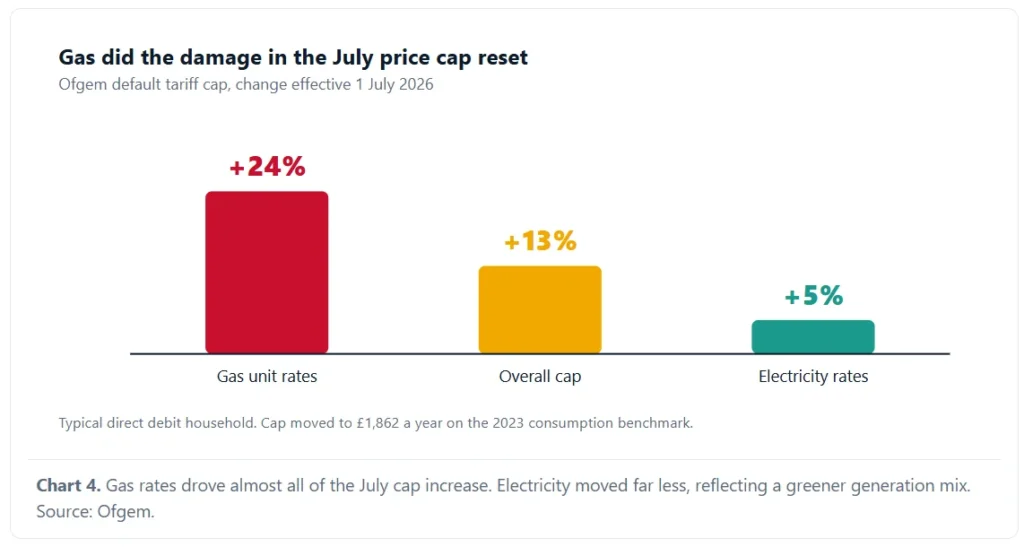
That shock lands in the third quarter inflation prints. Consequently, the Committee expects CPI to climb again through late 2026.
The Bank also published an adverse scenario. Under repeated escalation, inflation reaches 4.1% by the third quarter of 2027. Growth slows to 0.9% over the same period. Second-round effects then become far harder to dismiss.
For now, though, evidence for those effects looks thin. The Committee describes pressure as upstream and concentrated in a few sectors. Vacancies sit below pre-pandemic levels. Margins are not widening.
Growth stays stuck in the slow lane
Activity offers little reason to tighten either. The central projection shows annual growth of 1.1% in the third quarter of 2026. It stays at 1.1% a year later. Only in 2028 does the pace lift to 1.7%.
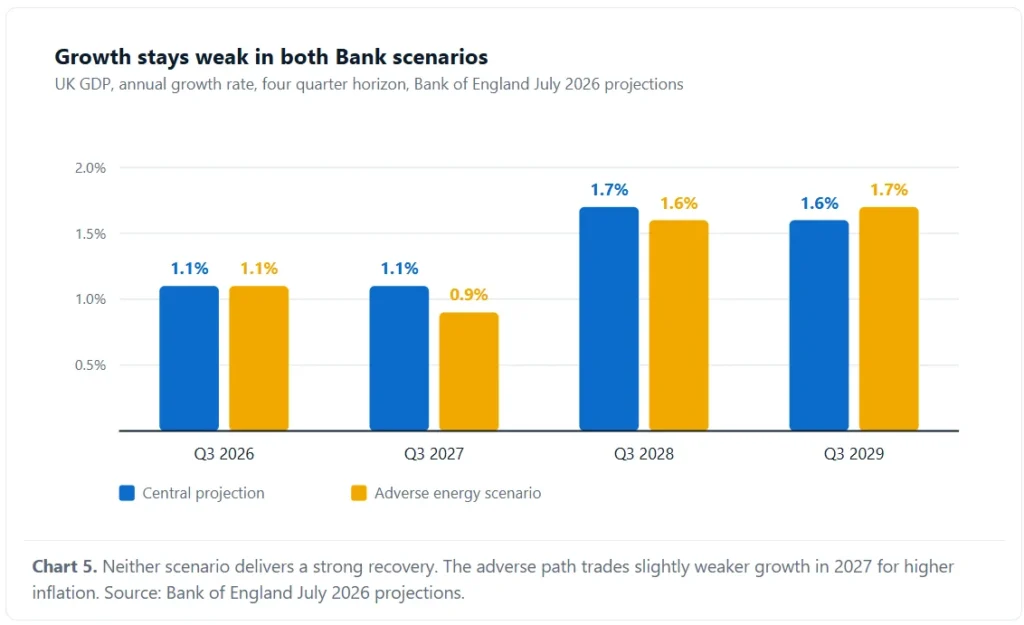
Meanwhile, the balance sheet keeps shrinking. The Bank bought £895bn of bonds under quantitative easing. Since February 2022, it has steadily unwound that stock. Quantitative tightening therefore adds passive restraint alongside the 3.75% policy rate.
What traders should watch next
Three catalysts now shape the September decision. First, July and August CPI prints will test the energy pass-through. Second, the October price cap will set the 2027 wage anchor. Third, early pay settlement signals arrive towards the year end.
Mortgage borrowers therefore gain little near-term relief. Savers, meanwhile, keep an unusually generous return. Sterling markets face a genuine two-way risk. A fourth hawkish dissent would flip the arithmetic fast. Conversely, one soft services print could bury the hike trade entirely.
The next scheduled announcement comes on 17 September 2026. Until then, the Committee waits. Its forecast, however, has already made an argument the hawks have yet to answer.




