

May 24, 2026 – Japan and South Korea posted strong gains as Nvidia’s record earnings boosted tech stocks. China and India diverged from the broader regional rally.
In Summary
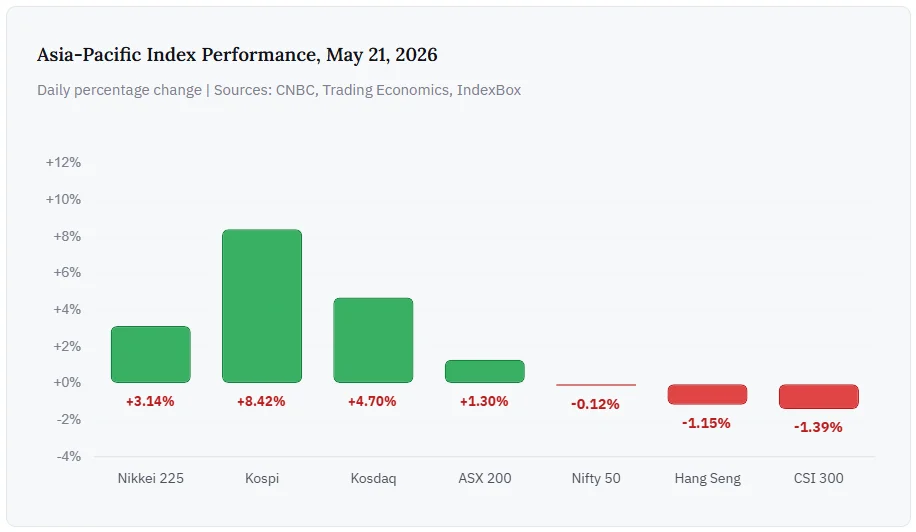
Japan’s Nikkei 225 closed at 61,684.14. That is a gain of +3.14 % on strong April export data.
South Korea’s Kospi surged to 7,815.59, up +8.42%, near its all-time high.
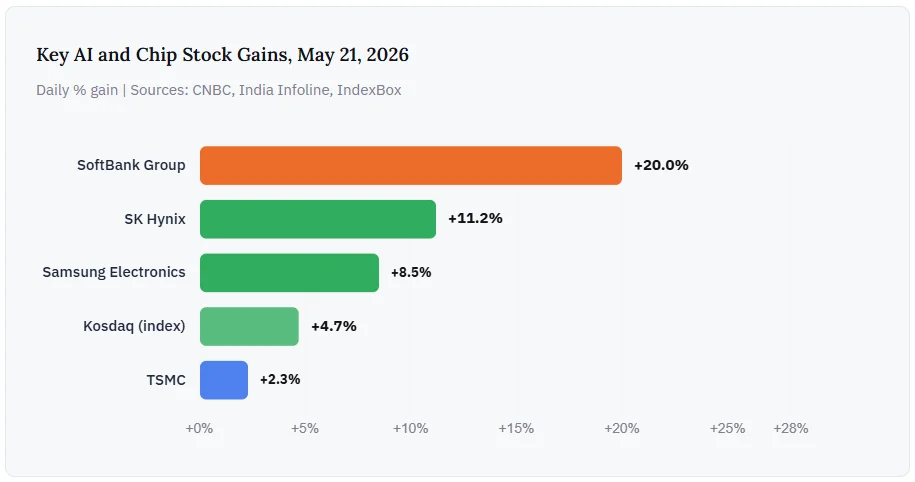
SoftBank Group jumped nearly 20% after Nvidia’s blockbuster quarterly earnings.
Samsung averted an 18-day strike by 47,000+ workers. Its shares rose+8.5%.
China’s CSI 300 fell 1.39%. The Hang Seng declined by 1.15% on trade uncertainty.
A Powerful Rally Sweeps the Region
Asia-Pacific markets surged higher on Thursday, May 21. NVIDIA’s record quarterly earnings acted as the primary catalyst. Technology stocks across the region responded with sharp, decisive gains. However, the rally was uneven. Japan and South Korea outperformed significantly. China and India lagged behind the pack.
The Nvidia effect proved immediate and powerful. The U.S. chipmaker reported record revenue of $68.13 billion for its latest quarter. This beats the analyst’s estimate of $66.21 billion. Furthermore, adjusted earnings per share of $1.62 exceeded the consensus forecast of $1.53. These figures confirmed that global AI infrastructure spending remains firmly on track.
Additionally, easing tensions in the Middle East provided a secondary tailwind. Oil prices softened slightly early in the session. This helped lift broader market sentiment. However, macro risks persisted. Global bond yields edged higher, signaling growing inflation concerns.

Japan Posts One of Its Strongest Sessions
Japan’s Nikkei 225 advanced 3.14% to close at 61,684.14 on Thursday. This was one of the index’s strongest sessions in recent weeks. Two key factors powered the move. First, Japan’s April trade data beat expectations. Second, Nvidia’s earnings boosted global tech sentiment overnight.
Exports rose 14.8% year-on-year in April. That marked Japan’s fastest export growth since January. Semiconductor shipments were the primary driver. Imports also topped forecasts, growing 9.7% year-on-year. Japan’s trade balance narrowed to 301.9 billion yen in April. This compares favorably to 643 billion yen in March. Therefore, Japan’s external sector showed remarkable strength.
Furthermore, SoftBank Group was the session’s most dramatic performer. The AI investment giant surged nearly 20% on the day. NVIDIA’s results directly validate SoftBank’s aggressive AI strategy. The company holds stakes in OpenAI and other frontier AI firms. Investors treated Thursday’s rally as structural, not merely reactive.
South Korea Leads Asia With an 8% Surge
South Korea delivered the region’s strongest single-session performance. The Kospi advanced 8.42% to close at 7,815.59. This placed the benchmark index near its all-time high. The small-cap Kosdaq also rose 4.7% to 1,105.97. Both indices reflected deep enthusiasm for AI-related equities.
Two catalysts combined to produce this extraordinary result. First, Nvidia’s earnings directly benefited Korean chipmakers. SK Hynix surged 11.2%. The company supplies high-bandwidth memory (HBM) chips to Nvidia. These chips are essential for running large AI models at scale. Therefore, Nvidia’s revenue growth translates directly into SK Hynix’s forward order book.
Second, Samsung Electronics gained 8.5%. Management and the union averted a planned 18-day strike involving over 47,000 workers. Wage negotiations reached a breakthrough at the last moment. That resolution removed a major production risk for the world’s largest chipmaker by revenue.
“We expect the Kospi to reach 10,000 by year-end.”
-Daniel Yoo, Global Strategist, Yuanta Securities Korea, speaking on CNBC Squawk Box Asia
Moreover, analyst sentiment turned decisively bullish. Daniel Yoo of Yuanta Securities appeared on CNBC’s Squawk Box Asia. He stated his expectation that the Kospi will reach 10,000 by year-end. From current levels, that target implies a gain of approximately 28%. Samsung and SK Hynix together account for 42.2% of the Kospi’s total market weight. Therefore, AI chip demand is now central to Korea’s broader market trajectory.
China and India Diverge From the Rally
However, Chinese markets moved in the opposite direction on Thursday. The CSI 300 fell 1.39% to 4,783.1. Hong Kong’s Hang Seng Index declined 1.15% as well. Persistent concerns about U.S.-China trade policy weighed heavily on sentiment. Additionally, geopolitical tensions in the Middle East added a layer of caution for mainland investors.
India’s equity markets offered a subdued response. The Nifty 50 ended broadly flat. The BSE Sensex edged 0.31% lower. Despite the muted session, the longer-term outlook for Indian IT firms remains positive. NVIDIA’s strong AI data center spending supports global demand for cloud and software services. Furthermore, Indian companies with AI inference and cloud migration capabilities are well placed for the second half of 2026.
Oil Prices Add a Layer of Uncertainty
Meanwhile, oil prices remained a critical variable for investors across the region. Brent crude traded at $105.50 per barrel early in Thursday’s session. Three supertankers transited the Strait of Hormuz on Wednesday. That event marked the first significant commercial shipping passage since hostilities in the Middle East began. However, the relief proved short-lived. Brent crude reversed higher to $105.62 per barrel by Friday, gaining 2.96%.
Japan’s 10-year government bond yield climbed by more than 9 basis points to 2.793%. Rising bond yields reflect mounting inflation expectations globally. They also place downward pressure on equity valuations over time. Nevertheless, Thursday’s AI-driven earnings momentum proved stronger than these macro headwinds. Investors chose to prioritize growth signals over rate risks.
What Investors Should Watch Next
Furthermore, investors will closely monitor several key events in the coming days. The trajectory of U.S.-Iran diplomacy remains highly uncertain. Any new escalation could push oil prices sharply higher. Additionally, the broader consequences of recent U.S.-China summit discussions continue to shape expectations for trade policy.
Artificial intelligence dominates the prevailing market narrative. NVIDIA’s results confirmed that global AI infrastructure spending shows no sign of slowing. South Korea and Japan sit at the heart of the global semiconductor supply chain. Therefore, further gains in the Kospi and Nikkei appear plausible if AI momentum holds through the second half of 2026. The primary risk to this outlook remains geopolitical uncertainty, particularly any new developments in the Middle East.