

May 05, 2026 – Amazon’s new Supply Chain Services opens its freight empire to all businesses, sending shockwaves through the $1 trillion logistics sector on May 4, 2026.
In Summary
UPS stock fell 9.68%, and FedEx dropped 9.54% on May 4, 2026.
Amazon launched Amazon Supply Chain Services, open to all businesses.
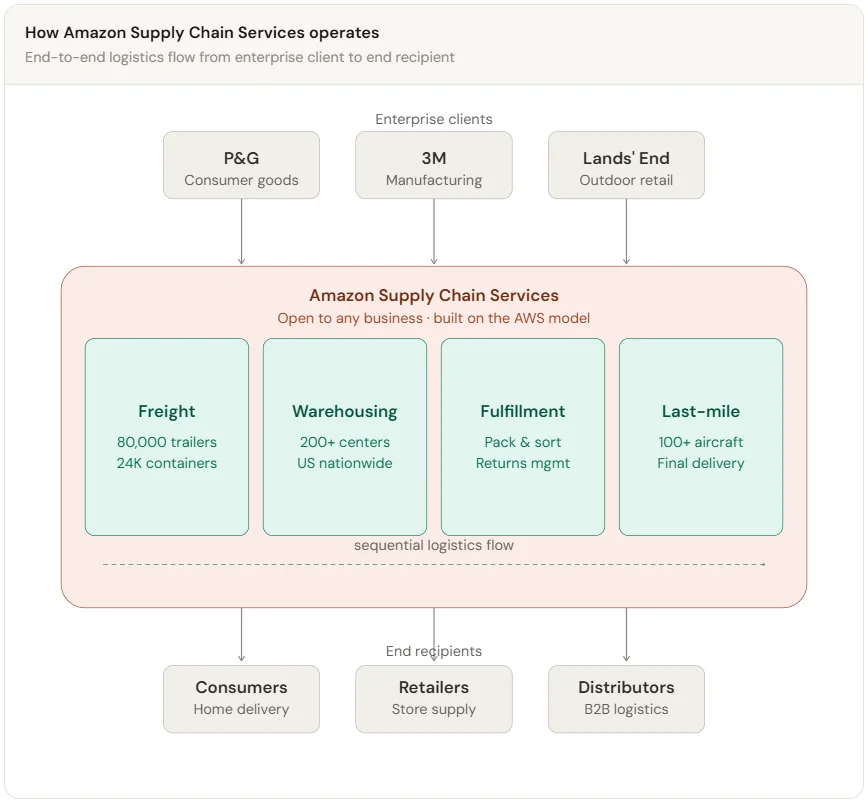
The service bundles freight, warehousing, fulfilment, and last-mile delivery into a single platform.
Amazon operates 200+ fulfilment centres, 80,000 trailers, and 100 cargo aircraft.
Morgan Stanley called the move a potential “watershed moment” for North American freight.
On May 4, 2026, Amazon made its boldest move yet. The company launched Amazon Supply Chain Services, a unified platform offering freight, warehousing, fulfilment, and last-mile delivery to any business. The market reacted swiftly and severely.
Market reaction
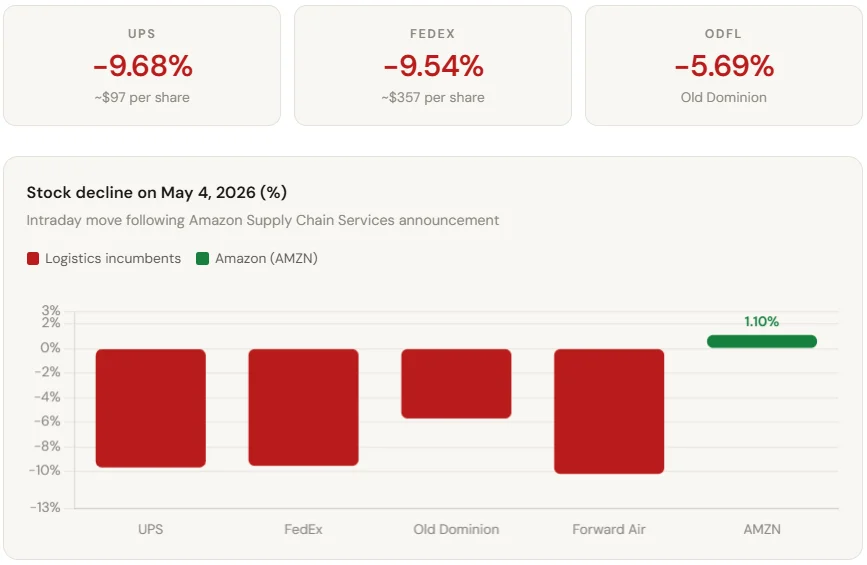
Bloomberg reported that Forward Air Corp. and GXO Logistics also suffered double-digit declines. Amazon’s own stock edged up 1.1%. This divergence signals deep investor fear about long-term freight market share.
What are Amazon Supply Chain Services?
According to GeekWire, the service bundles Amazon’s full logistics stack into one platform. It covers freight forwarding, distribution, fulfilment, and last-mile delivery. Any business can now access it, not just Amazon marketplace sellers.
Peter Larsen, Amazon’s VP of Supply Chain Services, compared the launch directly to AWS. He said the offering brings Amazon’s supply chain to outside businesses “much like Amazon Web Services did for cloud computing”. That analogy carries weight. AWS now generates over $100 billion annually.
“Bringing its end-to-end capabilities to market in a unified service offering stands to disrupt the US logistics market.”
— Nate Skiver, Founder, LPF Spend Management
Amazon’s logistics infrastructure
Amazon has spent a decade building a network that rivals any carrier. Investing.com confirmed the full scale of assets now available to external clients.
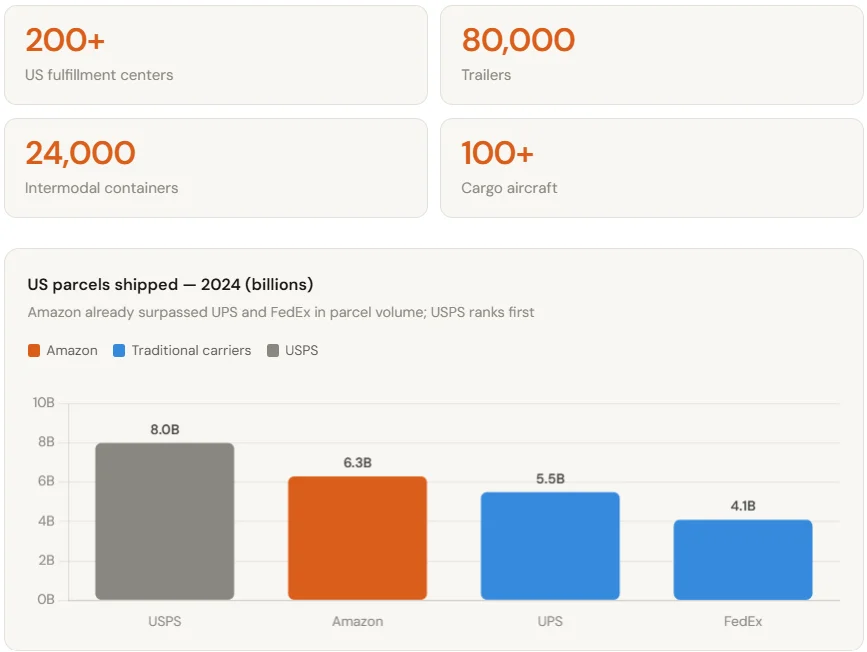
Amazon already surpassed both carriers to become the nation’s largest private parcel shipper by volume, shipping 6.3 billion parcels in 2024, according to parcel analytics firm ShipMatrix. That density gives Amazon a critical pricing advantage on routes already saturated with its own volume.
Early customers signal serious intent
The launch was not just theoretical. Amazon announced real enterprise clients from day one. Procter & Gamble is using Amazon’s freight network to move raw materials. 3M is routing manufactured goods through Amazon’s distribution centres. Lands’ End is fulfilling orders across sales channels via Amazon’s warehouses.
These are not small pilots. P&G and 3M are Fortune 500 companies. Their participation signals that the service is ready for enterprise scale. It also signals something else: these companies were previously clients of UPS and FedEx.
Why UPS is especially vulnerable
24/7 Wall St. noted that Amazon was once UPS’s largest single customer. Now it becomes its most dangerous rival. UPS CEO Carol Tomé had already warned 2026 would be an “inflection point”. The company eliminated 48,000 positions and closed 93 facilities in 2025. Its Q1 2026 US domestic volumes fell 8%, a deliberate pullback from low-margin work for Amazon.
That pullback now looks premature. UPS shed Amazon revenue to protect margins. But Amazon used that time to build its external logistics product. The math is uncomfortable for UPS shareholders.
The strategic parallel to AWS
Amazon’s pattern is consistent: build a capability for internal use, then monetise it externally. AWS started as an internal infrastructure. Amazon Advertising started as an internal tool. The logistics play follows the same script. Morgan Stanley analyst Ravi Shanker wrote that this could be a “watershed moment for North American freight transportation companies”.
“Not immediate disruption, but a structural warning shot.”
— Parth Talsania, CEO, Equisights Research
What comes next
The next signal will come from enterprise contracts. If major shippers visibly shift freight from UPS and FedEx to Amazon, pressure will intensify. FedEx also faces a complication: its FedEx Freight spinoff is scheduled for June 1. Amazon’s new service competes directly in that segment. The logistics sector faces a structural reset. Amazon’s entry does not guarantee dominance. But it does guarantee disruption.




