


July 19, 2026 – A holiday week failed to slow dealmaking. Instead, large rounds flowed to AI, robotics, defense, and fintech across the United States.

In Summary
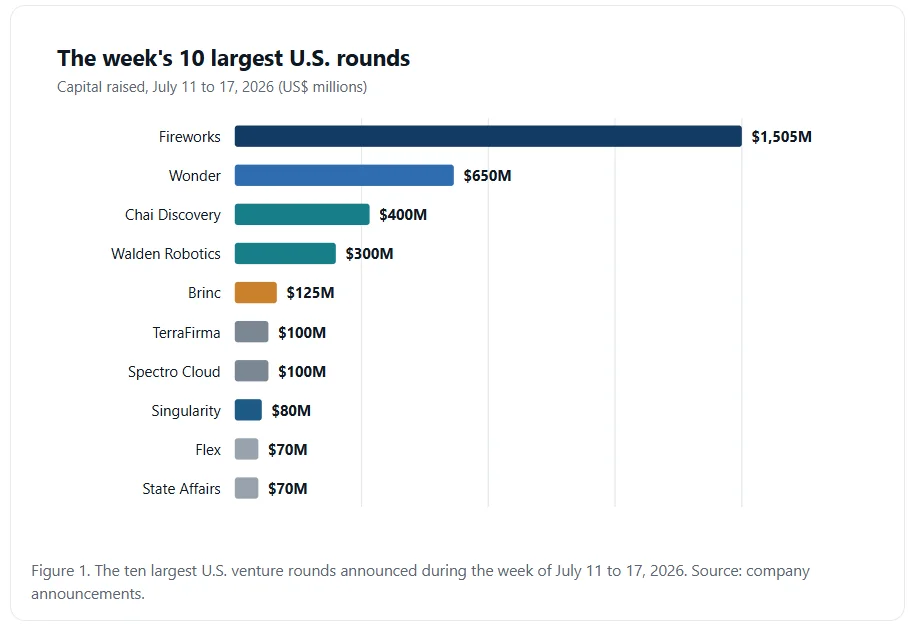
AI led the week as ten U.S. firms raised about $3.4 billion from July 11 to 17.
Fireworks’ $1.505 billion Series D topped the list at a $17.5 billion value.
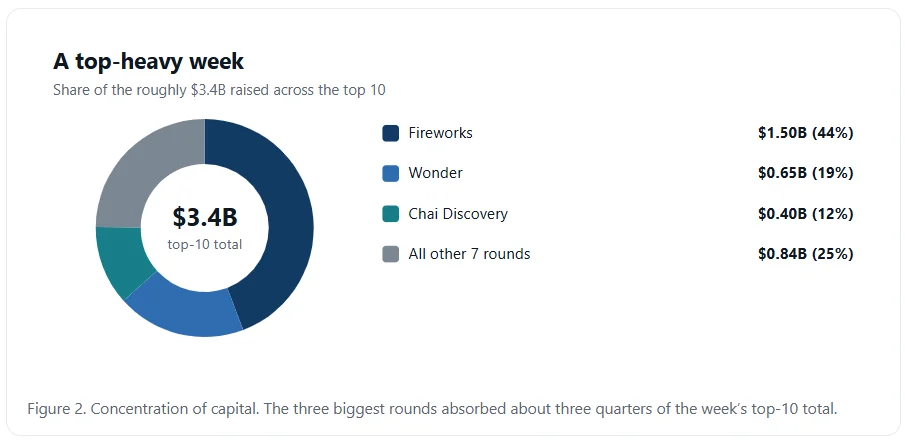
The three biggest rounds absorbed roughly 75% of the top-10 total.
Robotics and defense both drew nine-figure launches straight out of stealth.
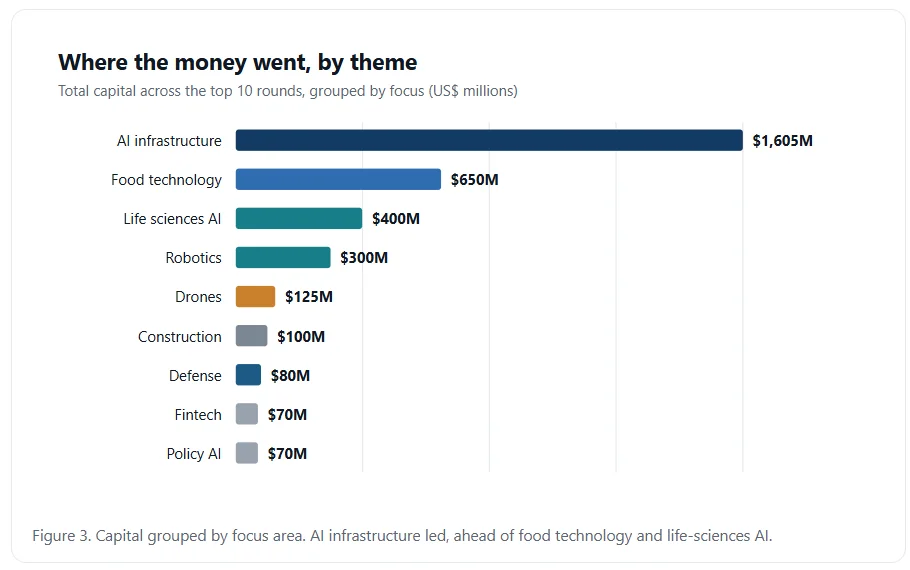
AI startup funding led a busy mid-July deal week, with 10 U.S. firms raising close to $3.4 billion. From July 11 to 17, large checks flowed into AI, robotics, defense, fintech and food technology. Moreover, AI startup funding drove nearly every major round. A holiday week clearly failed to slow the flow of cash.
Enterprise AI leads the pack
The top deal went to Fireworks, a San Mateo AI firm. It closed a $1.505 billion round this week. Furthermore, that round valued the company at $17.5 billion. Fireworks now serves more than 40 trillion tokens each day. It also passed $1 billion in yearly sales. Notably, about 95% of those tokens run on custom models. So demand for tailored AI looks very strong.
Cash piled up at the top
The pattern shows how AI startup funding is becoming more concentrated around a few large winners.
The week’s money was tied to just a few names. In fact, the top three deals took about 75% of the total. Fireworks alone made up close to 44%. As a result, smaller firms split a thin slice.
Wonder took second place with a $650 million round. Meanwhile, the New York food firm hit a $9 billion valuation. The company runs 140 sites today. It will also spend the cash on robots and AI. Its reach has tripled since May 2025.
Chai Discovery came third with a $400 million round. Then it hit a $3.8 billion value, roughly triple its recent price. This San Francisco startup designs new drugs with AI. Its tools already serve two of the largest drug makers. So backers viewed the deal as core tech, not hype.
Stealth launches and robots
Robots also drew big money this week. Walden Robotics left stealth with $300 million in seed cash. That seed round set a $1.1 billion value for the Cambridge team. The group spun out of a top carmaker’s research arm. Since February, its robots have worked inside a U.S. plant. Thus, the deal points to real use, not a demo.
Defense tech gave the week a second stealth debut. Singularity broke cover with an $80 million round. That round set a $400 million valuation. The Los Angeles firm builds cheap air defense gear. Furthermore, it addresses the rising threat posed by small drones. Two well-known funds co-led the deal.
Deals spread across many fields
Several mid-size rounds widened the week’s reach. For example, a Seattle drone maker raised $125 million for safety work. In addition, an Austin construction robotics firm took $100 million. An AI backbone firm matched that sum in San Jose.
Fintech and policy tech also made the list. Flex, a private banking app, raised $70 million in San Francisco. Similarly, a policy AI platform closed $70 million. Both deals show steady interest beyond pure model shops.
These rounds reached firms from coast to coast. Seattle, Austin, and San Jose all landed on the list. Thus, the boom is not just a Bay Area story. Investors clearly hunt for strong teams in many cities.
Seed rounds also grew unusually large this week. Walden pulled $300 million before its first public reveal. Likewise, Singularity raised $80 million straight out of stealth. In the past, such sums came much later. Now top teams can command them from day one.
Valuations race ahead of sales
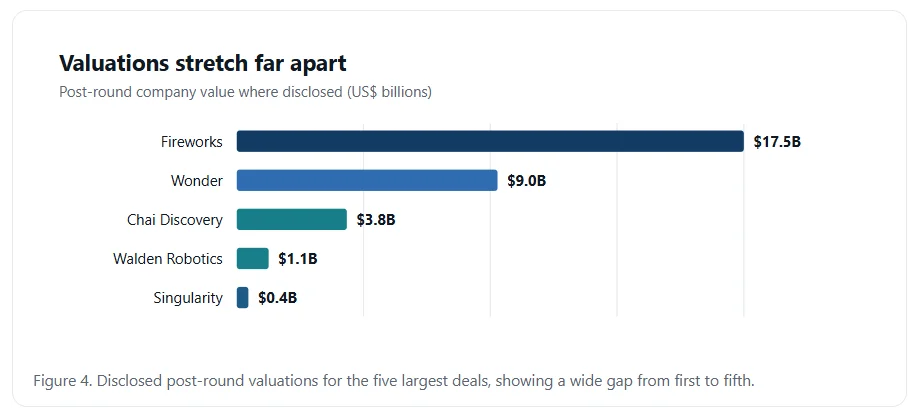
Prices climbed fast across the top deals. Fireworks now holds a $17.5 billion tag, the week’s highest by far. Wonder sits next at $9 billion before new cash. Chai Discovery trails at $3.8 billion. Then Walden and Singularity land near or below the $1 billion mark. Clearly, the gap between first and fifth stays wide.
Sales rarely keep pace with these prices. Fireworks stands out with $1 billion in yearly revenue. Most peers, though, rely on promise more than proof. Therefore, the bar for future growth now sits high.
Why the funding pattern matters
This pileup fits a clear theme across 2026. Backers keep steering cash toward a few AI leaders. However, they also fund nearby fields such as robotics and defense. These sectors lean on the same core models.
Still, such focus brings real risks. When one deal drives 44% of a week, breadth suffers. Meanwhile, seed-stage founders face a harder climb. Big rounds also push values far past sales.
The trend also rewards proven teams above all. Many founders here came from big labs or top firms. So track records now shape who wins large checks. New names, by contrast, must fight harder for cash.
For market watchers, three signals stand out. First, custom AI now pulls in ten-figure checks with ease. Second, robot and defense firms can raise huge seed rounds. Finally, stealth launches often arrive with cash and clients in hand.
What to watch next
Two threads deserve close watch from here. First, robots keep moving from labs to real plants. Walden’s early plant work shows that shift in action. Second, defense keeps pulling private cash at speed. Cheap drones have turned air defense into a hot field.
The week also hinted at a wider base. Food, drugs, banking, and building all drew checks. So the AI wave now reaches many old trades. In short, capital keeps chasing firms that turn models into work. The summer lull never showed up this year. Whether strong returns follow remains an open question.




