

August 13, 2026 – A sovereign investment report reignited the memory trade. Record HBM economics suggest the move rests on more than market sentiment.
In Summary
Temasek plans to raise AI exposure from 6% to as much as 15% by 2031.
SK hynix and Samsung reported record memory results as AI server demand tightened supply.
Micron’s fiscal third-quarter revenue reached $41.46 billion, more than four times the year-earlier level.
A report that Temasek may buy direct stakes in Samsung Electronics and SK hynix lifted global memory stocks.
The AI memory stocks rally matters because advanced memory has become a strategic bottleneck for AI infrastructure.
Temasek has not publicly announced the reported purchases. However, its published investment strategy strongly supports the broader sector thesis.
Why the Rally Matters
The market reaction was not limited to two Korean chipmakers. South Korean equities also surged as investors repriced the country’s AI exposure.
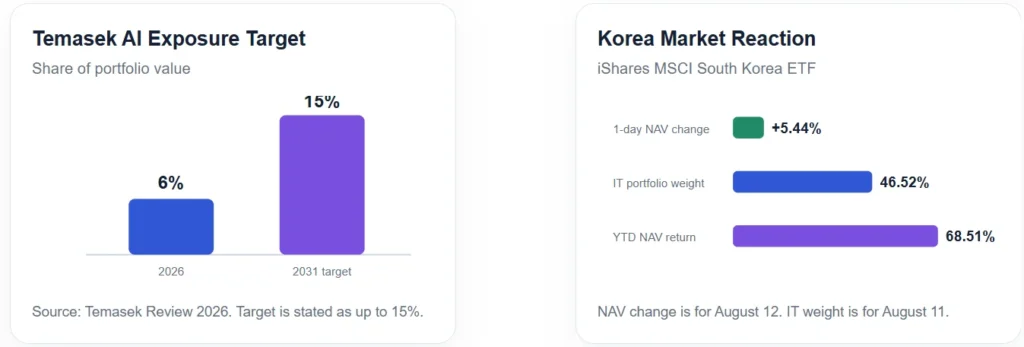
The iShares MSCI South Korea ETF posted a 5.44% one-day NAV increase on August 12. Information technology represented 46.52% of its market value one day earlier. That concentration helps explain the powerful response. Korea holds critical positions across memory, foundry services, displays, batteries, and advanced manufacturing.
The reported Temasek interest also arrived at a sensitive moment. Memory shares had recently corrected after a strong AI-driven run. Temasek’s strategy gives the report additional weight. The fund valued its portfolio at S$518 billion at March 2026. It said AI-related exposure represented 6% of portfolio value.
Temasek aims to increase that allocation to as much as 15% by 2031. That target covers semiconductors, data centres, cloud providers, foundation models, and AI software infrastructure.
The shift is important for capital markets. Large institutional allocations can lengthen investment horizons across highly cyclical semiconductor businesses.
Fundamentals Support the Excitement
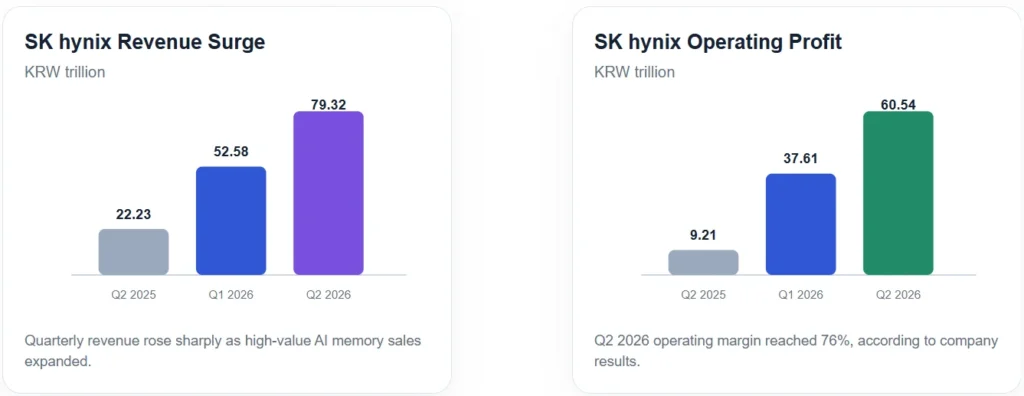
SK hynix offers the clearest evidence of the current memory cycle. Second-quarter revenue reached KRW 79.32 trillion. That was 257% above the same quarter in 2025. Operating profit reached KRW 60.54 trillion, up 557% year over year. The company said AI infrastructure spending drove demand for HBM, AI server DRAM, and enterprise SSD products.
SK hynix also began mass HBM4 shipments during the quarter. It has signed long-term agreements with around ten major customers. Those contracts matter because memory has historically suffered from violent supply cycles. Longer commitments can improve visibility and reduce earnings volatility.
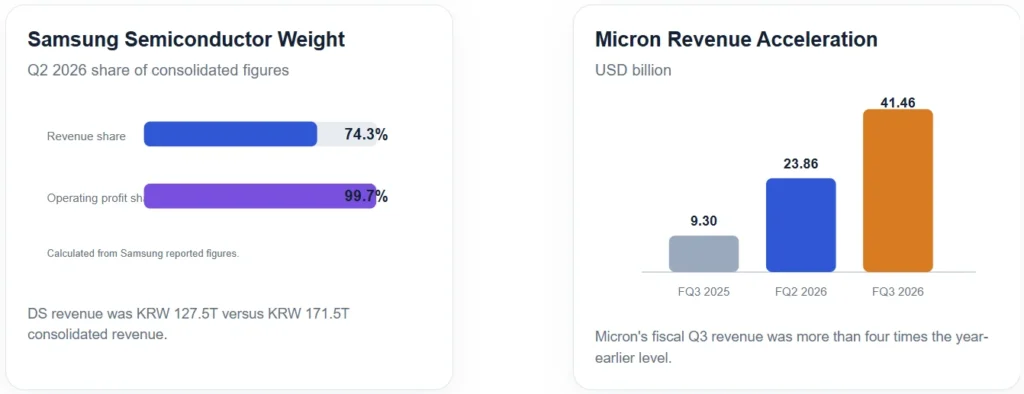
Samsung is seeing similar conditions. Its Device Solutions division generated KRW 127.5 trillion of second-quarter revenue. The division produced KRW 89.2 trillion of operating profit. Samsung said its memory business reached record quarterly revenue and profit.
Management expects server DRAM, enterprise SSD, and HBM demand to remain robust during the second half. The company also warned that supply constraints may continue. That combination is supportive for pricing and margins. The earnings mix is striking. Device Solutions produced about 74% of Samsung’s quarterly revenue and nearly all operating profit. That calculation uses Samsung’s reported Q2 2026 consolidated and Device Solutions figures.
It also explains why memory trends can move the broader Korean market.
Micron Confirms the Global Pattern
The boom extends beyond Korea. Micron reported fiscal third-quarter revenue of $41.46 billion. Revenue was $23.86 billion in the previous quarter and $9.30 billion one year earlier.
Micron’s cloud memory unit generated $13.77 billion. Its core data centre unit added another $11.52 billion. The company guided for $50 billion of fourth-quarter revenue, plus or minus $1 billion.
These figures show why investors increasingly view memory as AI infrastructure rather than a commodity afterthought.
HBM sits next to advanced accelerators and feeds them data at enormous speed. Without enough bandwidth, expensive processors cannot operate efficiently.
This changes the economics of memory. Performance, power efficiency, packaging, and guaranteed supply now influence purchasing decisions alongside price.
What Investors Should Watch
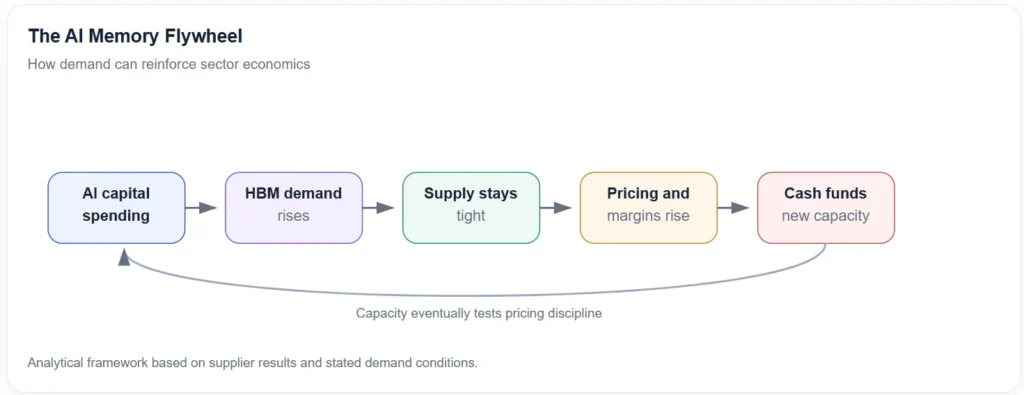
The strongest bull case depends on three conditions. AI capital spending must remain elevated, HBM supply must stay disciplined, and pricing must hold.
The main risk is also clear. Semiconductor cycles can reverse quickly when new capacity arrives or customers digest inventory.
Moreover, reported sovereign investment interest should not be confused with a confirmed transaction.
Temasek’s published materials confirm its AI strategy, not these specific purchases.
Investors should therefore focus on orders, contract duration, HBM4 qualification, capacity additions, and memory pricing.
The current evidence remains constructive. Demand is rising, margins are expanding, and suppliers are securing longer customer commitments.
That makes the latest rally more than a sentiment event. It reflects a market reassessment of memory’s role in the AI value chain.