

July 05, 2026 – U.S. startups raised billions during a short holiday week. Energy and AI infrastructure led the way, while biotech and niche bets filled the rest.
In Summary
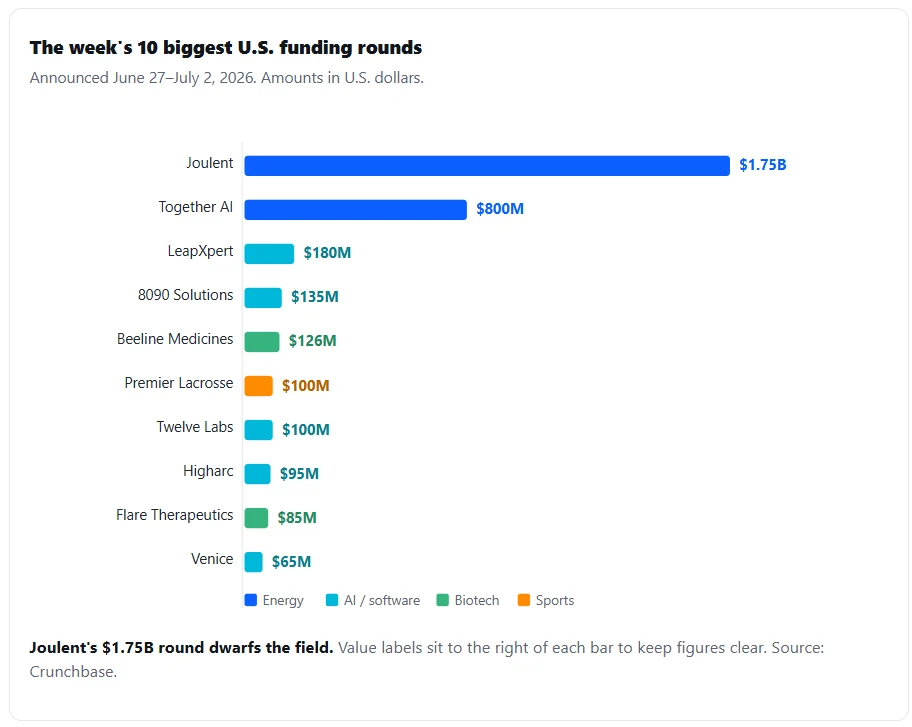
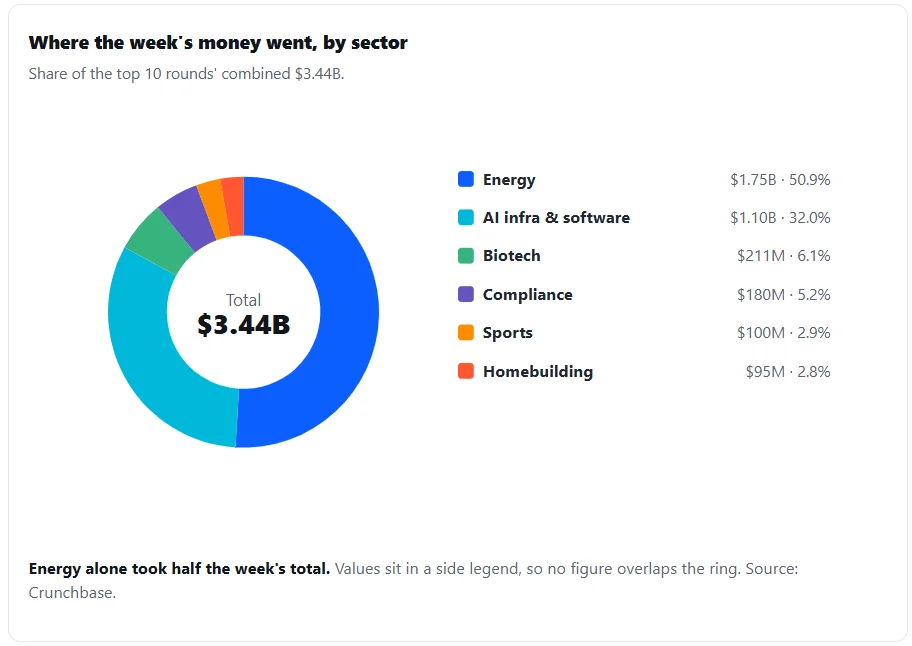
Joulent won the week with a $1.75B deal from National Grid Ventures for a 35% stake.
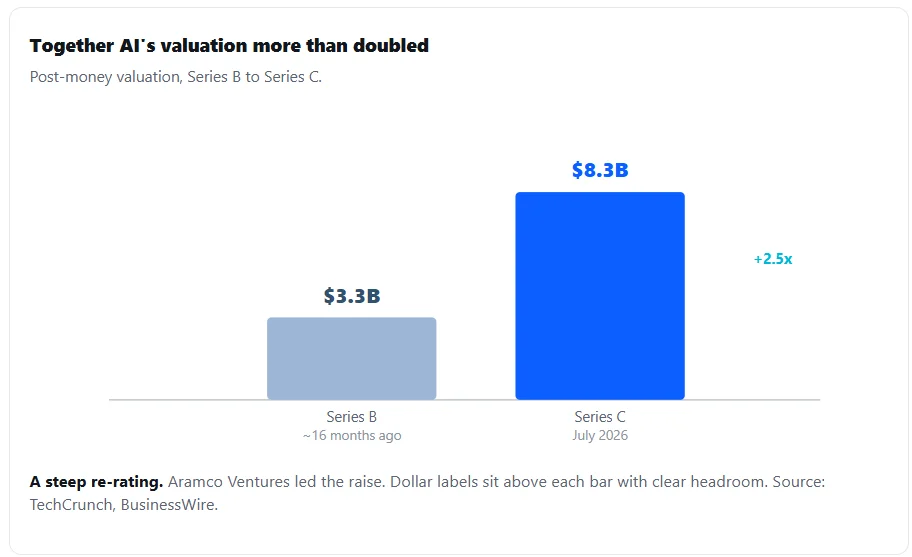
Together AI raised $800M at an $8.3B valuation, with Aramco Ventures leading.
AI drew more than 70% of global venture funding in Q2 2026, up from under 50% a year earlier.
Energy, biotech, compliance, and even lacrosse rounded out the 10 biggest U.S. rounds.
AI and energy funding lead a short week
U.S. startups still raised big sums during the July 4 holiday week. Also, energy and AI led the top deals. Houston-based Joulent won the biggest round. Meanwhile, Together AI took second place. So the week’s 10 largest U.S. rounds show a clear trend. Investors now chase the power and chips behind AI. Clearly, AI and energy funding set the pace for the week. In short, data centers and grids draw huge amounts of money.
This trend is not new. Yet the past week made it sharper. AI took more than 70% of global venture funding in the second quarter of 2026. That share sat just under 50% a year before. Plus, global funding hit a record $510 billion in the first half of 2026. So these rounds sit inside a rare boom. Much of that cash still flows to just a few firms. Even so, the spread is now widening fast.
Joulent lands the biggest check
Joulent raised $1.75 billion in a strategic deal. National Grid backed it through its Ventures arm. In return, the British utility took a 35% stake. Joulent builds power plants for heavy compute users. Notably, its work aims at AI data centers.
The cash backs a project named Kilby. This West Texas site will supply about 2.67 gigawatts. Also, it will feed a Microsoft data center campus. The two firms signed a 20-year power deal. As a result, Joulent gains steady, long-term income. That setup attracts investors seeking safe cash flow.
Chevron and GE Vernova also joined the Kilby build. So the project blends oil, grid, and tech skills. This mix shows how AI now reshapes old fields. Energy deals like this point to a deeper shift. AI models require vast amounts of power to run. Meanwhile, grid links can take years to build. Startups now sell fast, private power instead. In turn, cash flows to firms that move quickly. Utilities gain a stake in rising demand too.
Together AI signals open-source momentum
Together AI raised $800 million in a Series C round. Aramco Ventures led the deal. It set an $8.3 billion value for the firm. For comparison, the firm was worth $3.3 billion just 16 months before. So its value rose about 2.5 times in that span.
This startup rents Nvidia chip clusters to firms. Plus, it helps them run open-source models cheaply. Named clients include Cursor, Cognition, and Decagon. Notably, its yearly bookings just passed $1.15 billion. The firm says some clients cut costs by up to 60%. It also plans to grow its compute by about 50 times in five years.
That raise sends a wider signal. More firms now pick open models over closed ones. Open-source use tripled across the field last year. So hosts like Together AI catch that rising demand. Aramco’s role matters as well. Gulf state money continues to flow into AI worldwide. In fact, sovereign funds now anchor many of the biggest rounds. On the same day, Abu Dhabi’s MGX closed a $49 billion AI fund. Thus, the Gulf’s push into AI continues to gain pace. Nearly three in four firms plan to use more open models, McKinsey says. In turn, that gives hosts like Together AI a long runway.
Biotech and niche bets fill the list
Beyond energy and AI, other fields drew big checks. Boston-based Beeline Medicines took in $126 million in a Series A boost. Bain Capital, CPP Investments, and Bristol-Myers Squibb backed it. Also, the firm develops precision medicines for autoimmune diseases. That round came after an earlier $300 million Series A. Clearly, health startups still pull strong support.
Other deals hit odd corners of the market. LeapXpert raised $180 million for compliance tools. Next, 8090 Solutions took $135 million for AI software work. Meanwhile, the Premier Lacrosse League closed a $100 million round. That deal ranks as the sport’s biggest ever. Plus, Higharc raised $95 million for AI homebuilding tools. The Durham, North Carolina, firm wants faster home design.
Two more rounds show how far AI now reaches. Twelve Labs took $100 million for video-based AI. Separately, Venice raised $65 million for private access to AI. That deal set a $1 billion value for the young firm. Venice, based in Wyoming, is only two years old. Flare Therapeutics also took $85 million for cancer work. In each case, a clear niche drew fresh money.
Exits return as the cycle broadens
The exit market also turned a corner this year. In the second quarter, SpaceX went public at a $1.77 trillion valuation. That listing raised $75 billion for the rocket firm. As a result, it ranks as the largest venture-backed IPO ever. Stronger exits give backers a way to cash out. In turn, fresh money can flow back into new deals.
This week backs up a few sharp trends. First, AI now shapes almost every big round. Even homes and video deals carry an AI tie. Second, energy has become an AI story, too. Power plants now rival software for the top spot. Third, the field spans far more than chatbots.
Still, a few giants shape the totals most. OpenAI and Anthropic alone took 43% of all funding in early 2026. Plus, 16 firms raised billion-dollar rounds last quarter. Those deals made up 53% of the quarter’s total. Yet smaller rounds like these show the boom spreading. Cash now reaches biotech, compliance, and hard assets. Real estate and even sports now join the list too. So the AI wave touches more of the economy.
What the week means for investors
Watch the rest of the year with care. More big energy deals seem likely to follow. AI firms will keep hunting for cheap, steady power. Open-source hosts should also grow their share. So this mix may define the months ahead.
Investors should still weigh the risks with care. Values have climbed fast across the field. Meanwhile, exits stay mixed for many young firms. Some deals may yet be priced too high. Even so, these rounds point to a broad, steady appetite. For now, AI and energy funding keep the lead.




