

June 02, 2026 – Big Tech hyperscalers are borrowing at record pace across Europe, Japan, and Switzerland to fund AI infrastructure. The global corporate bond market is being permanently reshaped.
In Summary
Amazon raised €14.5 billion in the largest-ever euro corporate bond deal, per LSEG data.
Hyperscaler non-dollar bond funding doubled to 30% of total issuance, per Bank of America.
Morgan Stanley forecasts €50 billion in European hyperscaler debt for 2026.
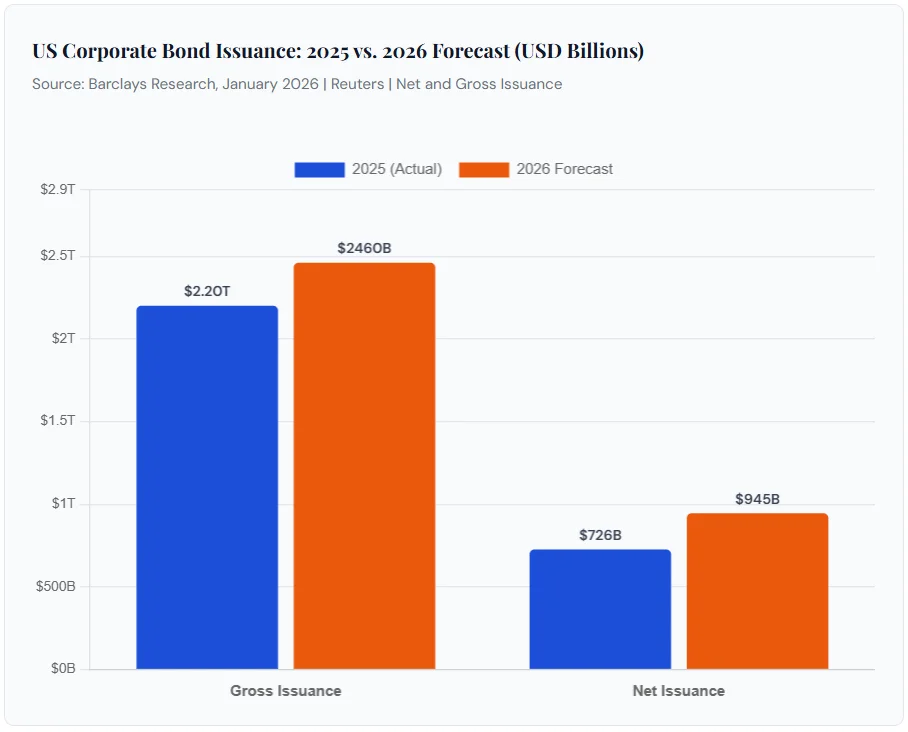
Barclays projects US corporate bond issuance will rise 11.8% to $2.46 trillion in 2026.
Alphabet already ranks as the fourth-largest sterling corporate bond borrower after just one issuance round.
Big Tech is rewriting the rules of global finance. The need for artificial intelligence infrastructure is pushing the world’s largest companies into bond markets everywhere. These companies are borrowing at record pace across Europe, Japan, and Switzerland. The $40 trillion corporate debt market is feeling the full force of this shift. Furthermore, this trend is accelerating fast. Hyperscalers are tapping foreign bond markets at a truly unprecedented scale.
The term “hyperscalers” refers to Big Tech companies like Amazon, Alphabet, Meta, Oracle, and Microsoft. They need enormous capital to build data centers and energy systems. These systems power the global AI boom. Traditional cash reserves are no longer sufficient. Therefore, they are turning to global bond markets for funding.

Record Bond Deals Across Markets
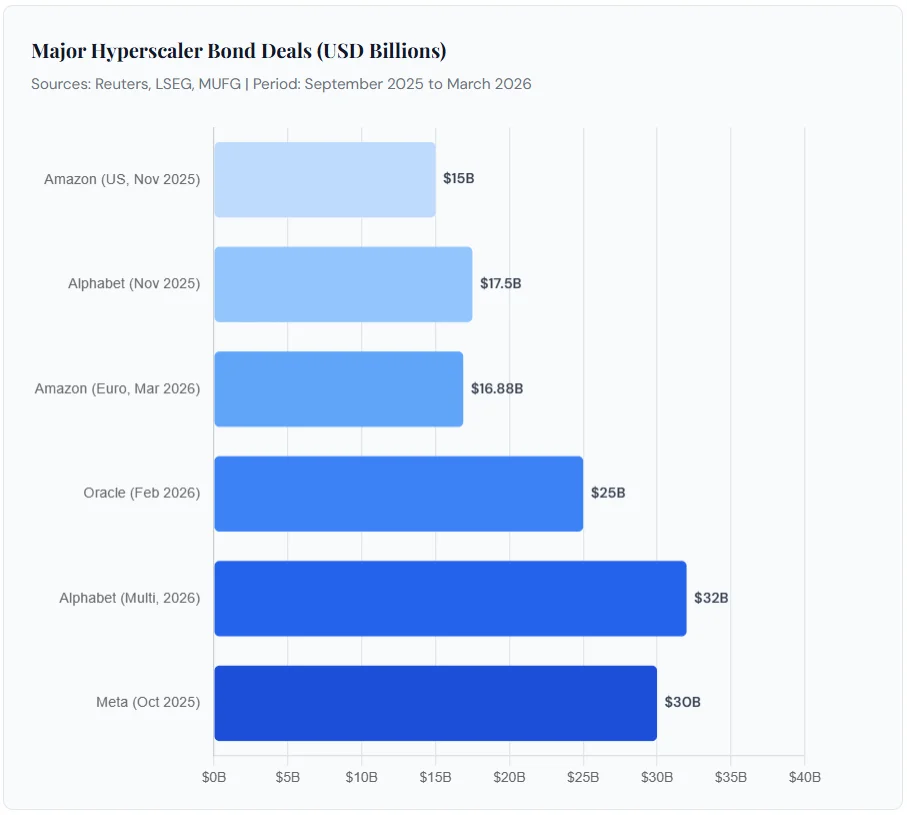
Amazon made history in March 2026. The company raised €14.5 billion ($16.88 billion) from an eight-part deal. According to LSEG data cited by Reuters, this was the largest-ever euro corporate bond deal. Additionally, Alphabet has set records in four key currency markets. These include the yen, Canadian dollar, Swiss franc, and sterling.
The record deals extend well beyond Europe. Meta completed a $30 billion bond deal in October 2025. This remains the largest single non-merger-related high-grade bond sale in history. It attracted $125 billion in investor demand. Oracle raised $18 billion in September 2025. Alphabet then raised $17.5 billion in November. Therefore, more than $100 billion in hyperscaler bonds hit markets in just three months.
US non-financial companies have issued more than €60 billion in euro-denominated debt this year. Reuters reports this is already a new annual record. Morgan Stanley estimates US companies could overtake France as the euro zone’s top corporate debt source.
Why Hyperscalers Are Going Global
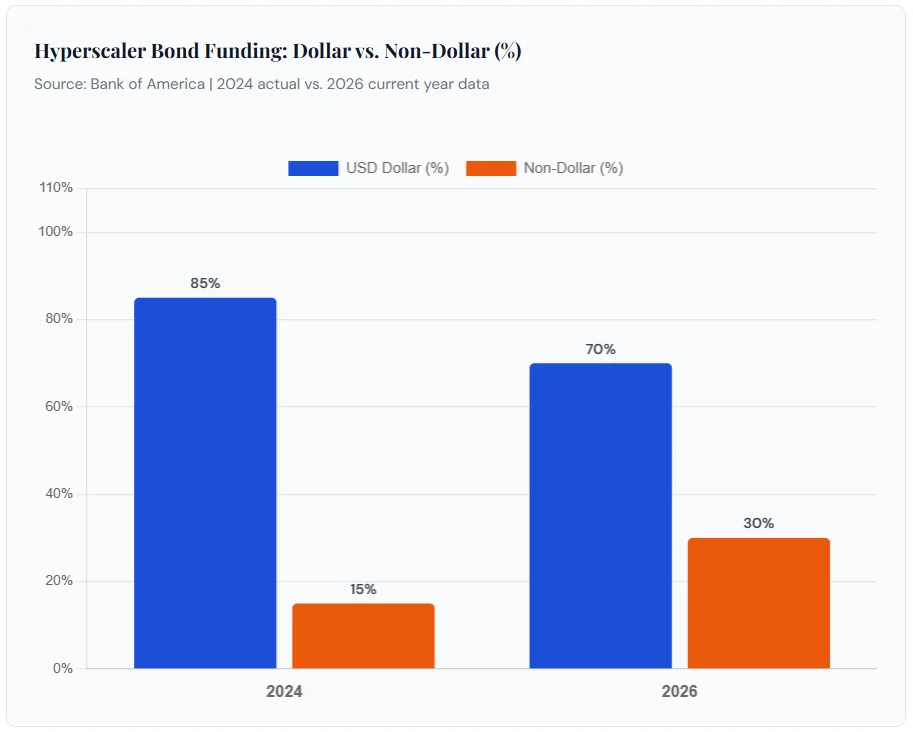
Hyperscalers have a clear strategic reason for borrowing abroad. They want to diversify funding sources beyond the US dollar. According to Bank of America, non-dollar issuance has doubled this year. It now makes up 30% of total hyperscaler bond funding. Previously, non-dollar deals accounted for just 15%.
Borrowing in foreign currencies also helps companies hedge currency risk. Many hyperscalers hold significant global assets. Matching local liabilities with local funding makes financial sense. Furthermore, European borrowing costs are sometimes lower than US rates. Bankers confirm that companies are largely keeping funds in the currency in which they were raised.
“A lot of these markets have evolved and now offer a lot more depth and opportunity for larger capital raising than was historically the case.”
-John Servidea, Global Co-Head of Investment Grade Finance, JPMorgan
Morgan Stanley expects around €50 billion of total hyperscaler euro borrowing in 2026. This could make US companies the largest source of corporate debt in the euro zone. Additionally, borrowing has surged in Australian and Hong Kong dollars. International companies are rapidly diversifying funding sources. Investors are also shifting focus away from the US dollar amid geopolitical uncertainty.
Investors Rush to Build AI Exposure
Investors are actively embracing this trend. Many want exposure to AI-linked credit in their home markets. Tech names previously had a very limited presence in European bond indices. However, that is changing quickly.
Nicolas Forest, chief investment officer at Candriam, is buying into euro hyperscaler deals. He aims to build exposure to the technology sector within the European bond framework. Additionally, Alphabet’s rise in bond indices has been remarkable. By April 2026, it ranked as the fourth-largest borrower in the ICE BofA sterling corporate bond index. It achieved this remarkable position after just one round of issuance. The sixth-largest spot in Swiss franc indices followed similarly.
“Some of these companies are already going to become among the biggest issuers globally in any currency.”
-Giulio Baratta, Co-Head of Investment Grade Finance, BNP Paribas
Risks Investors Cannot Ignore
Not everyone views this boom without caution. Heavy borrowing puts pressure on bond performance. Analysts note that hyperscaler bonds are underperforming the broader US corporate bond market. Furthermore, credit default swap costs are rising sharply. According to MUFG analysts, Oracle’s five-year CDS cost has more than tripled since its September 2025 deal.
Bondholders have also taken legal action against Oracle. They argue the company failed to disclose its significant AI-driven debt plans. David Zahn, head of European fixed income at Franklin Templeton, issued a clear warning. “If there are any problems with AI, it will probably create more volatility,” he said. Therefore, the AI bond boom carries real risks for fixed income investors everywhere.
What the Forecast Shows
The broader outlook remains bullish for 2026. Barclays forecasts US corporate bond issuance will reach $2.46 trillion this year. This represents an 11.8% increase from $2.2 trillion in 2025. Net issuance is set to rise 30% to $945 billion. The Big Five hyperscalers are projected to borrow $140 billion annually, according to Bank of America.
According to Vontobel’s Christian Hantel, this transformation is far from temporary. “The AI-driven transformation of the bond market is expected to accelerate in the coming months,” he said. Consequently, global fixed income markets will increasingly reflect the fortunes of artificial intelligence.
Investors, issuers, and policymakers are all watching closely. The AI infrastructure race is not just a technology story. Furthermore, it is now a defining force in the global fixed-income market. The world’s bond markets are being reshaped in real time.