

April 22, 2026 – AI’s power hunger is overwhelming the same grids that clean energy is destabilizing. BloombergNEF has named 12 startups it believes can solve both problems at once.
In Summary
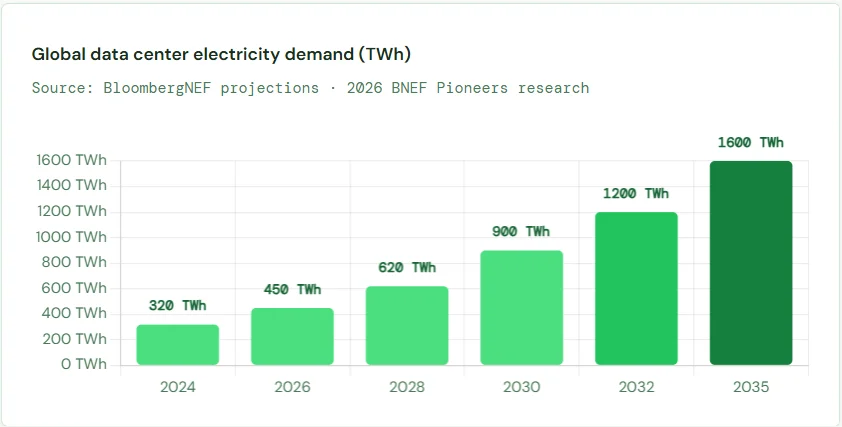
AI and clean energy are on a collision course; data centers will use 1,600 TWh by 2035, 5× the UK’s current consumption.
Renewables are crashing solar prices 40% below spot in Spain, slowing the very investment the grid needs.
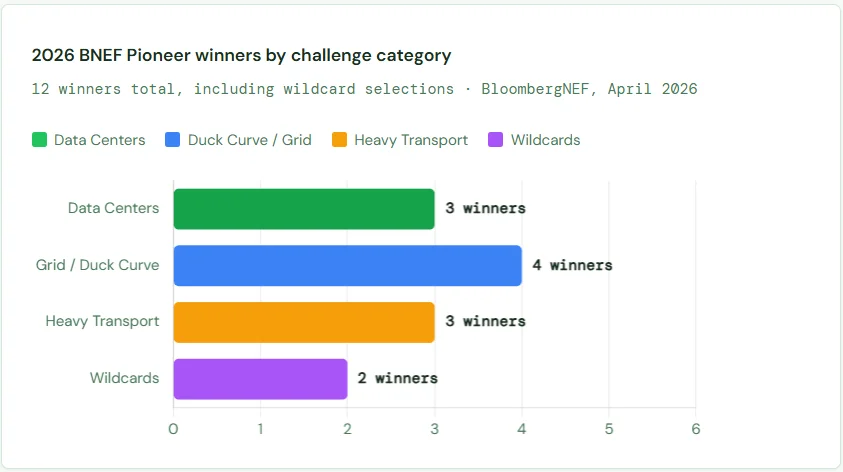
BloombergNEF named 12 startups as 2026 Pioneer Award winners, chosen from 611 entries across 66 markets.
Winners target three systemic crises: data center power demand, grid instability, and fossil-locked heavy transport.
176 past BNEF Pioneer alumni have raised over $25 billion, and the program has a proven track record of picking winners.
Artificial intelligence is consuming electricity faster than grids can supply it. At the same time, solar and wind power built to fix that problem are creating dangerous new instabilities. BNEF expects data center power demand to more than double to 106 gigawatts by 2035. That is the paradox sitting at the heart of the 2026 energy transition.
Into that paradox, BloombergNEF has named 12 startups as its 2026 Pioneer Award winners. Chosen from over 600 applications across 66 markets, each company targets one of three critical bottlenecks: AI data centers burning through clean power, renewable grids that crash prices and slow investment, and heavy transport that still runs almost entirely on diesel.
Together, BNEF argues, these 12 companies show that the world is increasingly running on electrons and that there is still a strong business case to keep funding the transition, even amid geopolitical fragmentation.

Challenge 1: The AI Energy Problem
Artificial intelligence is eating the world’s electricity. BNEF projects that data centers will consume 1,600 terawatt-hours of electricity by 2035. That figure equals roughly 4.4% of all projected global electricity demand. It is comparable to the power consumption of some of the world’s largest economies today.
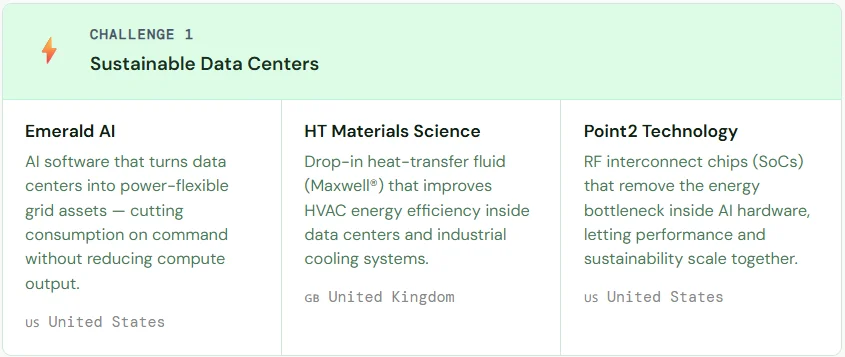
Two 2026 winners tackle this head-on. Emerald AI uses artificial intelligence to cut power consumption in data centers without reducing computing performance. Across five commercial data center demonstrations, its system proved it can slash power on demand. Point2 Technology takes a different approach: its RF interconnect chips reduce the energy bottleneck in AI hardware, enabling performance and sustainability to scale together.
Challenge 2: Flattening the Duck Curve
Solar and wind power create a dangerous imbalance on the grid. When the sun peaks at midday, supply surges and prices crash. At dusk, demand spikes and the grid scrambles. This is the “duck curve”, a shape familiar to any grid operator.
The problem is already real. In Spain, where renewables supply 50% of the electricity mix, solar prices averaged 40% below spot market rates over the past 12 months. That gap kills investment in new clean energy projects.
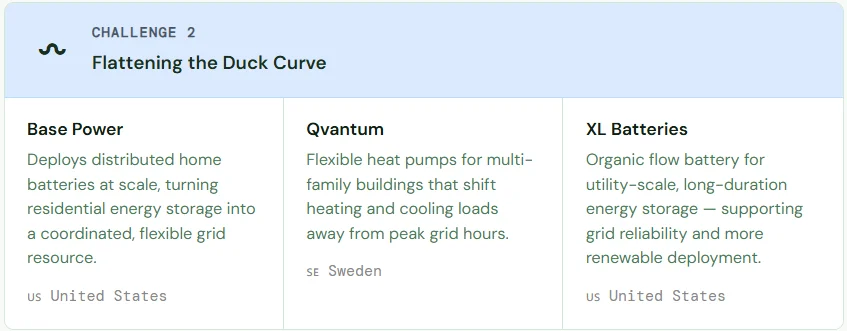
Winners in this category include Base Power, which deploys distributed home batteries to act as a coordinated, grid-scale resource. Qvantum is reimagining heat pumps as a flexible load tool. XL Batteries offers an organic flow battery built for utility-scale, long-duration storage.
Challenge 3: Cleaning Up Heavy Transport
Shipping and long-haul trucking are among the hardest sectors to decarbonize. They need energy-dense fuels, and their infrastructure is fragmented globally. BNEF expects heavy transport emissions to fall by roughly a quarter by 2050 through fuel switching and electrification. But further innovation is needed to reach net zero.
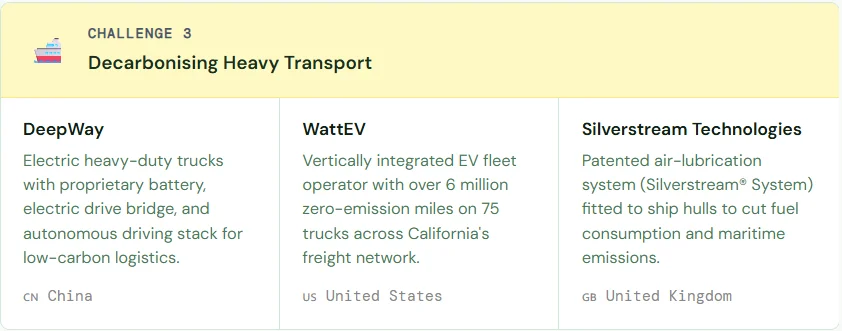
DeepWay, a Chinese electric heavy-duty truck maker, won for its proprietary battery and autonomous drive stack. Other finalists covered wind-assist ship tech and hull-optimization systems. The category shows how geographically diverse clean solutions have become.
“New technology innovation remains of paramount importance during times of volatile energy prices and trade tensions.”
— Claire Curry, Global Head of Technology, Industry & Innovation, BloombergNEF
Wildcards: The Unexpected Bets
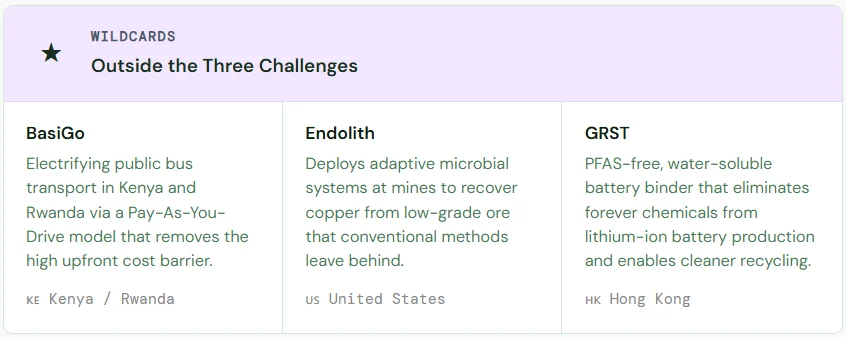
Not every breakthrough fits a neat category. BNEF’s wildcard selections reward left-field climate innovation. This year’s wildcards include an electric bus company operating in Africa, a startup using microbes to lower the impact of copper mining, and a firm cutting “forever chemicals” (PFAS) from battery production.
Together, these wildcards suggest that the energy transition is no longer limited to solar panels and wind farms. It reaches into mining, transport infrastructure, and materials science.
2026 BNEF Pioneer Award Winners at a Glance
Why This Matters: $25 Billion and Counting
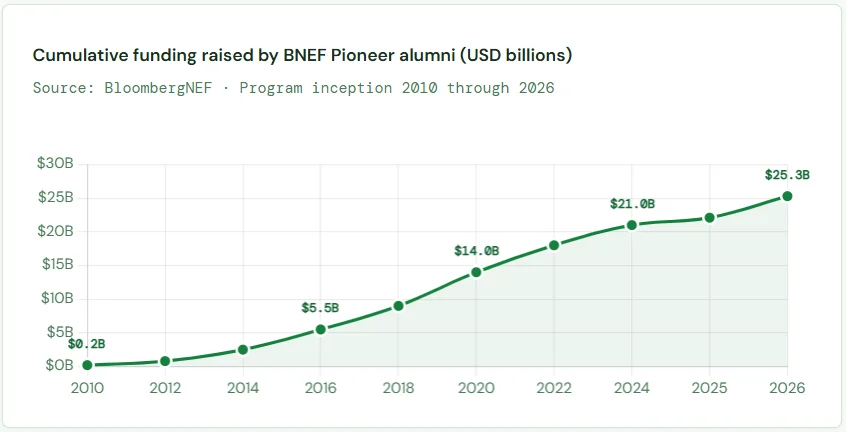
The BNEF Pioneers program started in 2010. Since then, 176 companies have won the award. These alumni have collectively raised over $25 billion in funding. The program has become a reliable signal for venture capital and institutional investors looking for early-stage climate bets.
This year’s competition received over 600 applications. A panel of BNEF analysts and Bloomberg Green editors assessed each entry on three criteria: emissions impact, technology originality, and likelihood of adoption at scale. That rigorous filter is what gives the Pioneer label its weight in the market.
The Bottom Line
The 2026 BNEF Pioneer Award winners reflect a market under pressure. AI is driving electricity demand to record highs. Renewable energy is creating new grid instabilities. Heavy transport still runs on diesel. Each winning company is building a direct answer to one of these problems. Together, they map a credible path through the most complex phase of the energy transition.
For investors, operators, and policymakers, the 2026 Pioneer list is more than a recognition ceremony. It is a precise reading of where the capital and the urgency are flowing next.