


August 19, 2026 – The Russell 2000 closed at an all-time high on 14 August. Weak consumer data and cooling wholesale prices did the heavy lifting.
In Summary
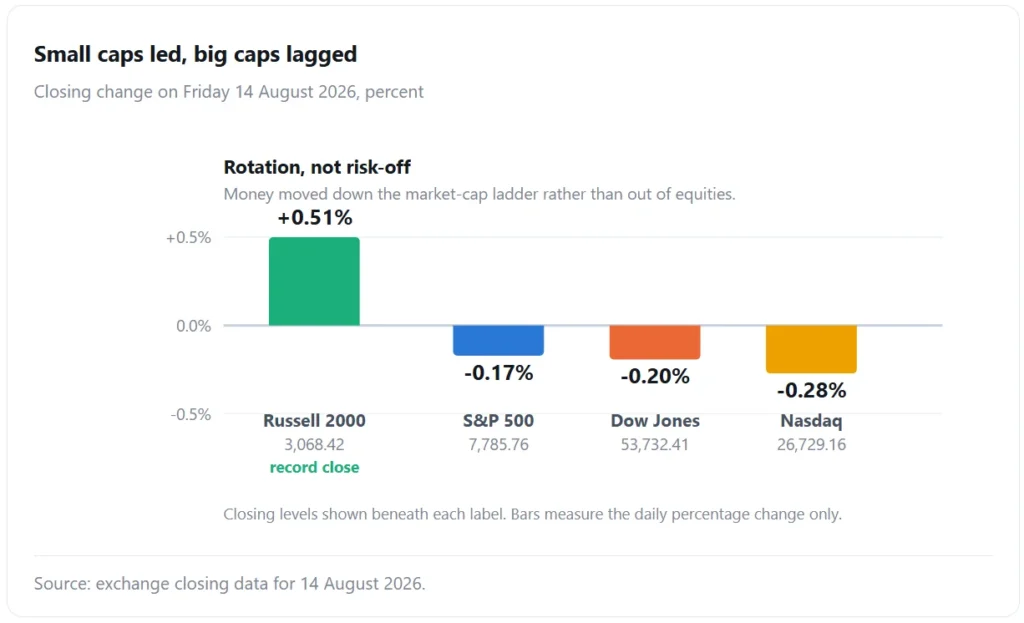
The Russell 2000 rose 0.51% to a record close of 3,068.42 on 14 August 2026. Meanwhile, the three large-cap benchmarks all finished lower.
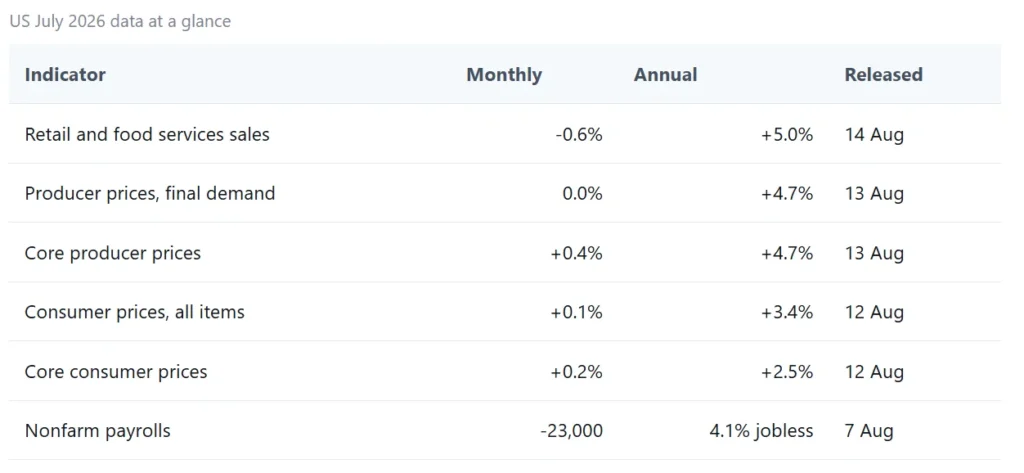
US retail sales fell 0.6% in July to $763.6bn, the first monthly drop in months. Yet sales still ran 5.0% above July 2025.
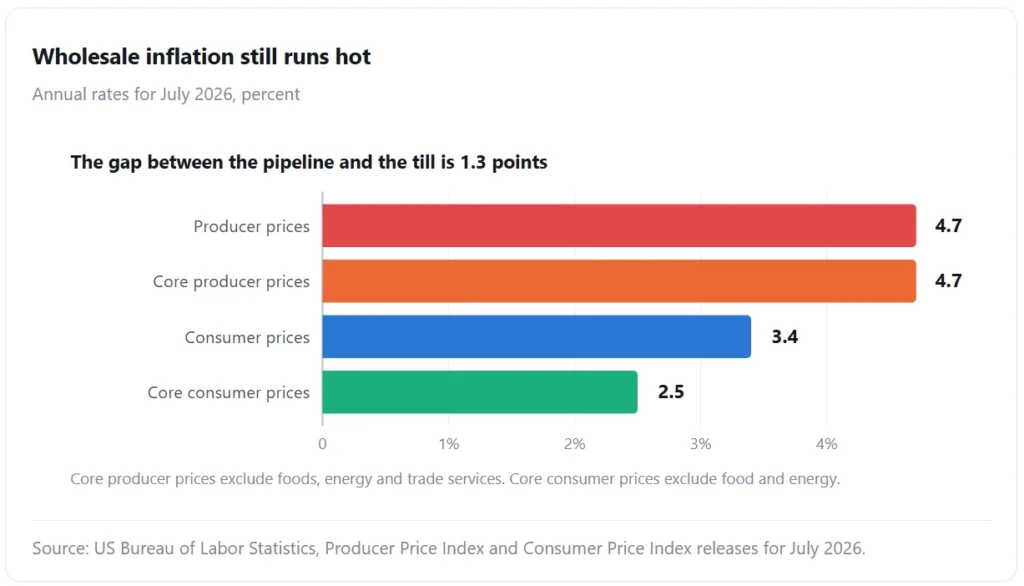
Producer prices were unchanged in July, although the 12-month rate held at 4.7%. Core producer prices rose 0.4% in the month.
Nonfarm payrolls fell by 23,000 in July. Revisions cut May and June by a combined 103,000 jobs.
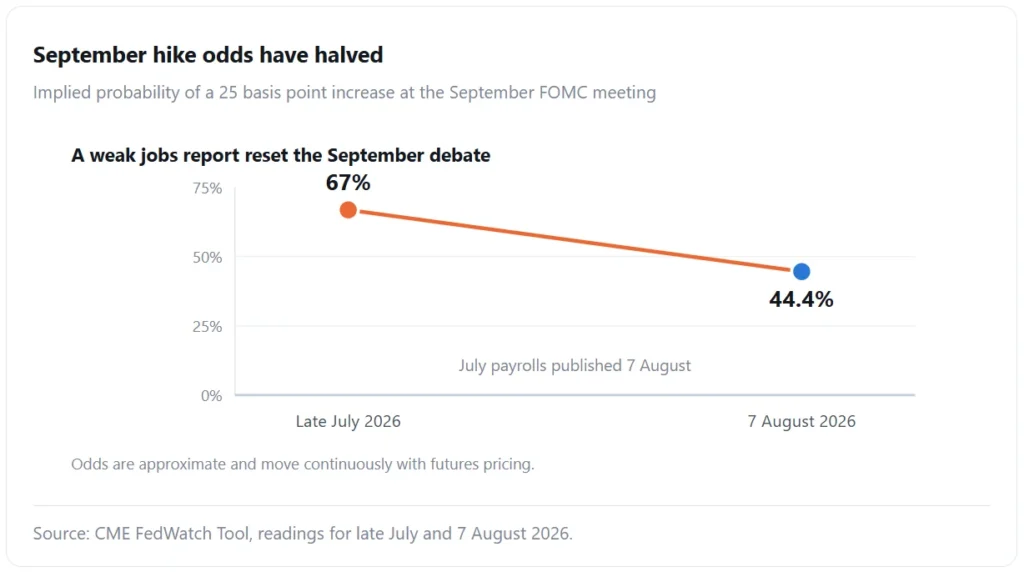
Odds of a September rate rise fell from about 67% in late July to 44.4% on 7 August, according to CME FedWatch.
The 10-year Treasury yield eased to 4.63% on 13 August from 4.72% on 10 August. Even so, it remains historically elevated.
A small caps record is an unusual thing to celebrate in a week of soft economic data. Nevertheless, that is exactly what happened. The Russell 2000 climbed 15.57 points, or 0.51%, to close at 3,068.42 on Friday, 14 August 2026. It set fresh intraday and closing highs in the same session.
Large caps went the other way. The S&P 500 slipped 13.23 points to 7,785.76, one day after breaking above 7,800 for the first time. Blue chips fared no better, as the Dow Jones Industrial Average fell 107.58 points to 53,732.41. Lastly, the Nasdaq Composite gave up 73.86 points to 26,729.16.
The consumer finally blinked
The Census Bureau released July retail and food services sales on 14 August. Total sales came in at $763.6bn, down 0.6% from June. Economists had expected a small gain, so the miss landed hard.
Context tempers the alarm. Sales still stood 5.0% above July 2025. The three months to July ran 6.3% ahead of the same period a year earlier. Excluding motor vehicles, sales fell only 0.3% in the month while rising 5.8% over the year. Furthermore, the Census Bureau flagged that the monthly confidence band includes zero.
Investors read the drop as a rate signal rather than a recession signal. A cooler consumer takes pressure off prices. In turn, that lowers the case for another rate rise. Equity markets treated the miss as good news, at least for smaller companies.
Two inflation gauges, two stories
Consumer inflation looks tame. Headline consumer prices rose just 0.1% in July and 3.4% over 12 months, while core prices rose 0.2% and 2.5%. Wholesale prices tell a rougher tale. Producer prices were flat for the month, yet the annual rate sat at 4.7%.
Underneath, the mix was uneven. Final demand goods prices fell 0.7%, services rose 0.2%, and construction jumped 2.2%. Core producer prices, which strip out food, energy, and trade services, climbed 0.4% in a single month. Consequently, margin pressure has not disappeared for goods producers.
Why the Fed conversation flipped
Investors spent July worrying about a rate rise, not a rate cut. The Federal Open Market Committee held its target range at 3.50% to 3.75% on 29 July, its fifth straight hold. Three officials dissented in favour of a quarter-point increase.
Then the labour market cracked. Payrolls fell by 23,000 in July, against forecasts of a gain near 85,000. Revisions removed a further 103,000 jobs from May and June. Unemployment held at 4.1%, and average hourly earnings rose 3.2% over the year to $37.62.
The July meeting was far from unanimous. Three officials, Beth Hammack, Neel Kashkari, and Lorie Logan, voted for a quarter-point rise. The final tally came in at 9 to 3. Such a split is rare, and it shows how uneasy the committee has become.
Rate-sensitive small companies gain most from a softer path. Smaller firms carry more floating-rate debt. They also earn most of their revenue at home. Therefore, a Fed that stops threatening to tighten lifts its profit outlook faster than it lifts a global giant’s.
Scale explains part of the gap as well. A mega-cap tech name already prices in years of growth. By contrast, many small firms trade near book value. So a modest change in the rate outlook moves their shares far more.
Bonds are not fully convinced
Treasury yields eased, though they hardly collapsed. The 10-year yield fell to 4.63% on 13 August from 4.72% on 10 August. Longer-dated yields remain elevated because of heavy federal borrowing rather than because of inflation fear alone.
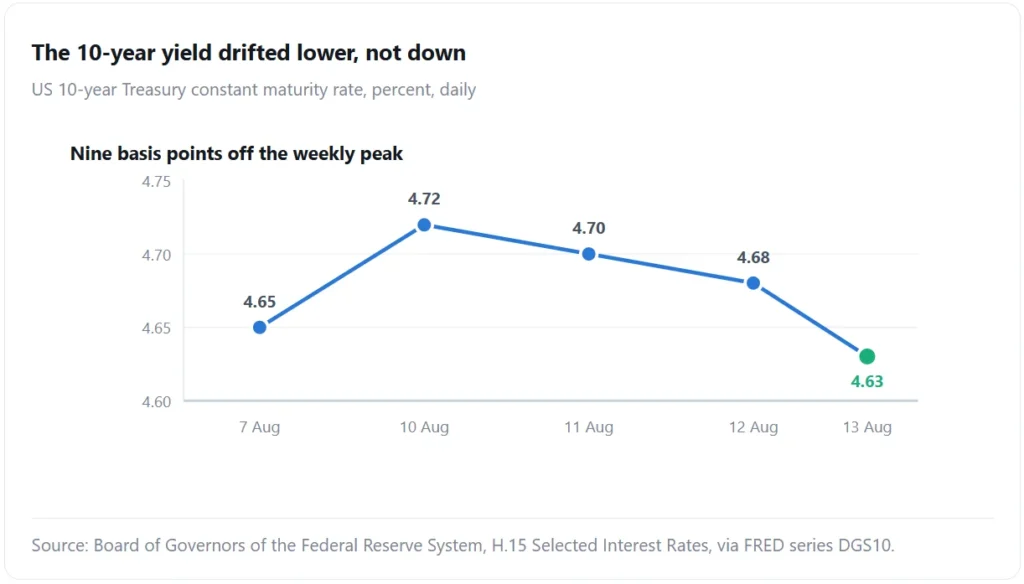
Two forces pull yields apart. Softer growth argues for lower yields. Heavy Treasury issuance argues for higher ones. For now, the second force is winning at the long end.
Energy adds another complication. Brent crude settled near $87.19 a barrel on 14 August. West Texas Intermediate traded around $81.71. Supply worries around the Gulf keep a floor under both grades. As a result, the goods disinflation seen in July may not repeat in August.
The growth picture is still solid
One number cuts against the gloom. Nominal economic growth ran at 6.5% over the year to the second quarter. Company revenue tracks nominal growth, not the inflation-adjusted figure. Therefore, sales lines should hold up better than the headlines suggest.
Jobs data also needs care. A single negative month rarely marks a turn. Local government education shed 50,000 posts in July, and that swing often reflects timing rather than demand. Health care, by contrast, added 22,000 roles.
What investors should watch
Three signals will decide whether the rotation holds. Firstly, the minutes of the July FOMC meeting arrived on 19 August. They will reveal how close the committee came to a rise. Secondly, August payrolls will test whether July was noise or a trend. Thirdly, quarterly guidance from consumer-facing companies will show whether the retail sales dip reached earnings.
For now, breadth is improving. A market where 2,000 smaller companies set records alongside a near-record S&P 500 looks healthy. It beats one carried by a handful of names. Investors should still respect the warning in the data. Consumers slowed, hiring stalled, and wholesale inflation stayed near 5%.




