


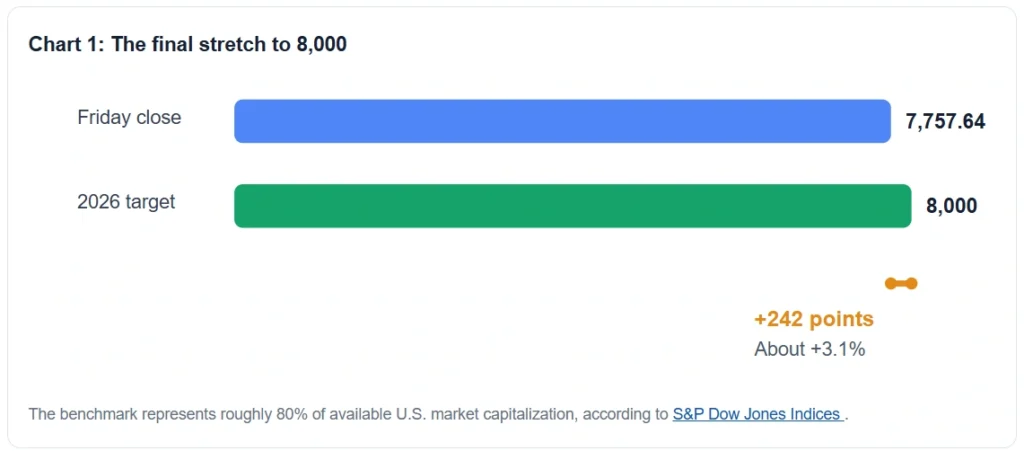
August 12, 2026 – JPMorgan has lifted its 2026 S&P 500 target to 8,000 after another powerful earnings season. The call leaves limited upside from current levels. However, the earnings assumptions beneath the target have become far more bullish.
In Summary
JPMorgan raised its year-end S&P 500 target from 7,800 to 8,000.
The target implies about 3.1% upside from Friday’s 7,757.64 closing level.
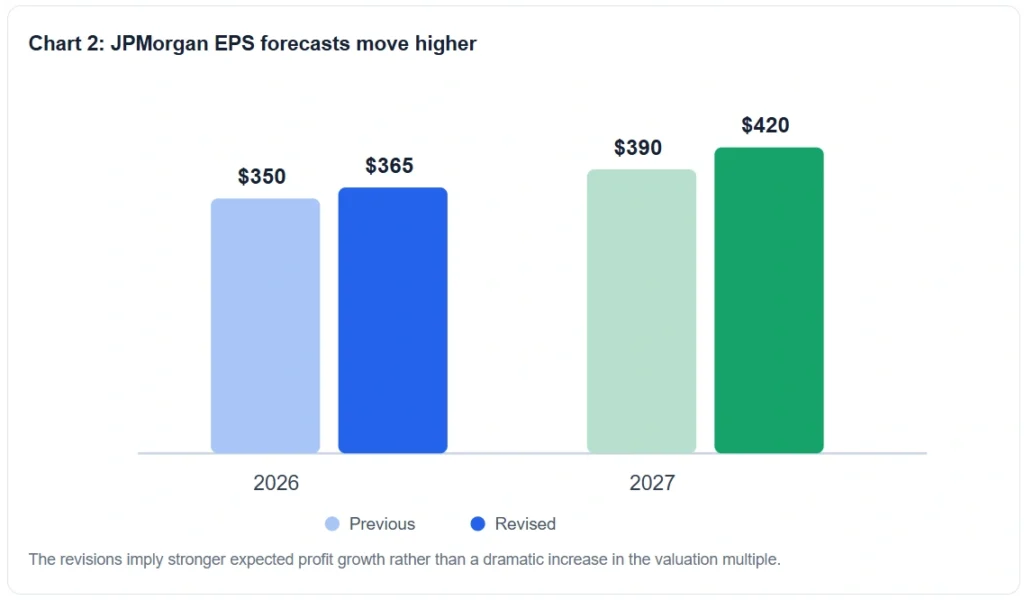
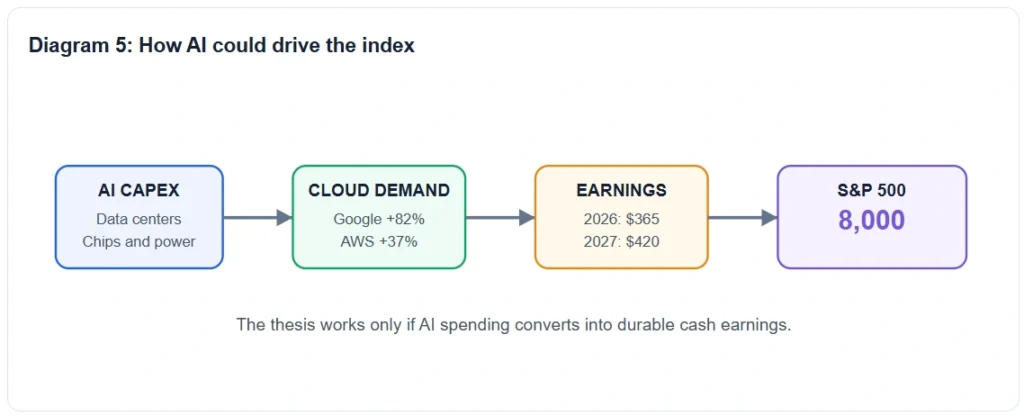
The 2026 EPS forecast rises from $350 to $365.
The 2027 EPS estimate increases from $390 to $420.
AI cloud growth strengthens the earnings case, while high rates restrain valuations.
Why the S&P 500 target matters
The S&P 500 ended Friday at 7,757.64, leaving only 242 points to the new target. Therefore, this forecast is not primarily a call for valuation expansion. Instead, it depends on stronger corporate profits.
J.P. Morgan’s public mid-year outlook had projected 7,800 and 2026 earnings per share of $350. The latest strategy revision lifts both assumptions.
The 2026 EPS estimate now stands at $365. That is $15 above the earlier forecast. Meanwhile, the 2027 estimate rises to $420 from $390. That represents roughly 15% earnings growth from 2026.
Earnings are doing the heavy lifting
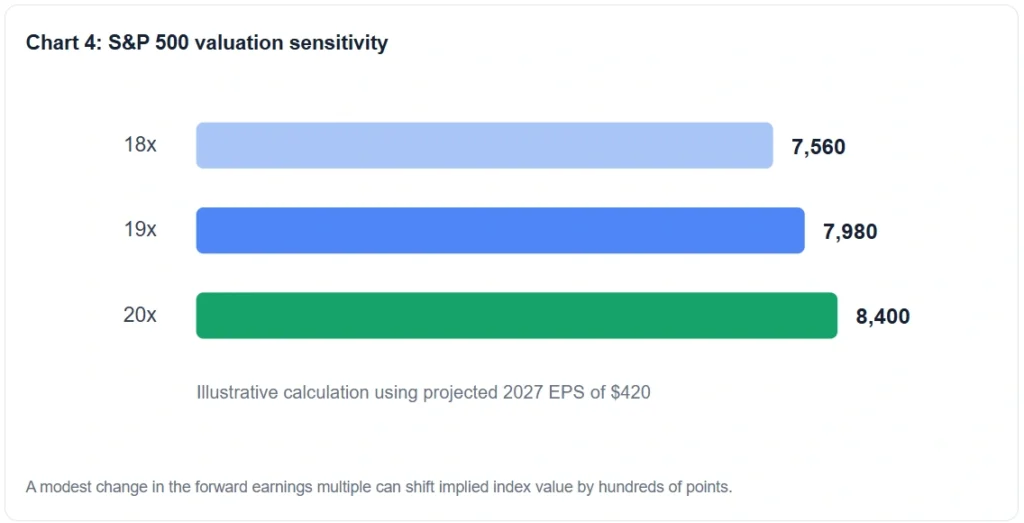
At 8,000, the index would trade near 19 times projected 2027 earnings. That fits a roughly 20-times forward valuation framework. Therefore, earnings delivery matters more than another major valuation rerating.
AI is becoming an earnings story
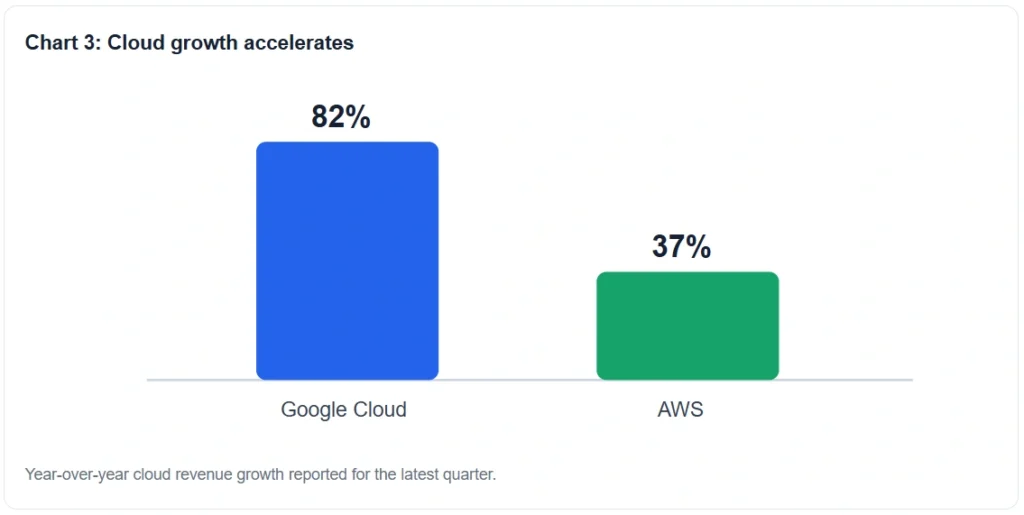
The strongest evidence comes from cloud computing. Alphabet reported that Google Cloud revenue jumped 82% year over year. Cloud revenue reached $24.8 billion during the second quarter.
Its backlog also reached $514 billion. The company expects more than half to become revenue within 24 months. Those figures come directly from Alphabet’s second-quarter earnings call .
That backlog matters because it represents contracted future demand. Therefore, AI spending now has a clearer bridge toward recognized revenue.
Amazon showed another strong trend. AWS revenue increased 37% to $42.2 billion during the second quarter. That marked its fastest growth in 18 quarters.
AWS operating income also reached $16.6 billion. However, the spending burden remains substantial. Amazon reported a trailing free-cash-flow outflow of $7.6 billion.
The company linked much of that pressure to artificial intelligence infrastructure investment. The figures appear in Amazon’s official second-quarter results .
Valuation leaves little margin for error
Valuation mathematics shows why execution remains critical. Using $420 of projected earnings, every one-turn multiple change moves value by about 420 points.
At 18 times earnings, the same forecast implies roughly 7,560. At 20 times, it implies approximately 8,400. That range highlights the importance of interest rates.
Rates still cap market enthusiasm
The Federal Reserve kept its policy rate between 3.5% and 3.75% in July. It also said inflation remained above its 2% objective.
The Federal Reserve’s July statement therefore supports caution around further valuation expansion.
Higher discount rates reduce the present value of future earnings. That effect matters most for companies with profits concentrated far into the future.
Large technology companies also face enormous financing requirements. They must fund data centers, chips, networking equipment, and electricity infrastructure.
What could push the S&P 500 higher?
The clearest upside route is faster earnings growth without another valuation rerating. Cloud backlogs must convert into revenue while operating margins remain resilient.
Broader sector participation would also make the rally more durable. The S&P 500 covers about 80% of available U.S. market capitalization.
Therefore, sustained gains should eventually extend beyond a small group of technology leaders. That would reduce concentration risk and improve the rally’s quality.
Investors should now watch three signals. First, cloud backlog conversion must remain strong. Second, AI capital spending must improve operating leverage.
Third, earnings growth must broaden beyond the largest technology platforms. If those conditions hold, 8,000 could become a waypoint rather than a ceiling.
The downside case is equally clear. AI spending could rise faster than cash generation. Rates could remain elevated, while geopolitical shocks could pressure margins.
The 8,000 target looks achievable, but it leaves little room for disappointment. The next rally phase now depends on profits, cash flow, and measurable AI returns.




