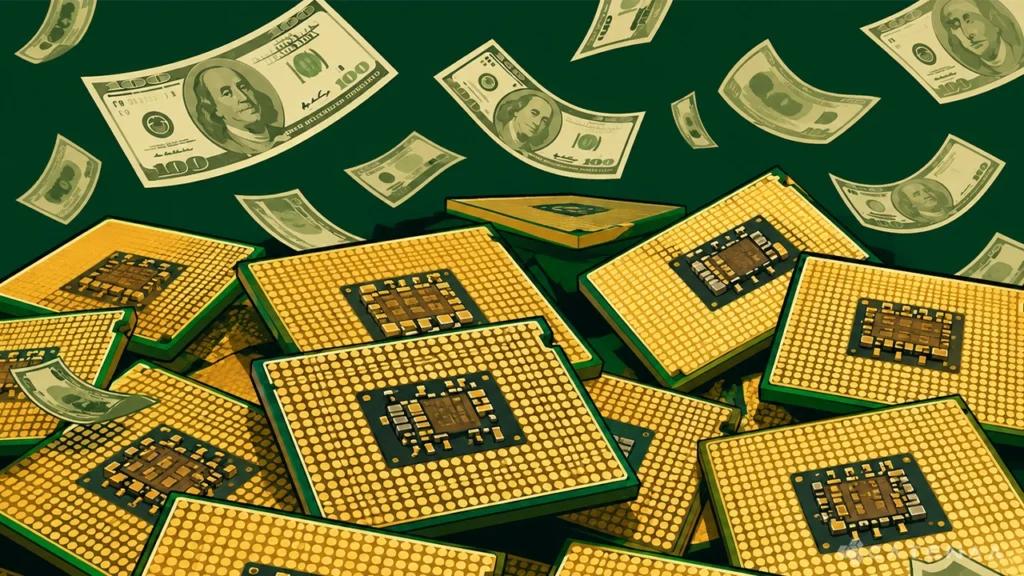


Catenaa, Friday, May 15, 2026- Global chip stocks fell after a summit between US President Trump and Chinese leader Xi Jinping concluded without major chip deals or a breakthrough on Nvidia’s exports.
Washington authorized Nvidia to export its H200 chips to China, though Beijing hasn’t formally approved shipments.
Expectations of a breakthrough had been building after Nvidia Chief Executive Jensen Huang joined a delegation of high-profile CEOs, including Apple’s Tim Cook and Tesla’s Elon Musk, who traveled to China with Trump.
Danni Hewson, Head of Financial Analysis at AJ Bell, wrote in market comments that investors were betting on the trip for tangible news that could lift Nvidia’s sales even further.
However, US Trade Representative Jamieson Greer said in an interview with Bloomberg that Nvidia and semiconductors weren’t front and center during the summit.
Nvidia shares fell more than 3% Friday, with other semiconductor stocks like Intel and Advanced Micro Devices down 6.8% and 4.1%, respectively.
In Asia, shares of South Korean memory-chip maker SK Hynix, which supplies Nvidia, closed 7.7% lower.
In Europe, STMicroelectronics, which supplies Apple, Tesla, and SpaceX, shed 5.4%, while German chip maker Infineon Technologies fell 5.5%. Shares of Dutch semiconductor-equipment maker ASML Holding declined 5%.
The selloff marks a rare dent in the gloss that has permeated chip stocks in recent weeks as investors continued to pour money into companies that provide semiconductors and equipment for the data centers behind the artificial-intelligence boom.
Shares of chip company Cerebras Systems soared in their stock-market debut on Thursday, underscoring investor fervor over AI.
Washington has resorted to export controls to curb China’s access to advanced semiconductors that could be used for military applications or make significant leaps in AI, prompting Beijing to look inward and encourage domestic firms to switch to homegrown hardware.
While the US now allows Nvidia to export its H200 chips, President Trump told reporters on Air Force One that China hadn’t bought any “because they chose not to. They want to try and develop their own.” Greer said in the interview with Bloomberg that it was a “sovereign decision for China” whether or not to buy from Nvidia.
“They’re very committed to domestic production,” he said, noting that the Chinese often see US high tech as a threat. “If we’re ahead of the game, like we are on AI chips, sometimes they feel that that can stop their own growth. Obviously, we think it can be helpful to them in the long run, but they’ll just have to make their decision on that.”




