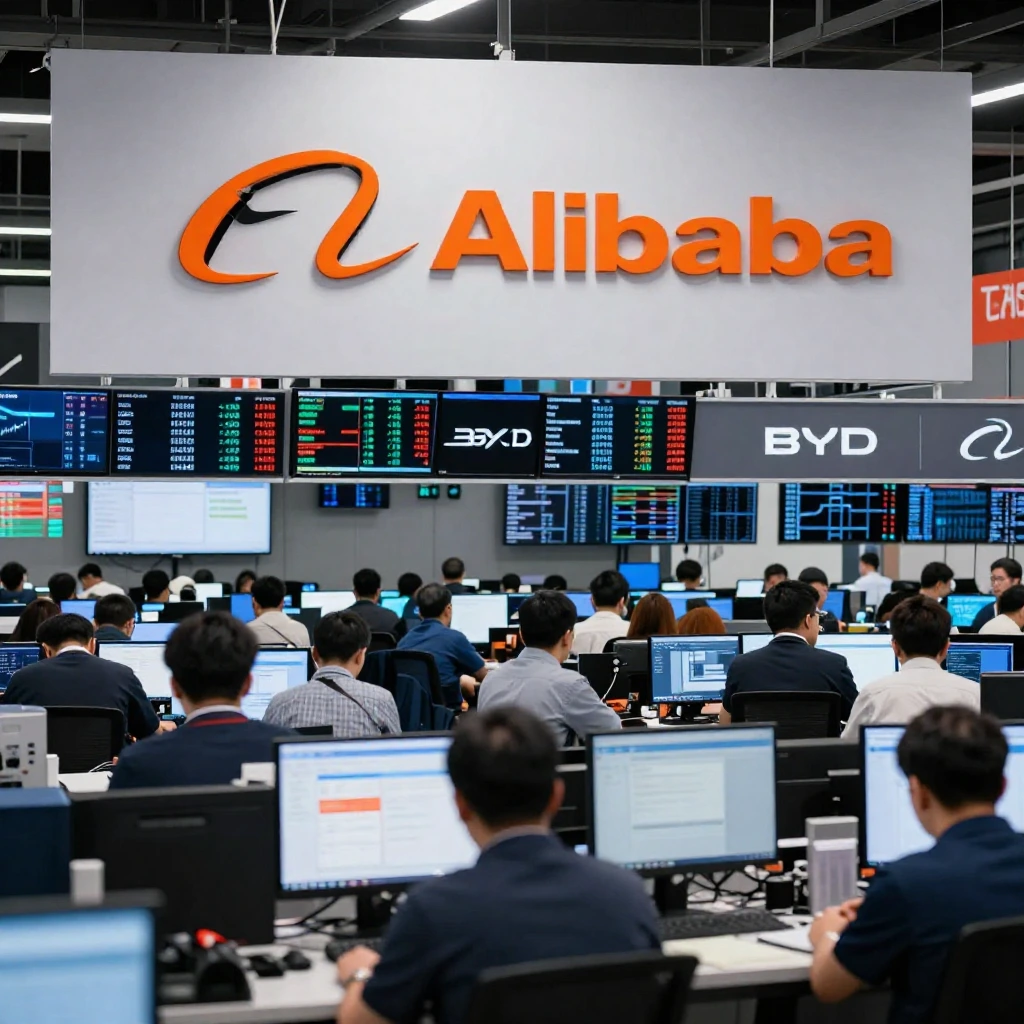


Catenaa, Sunday, May 17, 2026- Alibaba stock could be one of the more balanced ways to participate in the AI boom, with other stocks leading the charge coming with high growth potential, high expectations, rich valuations, and significant volatility.
One of the biggest risks in AI investing is uncertainty. Many investors value companies based on what AI might become, rather than what it is today. Alibaba offers a different profile.
In its December 2025 quarter, the company reported cloud revenue growth of roughly 36% year over year, driven largely by AI-related workloads.
Management also disclosed that AI workloads have been growing at triple-digit rates for the 10th consecutive quarter, suggesting that the trend is sustainable.
This matters because it reduces speculation about the future. Alibaba is not just talking about AI. It is already generating real, measurable demand. Above all, it’s already making money.
Unlike many AI-focused companies, Alibaba is not dependent on a single growth engine. Its e-commerce platforms, including Taobao and Tmall, may no longer be high-growth businesses.
Still, they remain large, deeply embedded in China’s digital economy, and capable of generating recurring cash flow.
That creates an important distinction from other pure-play AI companies. Alibaba can invest aggressively in AI and cloud infrastructure without relying on external capital. In other words, it can support its AI ambitions with its internal cash flow, without depending on raising more capital in the near future.
Another factor that makes Alibaba’s position unique is its broad participation in the AI ecosystem. The company is building across multiple layers, such as Infrastructure, Models, Tools, platforms, and Applications.
This vertical integration allows Alibaba to benefit from AI in two ways: as a provider of infrastructure and tools, and as a user within its own ecosystem. That combination gives Alibaba a competitive edge in the AI race.
Calling Alibaba a “safer” AI play does not mean it has zero risk. As a start, competition is extremely intense domestically, as most tech incumbents — such as ByteDance, Tencent, and Huawei — and newcomers like MiniMax are eyeing a share of this emerging industry.
At the same time, Alibaba’s investment in AI infrastructure will weigh on short-term profitability. Building data centers, scaling computing capacity, and developing AI models all require significant capital in the coming quarters, if not years.
And broader factors, including China’s economic environment and investor sentiment — remain outside the company’s control. In short, investors will need to accept these risks when investing in the stock.
Alibaba is not the most obvious AI stock. But that may be exactly what makes it worth considering. It offers a combination that is relatively rare in today’s market, which real AI-driven demand, an existing cash-generating business and more measured investor expectations.
That combination doesn’t necessarily make it the highest-upside AI play. But it may make it one of the more balanced and safer ones. In a market where many AI stocks are generally priced for perfection, Alibaba stock stands out as an attractive risk-reward opportunity.