

July 29, 2026 – Futures give a two-in-three chance the Fed holds at 3.50% to 3.75% today. Our data-driven read: the statement, not the rate, will set the tone for a live September.

In Summary
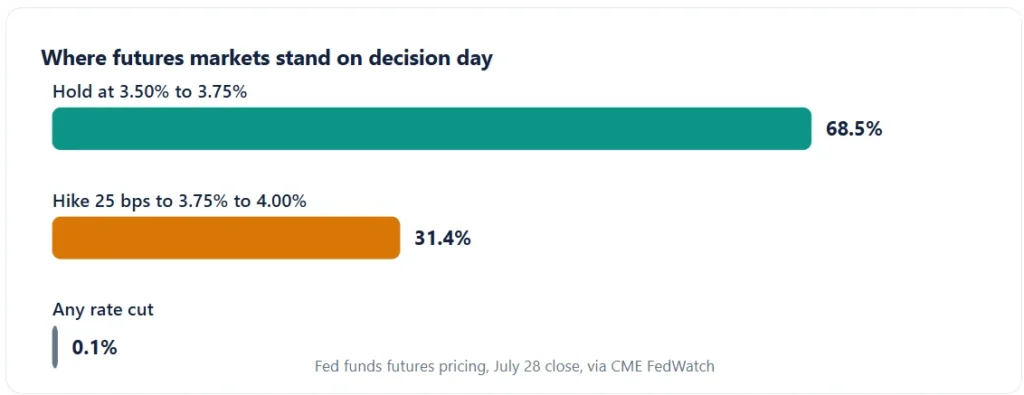
Markets price a 68.5% chance the Fed holds rates at 3.50% to 3.75% today, per CME FedWatch.
Hike odds tripled to 35.4% in nine days after Brent crude briefly topped $100, then eased with oil.
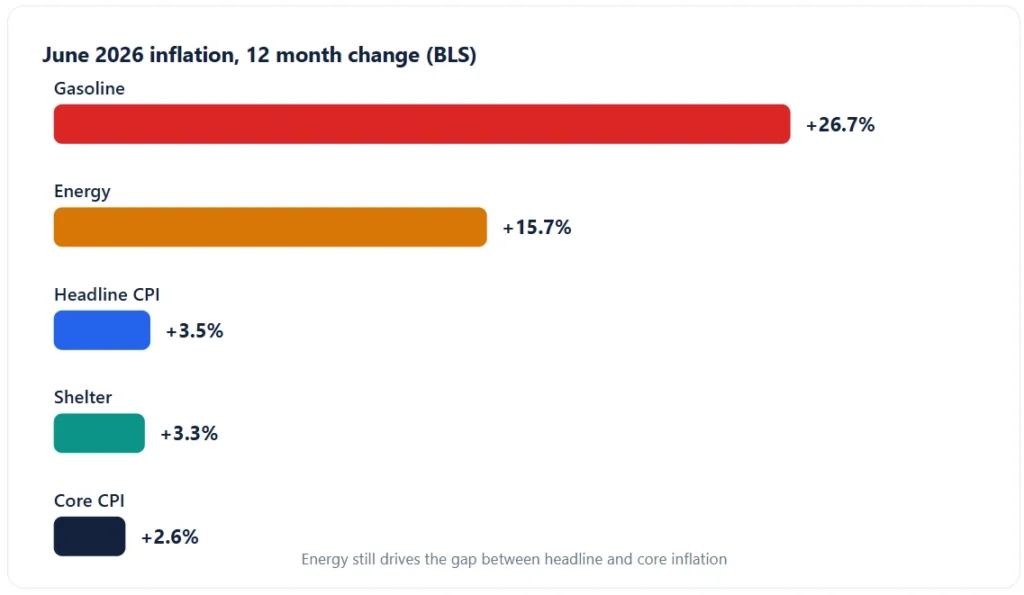
June CPI cooled to 3.5% and core to 2.6%, but energy still ran 15.7% higher over the year.
Payrolls rose just 57,000 in June, and nine of 18 Fed officials still project a 2026 hike.
Our forecast: a hawkish hold today, with September as the first truly live hike meeting.
The Fed rate decision lands today at 2:00 p.m. ET, and markets expect a tense hold. Futures traders assign roughly a two-in-three chance that the target range stays at 3.50% to 3.75%. However, the path to this meeting was anything but calm. Hike odds nearly tripled in just nine days during July. Therefore, today’s statement matters far more than the rate itself.
This is only Kevin Warsh’s second meeting as Fed chair. Moreover, he has scrapped the forward guidance playbook that markets leaned on for a decade. As a result, traders must read today’s language without a map. That uncertainty explains why pricing has swung so violently into the announcement.
Markets Price a Nervous Hold
The CME FedWatch tool tells the story in three snapshots. On July 15, futures implied just a 10.7% chance of a quarter-point hike. By July 24, that probability had jumped to 35.4% after Brent crude briefly topped $100 a barrel. Then oil retreated sharply this week, and hold odds recovered to near 68.5% by Tuesday’s close.
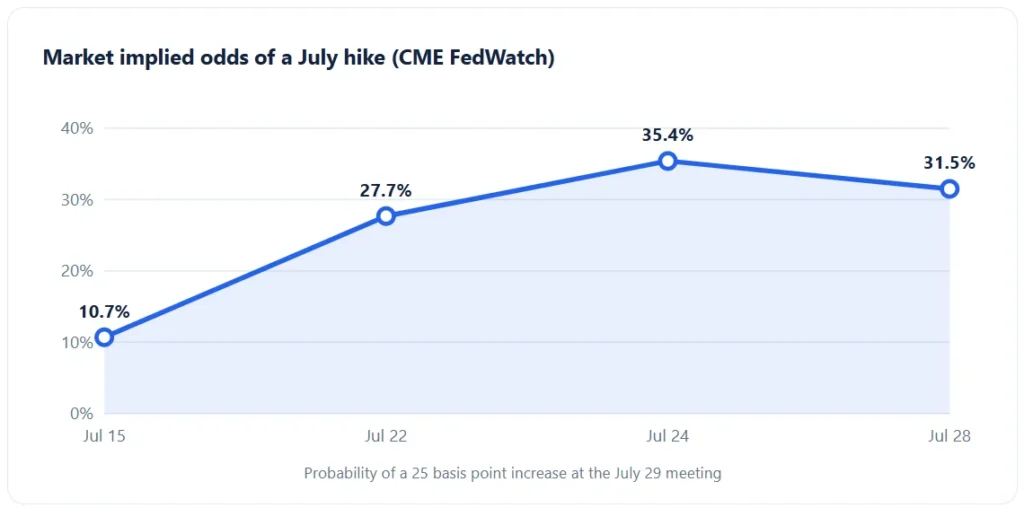
Consequently, the debate is no longer about a cut. Futures assign effectively zero probability to easing today. Instead, traders are split between a hold and a quarter-point rise to 3.75%-4.00%. In other words, the committee’s first tightening debate since 2023 is now live. Minutes from the June meeting show dealers expected no change until 2027 before oil intervened.
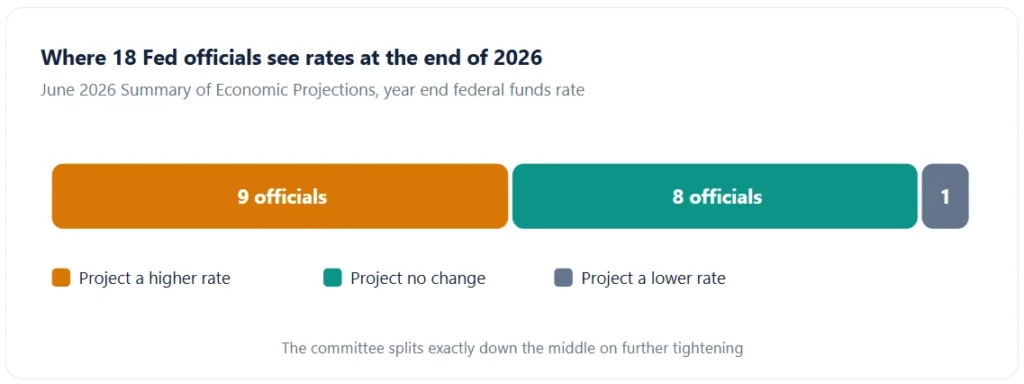
The committee itself looks divided. According to the Fed’s June projections, nine of 18 officials pencilled in a higher rate by year-end. Meanwhile, eight saw no change, and only one projected a cut. That near-even split is why every word of today’s statement will move markets.
Inflation Data Cuts Both Ways
June inflation gave both camps ammunition. Headline CPI rose 3.5% over the year, down sharply from 4.2% in May, according to the Bureau of Labor Statistics. Core prices climbed 2.6%, also cooler than the prior month’s 2.9% pace. On the surface, therefore, the disinflation story looks intact.
Yet the details are less friendly. Energy prices still rose 15.7% over the year, and gasoline surged 26.7%. Furthermore, the June relief came largely from an energy pullback after the U.S. and Iran paused hostilities. That truce remains fragile, and Red Sea shipping threats have not disappeared. A renewed oil spike could push headline inflation straight back above 4%.
Our platform calculation adds useful context here. The effective federal funds rate stands at 3.63%, while core annual CPI runs at 2.6%. Therefore, the inflation-adjusted policy rate sits near one percentage point. That stance is restrictive, but only mildly so against a fresh supply shock. For hawks like Warsh, who told Congress the committee has no tolerance for persistent inflation, that cushion may look thin.
Labor Market Flashes Yellow
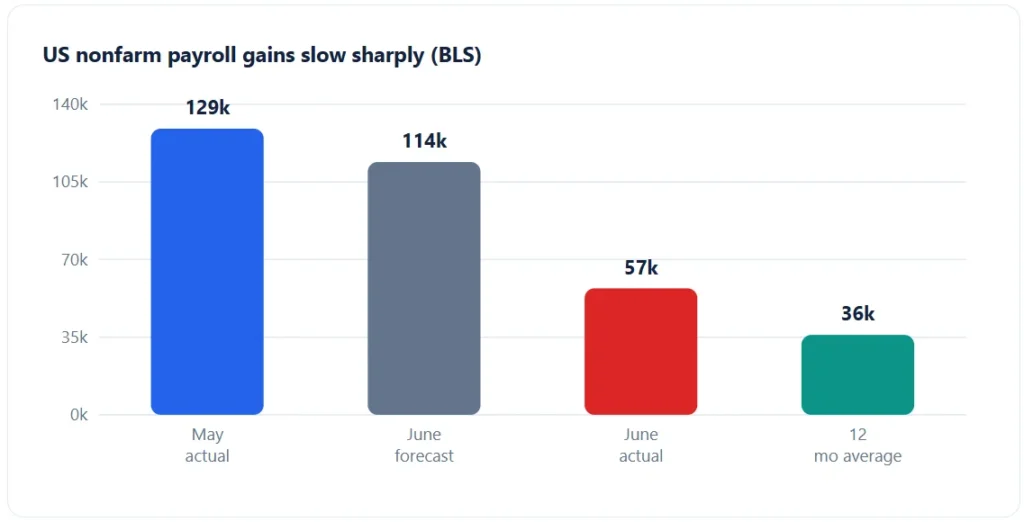
The other side of the mandate argues for patience. Employers added just 57,000 jobs in June, well below the prior month’s 129,000 gain. In addition, revisions erased 74,000 jobs from the April and May counts. Hiring now runs close to the 36,000 monthly average of the past year. By historical standards, that pace signals a clearly cooling jobs engine.
Admittedly, the unemployment rate ticked down to 4.2%. However, that decline reflects a shrinking labor force rather than strong demand. Participation has fallen to 61.5%, the lowest level since early 2021. Wage growth of 3.5% also looks consistent with cooling, not overheating.
Hence the committee’s dilemma. Raising rates into a softening job market risks turning a slowdown into a slump. Conversely, ignoring an oil-driven price shock risks a repeat of the credibility damage from 2021 and 2022. A hold with hawkish language splits that difference at minimal cost.
Why the Fed Rate Decision Points to September
Our base case is straightforward. We expect the committee to hold at 3.50% to 3.75% today, matching market pricing. Additionally, we expect the statement to flag upside inflation risks from energy and to drop any easing bias. Warsh will likely use the 2:30 p.m. press conference to keep a September hike firmly on the table.
The September meeting, therefore, becomes the real decision point. Futures already lean toward at least one quarter-point increase by then. Two data streams will settle the question. First, July and August CPI will reveal how much of the oil shock reached consumer prices. Second, the next two jobs reports will show whether June’s hiring stall was noise or trend.
The market’s own behaviour supports this timeline. Hike odds collapsed once oil fell back toward $84 this week. As a result, energy is now the single most important variable in the Fed’s reaction function. Watch Brent crude, not the dot plot, for the next policy signal. Crude near $84 keeps a hold intact, while a return above $100 would reprice everything.
What could break our forecast? A surprise hike today would do it, and one large trading desk has argued for exactly that shock move. Such a step would cement Warsh’s inflation-fighting credentials in one stroke. Still, moving against two-thirds of market pricing at his second meeting would be a bold gamble. New chairs rarely spend credibility that way.
The bottom line is simple. Expect a hold today, but read it as a pause before tightening rather than the end of the story. The committee’s center of gravity has shifted toward higher rates for 2026. Unless the labor market deteriorates quickly, the next move is more likely up than down. For crypto and risk assets, that means the liquidity headwind has not lifted yet.