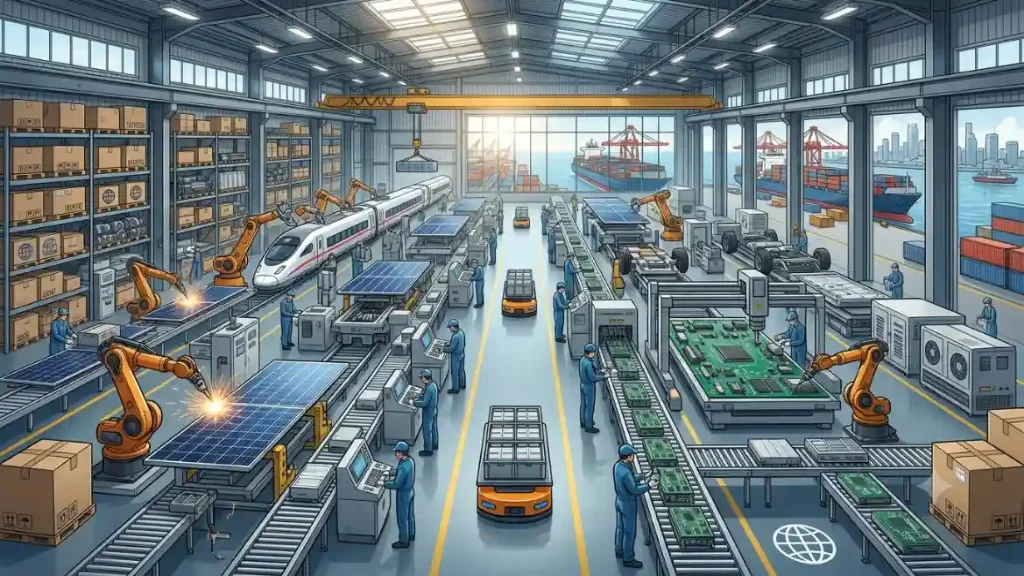


China’s manufacturing sector returned to expansion in June as stronger exports of artificial intelligence and green technology products supported factory activity despite ongoing global uncertainty.
Catenaa, Wednesday, July 01, 2026- China’s manufacturing sector returned to growth in June as resilient exports and stronger demand for artificial intelligence and green technology products helped factories expand after months of sluggish activity, according to official government data, the Wall Street Journal has reported.
The National Bureau of Statistics reported that the official Manufacturing Purchasing Managers’ Index (PMI) rose to 50.3 in June from 50.0 in May, exceeding economists’ expectations of 50.1.
A reading above 50 indicates expansion in manufacturing activity, while a figure below that threshold signals contraction.
The improvement suggests China’s industrial sector continues to benefit from external demand despite persistent domestic economic challenges and uncertainty surrounding global trade.
June’s reading marked a modest but meaningful improvement after manufacturing activity stagnated in May.
The increase was supported by continued overseas demand for Chinese exports, particularly products linked to artificial intelligence infrastructure and green energy technologies.
Economists said stronger export orders helped offset softer domestic demand, allowing manufacturers to increase production and improve business confidence.
Although the expansion remains moderate, it signals that China’s industrial recovery continues to gain traction.
Exports have become an increasingly important driver of China’s manufacturing sector during the past year.
Global investment in artificial intelligence has boosted demand for semiconductors, data center equipment, electronics and related industrial components produced by Chinese manufacturers.
At the same time, continued international demand for electric vehicles, batteries, solar panels and other clean-energy products has supported factory output despite slower growth in some traditional industries.
The combination has helped cushion the economy against weaker consumer spending at home.
The latest PMI reading exceeded market expectations and may ease concerns that China’s economic recovery is losing momentum.
However, economists caution that a single month of expansion does not necessarily indicate a sustained acceleration in growth.
Domestic consumption, property market weakness and geopolitical trade tensions continue to present challenges for the world’s second-largest economy.
Policymakers are expected to continue monitoring industrial production, employment and consumer demand as they seek to maintain stable economic growth.
China’s manufacturing performance remains closely watched because of its influence on global supply chains, commodity markets and international trade.
A stronger Chinese factory sector generally supports demand for industrial metals, energy products and transportation services while benefiting export-oriented economies across Asia.
For financial markets, improving manufacturing activity may also influence expectations for Chinese monetary policy and global economic growth during the second half of the year.
Investors will now look to upcoming export, inflation and industrial production data to determine whether June’s expansion represents the beginning of a broader recovery.
The Manufacturing Purchasing Managers’ Index is one of the most closely watched indicators of China’s industrial economy. Compiled monthly by the National Bureau of Statistics, the survey measures business conditions across factories, including production, new orders, employment and supplier deliveries. A reading above 50 indicates expansion, while a figure below 50 signals contraction. Because China is the world’s second-largest economy and a major manufacturing hub, changes in its PMI often influence global commodity prices, supply chains and investor sentiment.