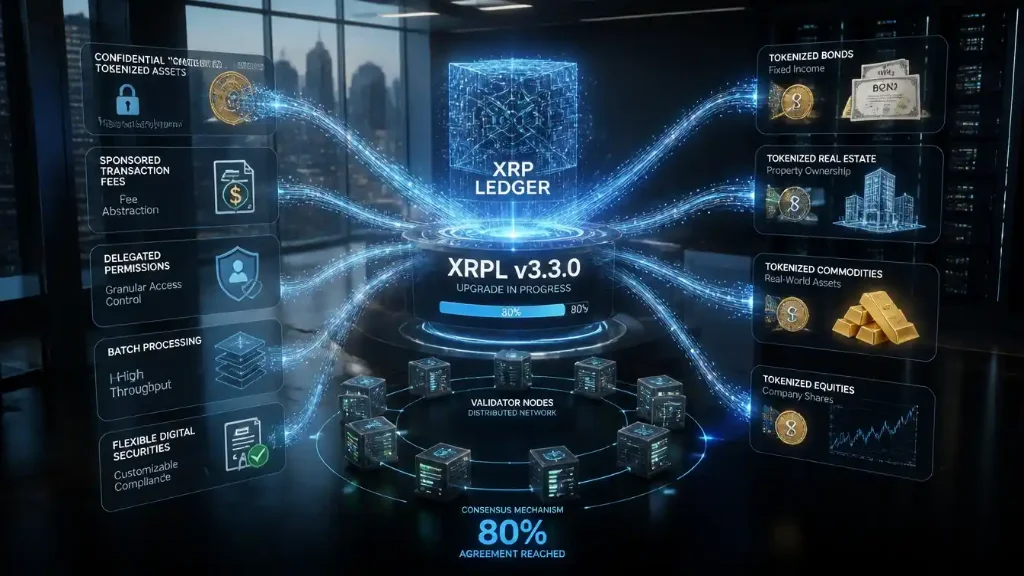


Catenaa, Monday, August 18, 2026- XRP Ledger’s upcoming v3.3.0 software release is set to introduce five proposed upgrades that could make the blockchain easier to use for tokenized assets, payments and institutional applications.
The release includes Confidential MPT, Batch, Permission Delegation, Sponsored Fees and Reserves, and Dynamic MPT.
However, installing the new software does not automatically activate those features.
Each amendment must receive support from at least 80% of XRP Ledger validators before it can become active. That distinction means developers can prepare for the new capabilities while the network separately decides whether to adopt them.
Among the most practical changes is Sponsored Fees and Reserves.
Blockchain applications generally require users to hold a network’s native cryptocurrency to cover transaction fees and other requirements. On XRP Ledger, that can mean users need XRP even when their primary purpose is interacting with another asset or service.
Fee sponsorship could allow another party, such as an application or financial service, to cover those costs.
For ordinary users, that could make blockchain applications behave more like conventional financial apps. A customer could potentially interact with a service without first buying XRP simply to pay network charges.
The feature could be particularly useful for businesses onboarding large numbers of customers who may have little knowledge of cryptocurrency.
Tokenization is another major focus.
Multi-Purpose Tokens, or MPTs, are designed to support more sophisticated digital assets on XRP Ledger.
Confidential MPT could add privacy capabilities around such assets, while Dynamic MPT could give issuers greater flexibility over how tokenized instruments operate.
Those features could become useful for financial institutions experimenting with tokenized securities and other real-world assets.
Traditional financial companies often require controls that basic cryptocurrency tokens were not designed to offer. Privacy, permissions and the ability to manage how an asset behaves can become important when regulated financial products move onto blockchains.
Permission Delegation addresses another operational problem.
Instead of requiring a primary account to approve every action directly, certain permissions could be assigned to another account or system. That could simplify business processes while allowing organizations to maintain controls over their main accounts.
Batch transactions could similarly allow several actions to be handled together rather than requiring users or applications to execute each step separately.
Taken together, the five amendments suggest XRP Ledger development is increasingly focused on making blockchain infrastructure less visible to the end user.
That could matter as banks, payment companies and asset issuers experiment with blockchain systems without necessarily expecting their customers to understand wallets, reserves and transaction fees.
Still, v3.3.0 represents infrastructure rather than adoption.
The release gives developers additional tools, but it does not guarantee financial institutions will use them or that all five amendments will become active.
Validator support is therefore the next milestone.
If the amendments clear XRP Ledger’s 80% consensus requirement, attention will shift from what the network can technically support to whether developers and institutions actually build products around those capabilities.




