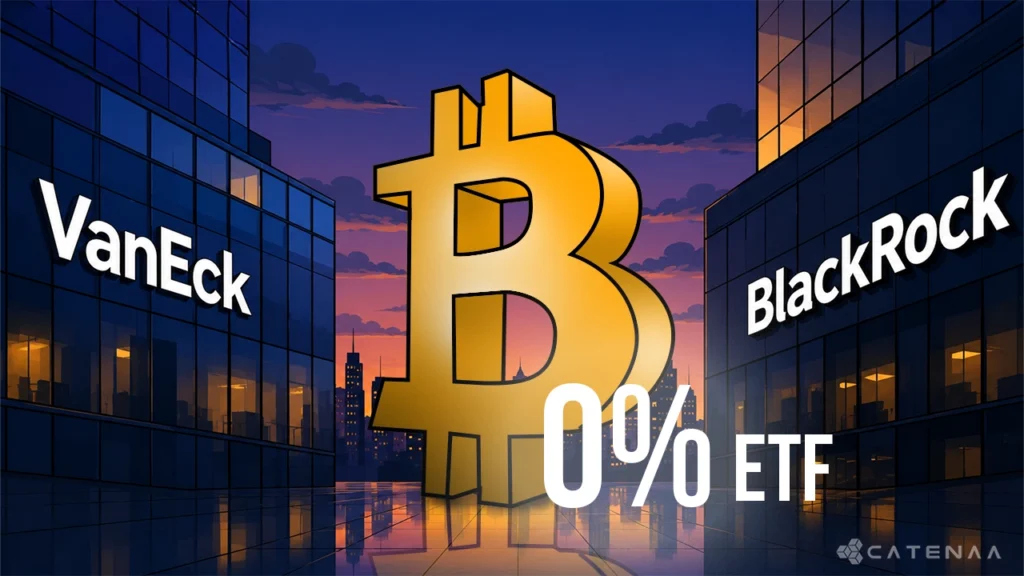


Catenaa, Sunday, June 28, 2026- Competition among spot Bitcoin exchange-traded fund providers is intensifying as VanEck temporarily eliminates management fees on its Bitcoin ETF, offering investors one of the lowest-cost entry points into regulated Bitcoin exposure.
The move places additional pressure on rivals, including BlackRock’s dominant iShares Bitcoin Trust, as asset managers compete for market share in one of the fastest-growing segments of the investment industry.
VanEck’s Bitcoin ETF currently charges no sponsor fee on qualifying assets following a temporary waiver that remains in effect through July 31, 2026, or until the fund reaches a specified asset threshold.
The promotion allows investors to gain Bitcoin exposure without paying annual management fees during the waiver period.
By comparison, BlackRock’s iShares Bitcoin Trust continues to charge a 0.25% expense ratio.
At first glance, the difference appears significant.
For long-term investors, lower fees can improve overall returns because management costs reduce portfolio performance over time.
The mathematics of fee competition has become an increasingly important consideration as Bitcoin ETFs attract billions of dollars from retail and institutional investors seeking regulated access to cryptocurrency markets.
However, industry analysts note that fees represent only one factor when evaluating exchange-traded funds.
Liquidity, trading volume, market depth and execution quality often play an equally important role, particularly for institutional investors and active traders.
BlackRock’s fund has established itself as the dominant player in the spot Bitcoin ETF market, managing tens of billions of dollars in assets.
Its scale creates significant liquidity advantages, including tighter bid-ask spreads and larger trading volumes.
Those characteristics can reduce transaction costs for investors moving substantial amounts of capital.
For smaller investors pursuing long-term exposure, management fees may be more influential.
For larger market participants, trading efficiency can sometimes outweigh modest differences in annual expense ratios.
The competitive battle reflects the broader maturation of Bitcoin investment products.
Since the approval of spot Bitcoin ETFs in early 2024, asset managers have aggressively sought to differentiate their offerings through fees, custody arrangements, branding and distribution strategies.
The funds generally track the same underlying asset, making cost and operational factors key areas of competition.
Custody arrangements also differ among providers.
While BlackRock relies on Coinbase Custody to safeguard Bitcoin holdings, VanEck utilizes a separate institutional custody structure.
Custodians play a critical role in protecting digital assets held by regulated investment vehicles and remain an important consideration for institutional investors.
The fee waiver strategy demonstrates how ETF providers are using pricing incentives to attract assets in an increasingly crowded market.
Such promotions are common within the broader ETF industry, where providers often lower fees to build scale and establish market presence.
Even after the temporary waiver expires, VanEck’s standard fee would remain slightly below BlackRock’s current charge.
The competition arrives as institutional demand for Bitcoin exposure continues to grow.
Spot Bitcoin ETFs have become one of the primary gateways for investors seeking cryptocurrency exposure without directly holding digital assets.
The products provide access through familiar brokerage accounts while avoiding many of the custody and security complexities associated with direct ownership.
For investors, the choice increasingly involves balancing costs against liquidity and operational considerations.
While management fees remain important, market structure and trading efficiency can have a substantial impact on overall investment outcomes.
Spot Bitcoin ETFs hold actual Bitcoin and allow investors to gain exposure through traditional stock exchanges. The products were approved in the United States in early 2024 and have since attracted substantial institutional and retail investment.
Fee competition could place downward pressure on costs across the Bitcoin ETF sector while increasing accessibility for investors seeking regulated cryptocurrency exposure.
Market analysts note that lower fees benefit long-term investors, but liquidity and execution quality often become more important considerations for institutions and active traders.
VanEck’s zero-fee promotion highlights the growing competition within the Bitcoin ETF industry. As providers battle for assets, investors are increasingly benefiting from lower costs and a wider range of regulated cryptocurrency investment options.
The approval of spot Bitcoin ETFs marked a major milestone in cryptocurrency adoption within traditional financial markets. Prior to their introduction, investors often relied on futures-based products, trusts or direct ownership to gain Bitcoin exposure. Spot ETFs simplified access by allowing investors to purchase shares through conventional brokerage accounts. Since launch, major asset managers including BlackRock, Fidelity, VanEck and others have accumulated significant assets under management. The rapid growth of the sector has intensified competition, leading providers to focus on fee reductions, institutional partnerships, custody solutions and product innovation as they seek to attract investor capital.




