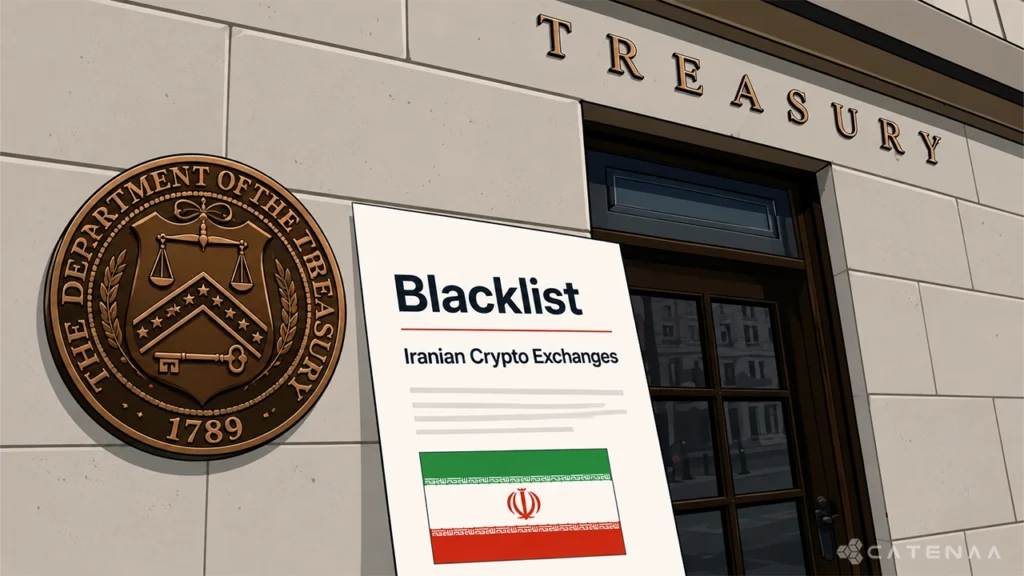


Catenaa, Monday, June 08, 2026- The United States imposed sanctions on Iran’s largest cryptocurrency exchange and several other digital asset trading platforms Tuesday as the Trump administration intensified its “Economic Fury” campaign targeting Tehran’s financial networks and sanctions evasion systems.
The US Treasury Department said Iran-based exchange Nobitex processed more than half of all Iranian cryptocurrency inflows during 2025 and allegedly played a major role in sanctions evasion, terrorist financing and transactions linked to the Islamic Revolutionary Guard Corps, widely known as the IRGC.
The Treasury’s Office of Foreign Assets Control, known as OFAC, also sanctioned Nobitex chairman and co-founder Amir Hossein Rad, chief executive Seyed Ali Khoee and co-founders Ali and Mohammad Kharrazi.
US authorities described the Kharrazi brothers as members of one of Iran’s politically connected families.
The sanctions also targeted Iranian crypto exchanges Wallex, Bitpin and Ramzinex, which US officials accused of facilitating financial activity connected to sanctioned Iranian entities and IRGC-linked operations.
Treasury Secretary Scott Bessent said the measures form part of Washington’s expanding economic pressure campaign against Tehran amid growing geopolitical tensions and increasing scrutiny over Iran’s use of digital assets.
US officials argued that Iranian authorities increasingly rely on cryptocurrency systems to bypass international banking restrictions, move capital abroad and finance sanctioned operations.
According to Treasury officials, Iran’s deteriorating economy accelerated government reliance on alternative financial channels, including digital assets and decentralized blockchain networks.
The sanctions block US individuals and institutions from conducting business with the targeted entities while freezing any assets falling under American jurisdiction.
The measures also increase secondary sanctions risks for foreign firms and exchanges interacting with the designated platforms.
Nobitex has long occupied a central position inside Iran’s cryptocurrency ecosystem.
Despite repeated scrutiny from blockchain analytics companies and lawmakers, the exchange had previously avoided direct Western sanctions while continuing to operate as one of Iran’s dominant crypto trading venues.
A Reuters investigation published last month reported that hundreds of millions of dollars linked to sanctioned Iranian entities allegedly moved through Nobitex infrastructure.
The report identified the Kharrazi brothers as relatives connected to Iran’s supreme leadership circles, intensifying political sensitivity surrounding the exchange.
Blockchain investigators and sanctions enforcement officials increasingly view crypto exchanges operating in sanctioned jurisdictions as major financial enforcement challenges.
Digital asset systems allow faster international transfers and create alternative liquidity pathways outside traditional banking channels heavily monitored by Western regulators.
The sanctions arrive days after Treasury officials disclosed updated figures surrounding US seizures of Iranian-linked cryptocurrency assets.
Last week, Bessent stated the US had seized roughly $1 billion tied to Iranian crypto activity, significantly higher than earlier estimates released during April.
However, Tuesday’s Treasury statement referenced previous estimates of nearly $500 million in seized digital assets rather than the larger figure mentioned publicly last week.
The discrepancy raised questions regarding the precise scale of US enforcement operations tied to Iranian cryptocurrency networks.
American authorities have increasingly expanded blockchain surveillance capabilities over recent years as cryptocurrency use inside sanctions-targeted economies accelerated.
Federal agencies now routinely track blockchain transactions, identify wallet clusters and coordinate with exchanges to freeze assets tied to sanctioned organizations.
The latest sanctions reflect broader efforts by the United States and allied governments to tighten oversight across global cryptocurrency infrastructure.
Digital assets increasingly occupy a central role in sanctions enforcement discussions because blockchain systems can move funds across borders without relying on conventional banking intermediaries.
Governments have grown particularly concerned about cryptocurrency use by sanctioned states, terrorist organizations, ransomware groups and transnational cybercrime networks.
The US has steadily expanded sanctions targeting crypto wallets, mixers, exchanges and blockchain services since 2022.
OFAC previously sanctioned multiple Russian-linked crypto services, North Korean laundering networks and decentralized platforms accused of facilitating illicit financial flows.
At the same time, regulators continue balancing enforcement efforts against broader institutional adoption of blockchain technologies and regulated digital asset markets.
Major banks, payment companies and financial institutions accelerated blockchain integration during 2025 and 2026 even as enforcement pressure intensified across higher-risk sectors of the crypto industry.
The sanctions could further isolate Iran’s digital asset economy from global crypto liquidity networks while increasing pressure on offshore exchanges handling Middle Eastern trading activity.
Analysts said the action also sends a broader signal that US regulators intend to treat cryptocurrency infrastructure as a central front in modern sanctions enforcement.
Crypto exchanges operating in politically sensitive jurisdictions may now face greater compliance scrutiny, especially if linked to sanctioned governments or military organizations.
The crackdown arrives during a period of growing geopolitical instability across the Middle East, where rising tensions increasingly intersect with digital finance, cyber operations and economic warfare strategies.