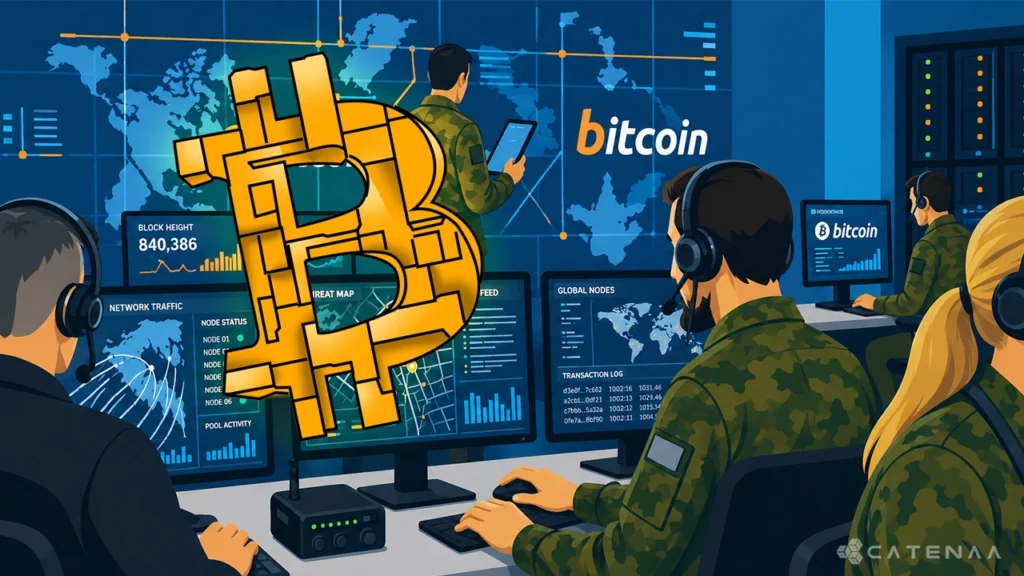


Catenaa, Wednesday, April 29, 2026-The United States military is actively testing the use of Bitcoin technology for cybersecurity and network defense, a senior commander told Congress, highlighting a growing strategic interest in blockchain beyond finance.
Admiral Samuel Paparo said the military is currently operating a Bitcoin node as part of ongoing experimentation. He told lawmakers the initiative focuses on monitoring the network and testing operational capabilities rather than mining or holding the digital asset.
Paparo made the disclosure during a House Armed Services Committee hearing in response to questions from Lance Gooden on Bitcoin’s potential national security role.
Technical Focus Over Financial Strategy
Paparo stressed that the military’s interest in Bitcoin is rooted in its underlying technology, not its role as a store of value.
He pointed to cryptography, decentralized architecture, and proof-of-work systems as features that could strengthen secure communications and network resilience. These elements, he said, may help defend against cyber threats and improve operational security across military systems.
The admiral avoided endorsing Bitcoin as a strategic reserve asset, despite questions about whether the United States should build holdings similar to gold or oil reserves. Instead, he framed Bitcoin as a tool for computer science applications within defense systems.
Cybersecurity and Network Resilience
The use of a Bitcoin node allows the military to study how decentralized networks operate in real time. Analysts say this could help defense agencies better understand how to secure communications in contested or degraded environments.
Blockchain systems like Bitcoin are designed to function without central control, making them resistant to single points of failure. This characteristic is of interest to military planners seeking resilient infrastructure that can withstand cyberattacks or disruptions.
Paparo indicated that testing includes evaluating how blockchain protocols could be adapted to protect sensitive networks and support operational continuity.
Strategic Context and Global Competition
The discussion took place against a broader backdrop of digital competition, particularly with China. Lawmakers have increasingly raised concerns about maintaining technological leadership in emerging sectors such as blockchain and artificial intelligence.
While Paparo did not directly address stockpiling Bitcoin, his comments suggest that the US military is exploring how decentralized technologies could play a role in future defense strategies.
He also linked the discussion to the global role of the US dollar, stating support for policies that reinforce its dominance. He referenced the GENIUS Act as part of ongoing efforts to strengthen the US position in digital finance.
Policy Momentum in Washington
The disclosure comes as cryptocurrency policy gains momentum in Washington. Lawmakers are working on legislation covering stablecoins and broader market structure, aiming to clarify regulatory frameworks and encourage innovation while managing risks.
The military’s involvement in blockchain testing may add a new dimension to these discussions, particularly as policymakers weigh the national security implications of digital assets and decentralized systems.
Experts say government experimentation could influence how institutions perceive blockchain technology, potentially accelerating adoption in areas beyond finance.
Implications for the Crypto Sector
The military’s interest signals a shift in how Bitcoin is viewed at the institutional level. Rather than focusing solely on price or investment potential, attention is increasingly turning to its underlying infrastructure.
For the crypto industry, this could reinforce the narrative that blockchain technology has applications in security, data integrity, and decentralized operations.
However, analysts caution that such use cases remain in early stages, and practical deployment within defense systems will require extensive testing and adaptation.




