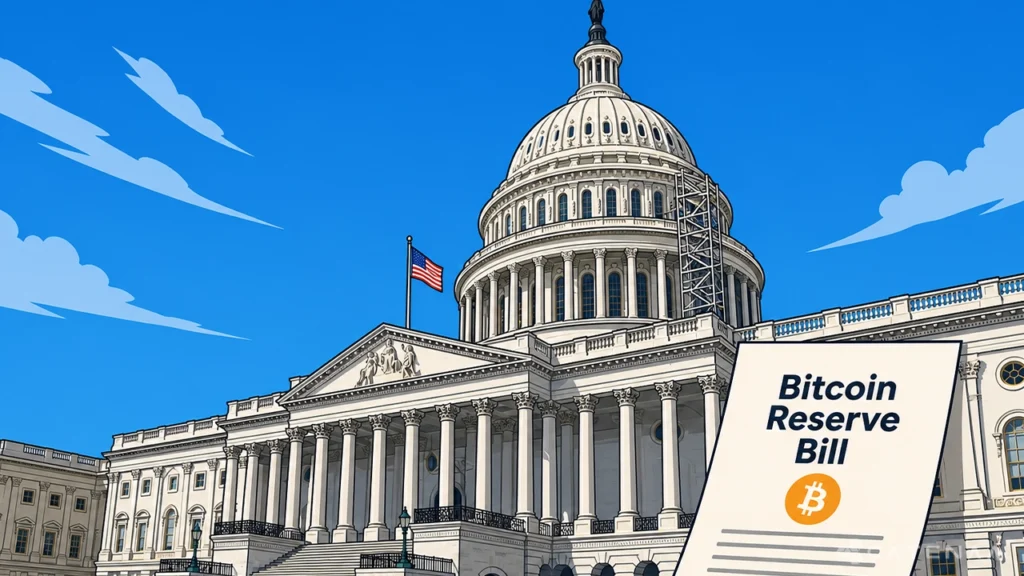


Catenaa, Saturday May 02, 2026 US lawmakers are preparing to reintroduce legislation to establish a national bitcoin reserve, with Rep. Nick Begich confirming plans to revive the proposal under a new name to formalize President Donald Trump’s earlier executive order.
The bill, now titled the American Reserves Modernization Act, is expected to be submitted within weeks following discussions with the House Financial Services Committee. The proposal seeks to classify bitcoin as a strategic reserve asset and place federal holdings under a structured custody framework, while also outlining a plan to acquire up to one million bitcoin over several years through budgetneutral methods.
Legislative Context Builds
The revived bill builds on earlier efforts led by Begich and Sen. Cynthia Lummis, who first introduced the measure to integrate bitcoin into US reserve policy. The renaming reflects efforts to broaden political support and clarify the proposal’s intent among lawmakers and the public.
The legislation aligns with an executive order issued during the early months of the Trump administration, which directed agencies to consolidate bitcoin holdings obtained through forfeitures into a unified reserve. Lawmakers now seek to convert that directive into statutory law, ensuring continuity beyond executive authority.
Officials involved in the process have indicated that updates to the bill are under consideration, though specific revisions have not been disclosed.
Implications for Policy
Formal recognition of bitcoin as a reserve asset would mark a shift in US financial strategy, expanding beyond traditional holdings such as gold and foreign currencies. The move could influence how digital assets are treated within federal accounting systems and longterm asset management frameworks.
A structured acquisition plan may also affect market dynamics, particularly if purchases are conducted over an extended period. Analysts suggest that government participation could shape demand patterns and reinforce bitcoin’s role as a store of value.
The proposal may also encourage other nations to evaluate similar approaches, potentially accelerating the integration of digital assets into sovereign reserve strategies.
Expert Perspectives Mixed
Policy analysts say codifying the reserve through legislation would strengthen its durability, reducing the risk of policy reversal under future administrations. They note that congressional approval would establish clearer guidelines for custody, reporting, and oversight.
Financial experts point to operational challenges, including managing volatility and ensuring secure storage of digital assets. They also highlight the need for coordination between federal agencies responsible for asset management and enforcement.
Some observers view the initiative as part of a broader shift toward recognizing bitcoin within institutional finance, while others caution that regulatory clarity will be essential for longterm stability.
Path Toward Approval
The bill’s reintroduction is expected to initiate a new round of legislative review, including committee hearings and potential amendments. Lawmakers aim to build consensus across party lines to secure passage.
Officials have indicated that the proposal will emphasize longterm holding strategies, positioning bitcoin as a reserve asset rather than a shortterm investment. The timeline for approval will depend on congressional priorities and the broader regulatory environment for digital assets.
The upcoming submission is likely to clarify how the reserve would be managed and how acquisitions would be executed within budget constraints.
Background on Reserve Strategy
The US government has accumulated bitcoin primarily through seizures linked to criminal investigations and enforcement actions. Historically, these assets were sold through auctions, generating revenue but limiting longterm holdings.
The concept of a strategic reserve represents a shift toward retaining bitcoin as part of national assets. This approach mirrors traditional reserve practices, where governments hold assets to support financial stability and respond to economic risks.
Globally, digital assets have gained attention as potential reserve components, though adoption remains limited. The US initiative is among the most developed efforts to integrate cryptocurrency into sovereign financial policy.
The outcome of the legislative process will determine whether bitcoin becomes a permanent fixture in the nation’s reserve framework.




