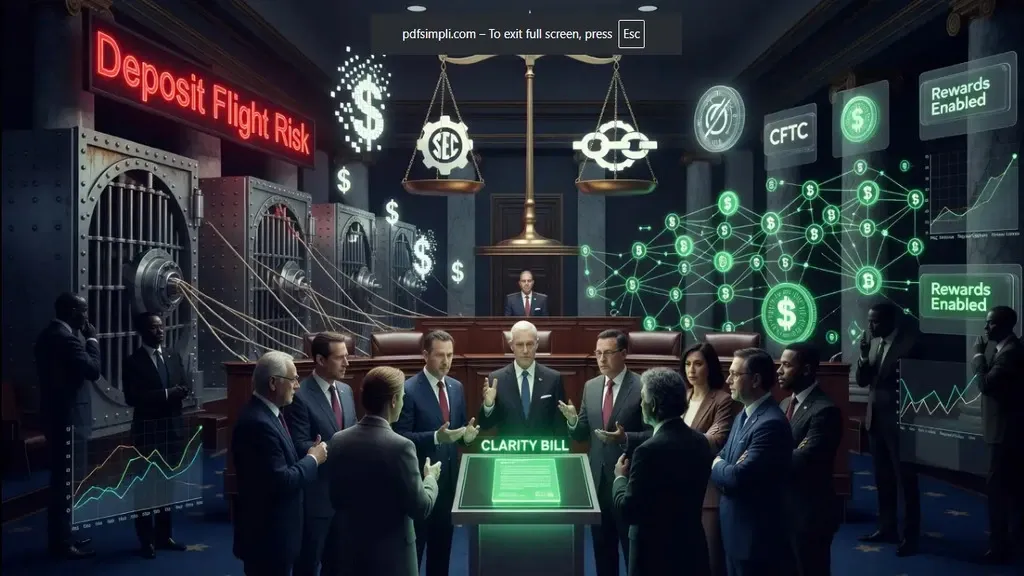


Catenaa, Wednesday, April 22, 2026- Negotiations on a major US cryptocurrency market structure bill are nearing agreement on stablecoin rewards, though disputes over illicit finance and ethics are expected to intensify.
Lawmakers are closing in on a compromise over stablecoin rewards, a central issue in the proposed Clarity bill. Angela Alsobrooks and Thom Tillis have led negotiations to refine rules governing how rewards can be offered to users.
Current proposals would restrict passive yield that resembles bank interest while allowing rewards tied to activity such as transactions. The approach aims to balance innovation in digital finance with concerns from the traditional banking sector.
The bill seeks to define whether digital assets fall under securities or commodities regulation, clarifying oversight between the Commodity Futures Trading Commission and the Securities and Exchange Commission.
Debate over stablecoin rewards has intensified in recent months. The American Bankers Association has argued that allowing such rewards could pull deposits away from banks, especially smaller institutions.
Crypto firms, including Coinbase, have pushed back, saying restrictions could limit growth and innovation in the sector.
A previous law, the GENIUS Act, banned direct interest payments by stablecoin issuers but left room for platforms to offer rewards through other mechanisms. The current bill attempts to clarify those boundaries.
While progress on rewards signals momentum, other contentious areas remain unresolved. Lawmakers are expected to scrutinize provisions related to illicit finance, particularly proposals that would limit liability for non-custodial blockchain developers.
Ethics concerns are also likely to resurface, especially regarding financial gains linked to crypto ventures associated with Donald Trump. Lawmakers have raised questions about potential conflicts of interest tied to crypto-related business activities.
Policy observers describe the emerging compromise on rewards as a “hard-fought” outcome after months of negotiation. However, they caution that unresolved issues could delay the bill’s progress.
Some lawmakers have warned that failure to pass crypto legislation soon could stall efforts for the foreseeable future, as legislative time becomes limited.
The Clarity bill represents one of the most comprehensive attempts to regulate digital assets in the United States. It aims to establish clearer rules for classification, oversight, and disclosure across the crypto market.
Efforts to advance the bill have faced delays, including a canceled committee markup earlier this year after industry support shifted. Lawmakers are now working to secure bipartisan backing before moving the legislation forward.