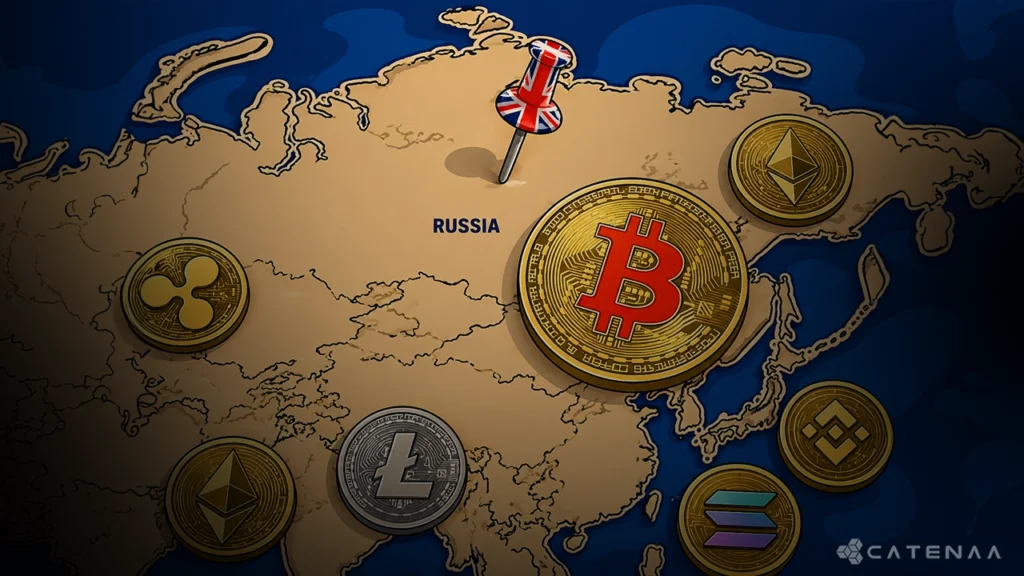


Catenaa, Monday, June 01, 2026- The United Kingdom has expanded its Russia sanctions regime into the cryptocurrency sector for the first time, targeting multiple crypto-related firms accused of facilitating financial activity linked to Moscow as regulators intensify pressure on blockchain-based payment networks.
British authorities announced sanctions against several entities including Bitpapa IC FZC LLC, Exmo Exchange Limited, Rapira Group LLC and Aifory LLC, alleging they provided financial services connected to sanction-evasion activity involving Russian-linked networks.
The move marks one of the strongest signals yet that Western governments are increasingly treating crypto infrastructure as part of broader geopolitical financial enforcement.
The sanctions form part of the UK’s broader campaign to restrict financial channels allegedly used to bypass restrictions imposed on Russia following international sanctions measures.
Officials accused several crypto-related entities of helping route funds connected to A7 Limited Liability Company, which authorities linked to sanction-evasion activity.
Blockchain analytics firms described the decision as the first direct application of Britain’s Russia sanctions framework against cryptocurrency exchanges and related digital asset infrastructure.
The crackdown also drew attention to HTX, formerly associated with the Huobi brand, after a related legal entity appeared in the sanctions discussion.
HTX responded by distancing its operational exchange infrastructure from Huobi Global S.A., arguing the sanctioned entity is legally separate from the active trading platform.
The exchange insisted user funds remain secure and normal trading operations continue uninterrupted.
The sanctions escalation highlights how cryptocurrency increasingly sits at the center of geopolitical financial enforcement and cross-border compliance battles.
Analysts said regulators are no longer focusing solely on traditional banking systems but are now targeting blockchain infrastructure capable of facilitating international capital movement outside legacy financial controls.
The case may also intensify pressure on global exchanges to strengthen compliance systems, jurisdictional transparency and sanctions-monitoring capabilities.
Several researchers warned that inconsistent international regulatory standards remain a major challenge because exchanges often operate across multiple legal jurisdictions simultaneously.
At the same time, some industry observers cautioned that aggressive sanctions enforcement could increase fragmentation across global crypto markets as firms attempt to isolate operational entities from legal exposure.
Blockchain compliance analysts said the UK’s move could encourage other Western governments to expand sanctions enforcement deeper into the crypto sector.
Several experts noted that exchanges increasingly face the same geopolitical scrutiny historically applied to international banks and payment networks.
Others argued however that blockchain transparency can also assist enforcement agencies because public ledgers allow investigators to trace fund movements more directly than traditional offshore financial systems.
Governments globally intensified oversight of digital assets following concerns that cryptocurrencies may be used for money laundering, sanctions circumvention and illicit cross-border payments.
Western regulators meanwhile increasingly pressure exchanges and blockchain companies to implement stricter identity verification, transaction monitoring and sanctions-screening systems.
The crypto industry has long argued that decentralized networks themselves remain neutral infrastructure, though regulators increasingly target centralized intermediaries facilitating blockchain transactions.
The UK sanctions action reflects the broader integration of cryptocurrency markets into global financial and geopolitical policy enforcement frameworks.