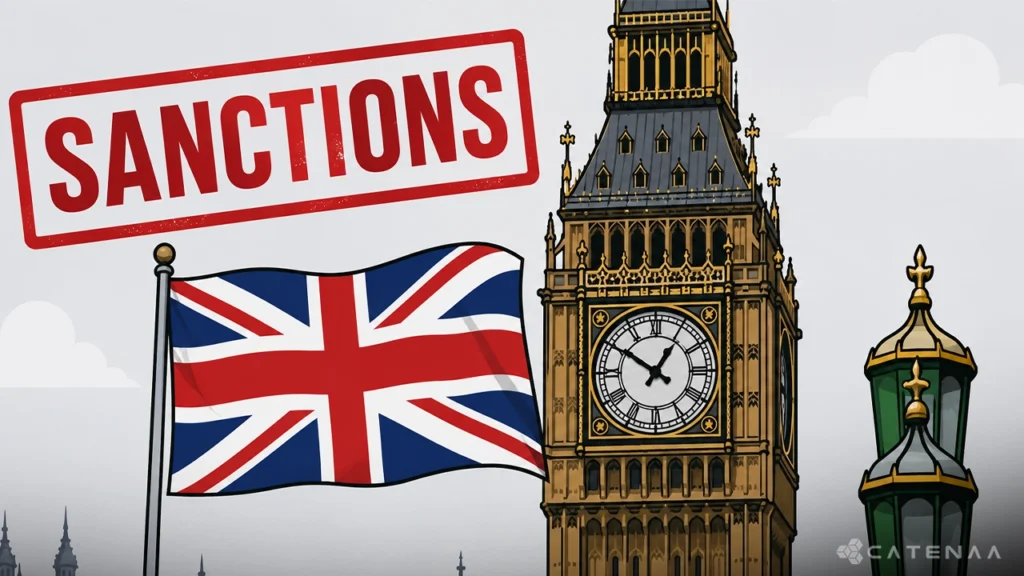


Catenaa, Friday, June 19, 2026- The United Kingdom has intensified its campaign against alleged Russian sanctions-evasion networks by imposing sanctions on cryptocurrency exchange Huobi, now known as HTX, in a move that could significantly increase compliance risks for digital asset platforms operating across global markets.
British authorities announced the measures as part of a broader sanctions package targeting what officials describe as the “A7 network,” a financial ecosystem allegedly used to facilitate transactions supporting Russia’s military activities in Ukraine.
The action places one of the cryptocurrency industry’s most recognizable exchanges under direct scrutiny from a major Western government and signals a growing willingness among regulators to target digital asset infrastructure they believe may be linked to sanctions evasion.
The sanctions package includes 17 individuals and entities alongside the exchange.
The latest measures highlight how cryptocurrencies have become increasingly intertwined with international security policy.
Initially promoted as borderless financial technologies, digital assets are now regularly appearing in sanctions enforcement actions, anti-money laundering investigations and national security discussions.
British officials claim the wider A7 network processed more than $90 billion in transactions during 2025, making it one of the largest alleged sanctions-evasion structures identified since the start of the Ukraine conflict.
Authorities argue that modern financial networks increasingly rely on a mixture of cryptocurrencies, shell companies and alternative payment systems to bypass traditional banking restrictions.
That evolution has forced regulators to adapt their enforcement strategies.
Huobi has long been one of the world’s largest cryptocurrency exchanges, serving users across Asia, Europe, Latin America and emerging markets.
Although the platform rebranded to HTX in 2023, it remains a major participant in global digital asset trading.
The sanctions do not accuse ordinary users of wrongdoing.
Instead, regulators are focusing on alleged connections between the exchange and entities associated with the broader A7 network.
The designation creates potential complications for financial institutions, exchanges, custodians and payment providers that interact with sanctioned entities.
Compliance departments worldwide are now expected to review exposure to affected parties.
The British action reflects a broader shift in sanctions enforcement.
Earlier measures often targeted individuals, oligarchs, banks or specific companies.
Increasingly, authorities are focusing on the financial infrastructure enabling cross-border transactions.
Cryptocurrency platforms have become central to that discussion.
Regulators in the United States, European Union and United Kingdom have repeatedly warned that digital assets could be used to facilitate sanctions evasion if compliance controls are inadequate.
The latest sanctions demonstrate that governments are prepared to act against major industry participants when concerns arise.
Despite the significance of the announcement, cryptocurrency markets showed little immediate reaction.
Major digital assets remained largely stable following the news.
Trading volumes also appeared relatively unaffected.
Analysts say the muted response reflects growing market familiarity with regulatory enforcement actions.
Unlike earlier years when sanctions announcements often triggered sharp volatility, investors increasingly view compliance measures as part of the industry’s maturation process.
However, the long-term implications may prove more important than the short-term market reaction.
The sanctions are likely to raise compliance expectations across the industry.
Exchanges operating internationally may face greater scrutiny regarding customer onboarding, transaction monitoring and sanctions screening procedures.
Regulators have increasingly emphasized that digital asset firms must meet standards comparable to those required of traditional financial institutions.
Failure to do so can result in fines, restrictions or sanctions designations.
The Huobi case may encourage exchanges to strengthen internal controls and expand compliance operations.
The crypto-related sanctions formed only one part of a larger package announced by Britain.
The government also expanded restrictions involving energy products, chemicals and maritime services linked to Russia.
Officials estimate that sanctions imposed since 2022 have collectively inflicted hundreds of billions of dollars in economic costs on Russia.
At the same time, London announced additional support for Ukraine’s energy infrastructure, reflecting the broader strategic context surrounding the measures.
One of the most important consequences may emerge beyond Britain itself.
Historically, sanctions introduced by major Western economies often influence regulatory approaches in other jurisdictions.
Financial institutions, exchanges and payment providers frequently adopt global compliance standards rather than maintain separate systems for individual markets.
As a result, the UK’s decision could affect how other regulators and industry participants evaluate relationships with sanctioned entities and cryptocurrency platforms.
The UK’s sanctions against Huobi represent another milestone in the growing intersection between cryptocurrency regulation and geopolitical enforcement. By targeting a major exchange within a broader alleged sanctions-evasion network, British authorities have signaled that digital asset infrastructure is now firmly within the scope of international financial enforcement. While markets remained calm, the decision is likely to reinforce compliance requirements across the global crypto industry and further integrate digital assets into the evolving framework of economic sanctions.
Governments have increasingly focused on cryptocurrency networks as part of sanctions enforcement efforts following Russia’s invasion of Ukraine. Western regulators have repeatedly warned that digital assets could be used to facilitate cross-border transactions outside traditional banking systems. The United Kingdom has imposed sanctions on more than 3,300 Russian-linked individuals and entities since 2022, while the European Union and United States have expanded similar measures. Crypto exchanges now face many of the same anti-money laundering, customer verification and sanctions-screening obligations imposed on conventional financial institutions. The latest action against Huobi underscores how cryptocurrency platforms have become central players in global compliance and financial security discussions.