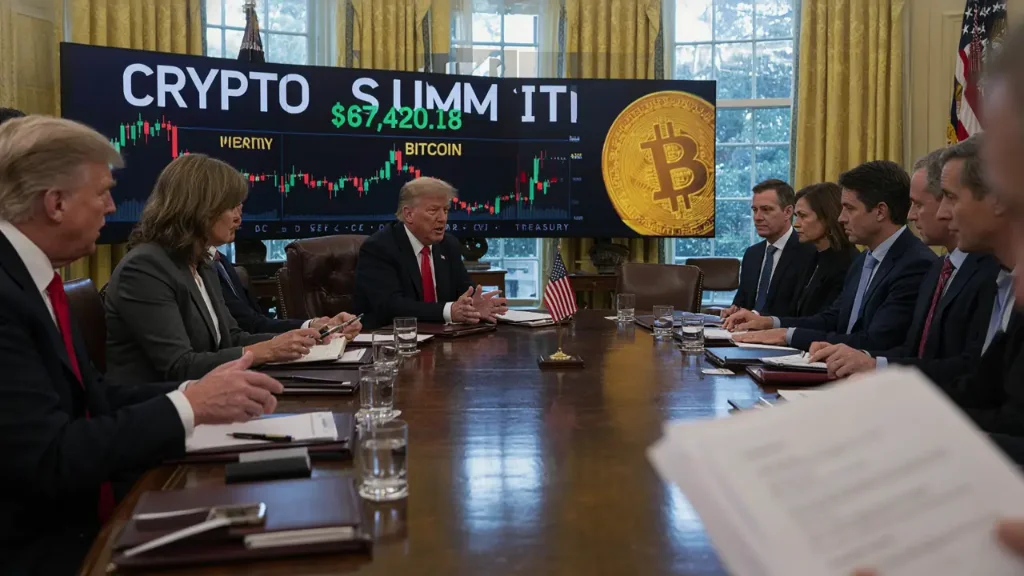


Catenaa, Thursday, August 20, 2026- President Donald Trump is expected to join senior regulators and crypto executives at the White House Wednesday as Washington confronts unresolved rules for digital assets and prediction markets.
Commodity Futures Trading Commission Chair Michael Selig is also expected at the 2:30 p.m. meeting at the Eisenhower Executive Office Building beside the White House.
Securities and Exchange Commission Chair Paul Atkins is expected to attend, according to reports.
The gathering comes one day before the CFTC holds the inaugural meeting of its Innovation Advisory Committee in Washington.
That timing places two of the industry’s most contested policy questions before the administration within 24 hours: crypto market structure and who controls prediction markets.
Reported invitees to Wednesday’s White House session include representatives from Coinbase, Ripple, Chainlink, a16z, Kalshi, Paradigm and The Digital Chamber.
The White House has not released a full public attendee list.
Thursday’s CFTC meeting will run from 1 p.m. to 4 p.m. and cover three subjects: cryptocurrency regulation, artificial intelligence in financial markets and prediction markets.
The crypto session will examine the development of U.S. regulation, overlapping jurisdictions and the remaining work toward a federal market structure.
That discussion arrives while Congress remains divided over the Digital Asset Market Clarity Act.
Senate Majority Leader John Thune filed cloture on a motion to proceed with the legislation before the August recess.
The Senate’s current schedule calls for that cloture motion to ripen at 2:15 p.m. on Sept. 15.
Reaching the 60-vote threshold would allow the Senate to move forward with consideration. It would not itself pass the bill.
The proposed legislation could reshape how authority over digital assets is divided between the SEC and CFTC.
Prediction markets may produce an even sharper debate today.
The CFTC’s official agenda specifically lists the respective roles of federal and state authorities, recent state litigation and enforcement actions, and jurisdiction over event contracts.
Selig has taken an assertive position in that dispute.
The CFTC has maintained that federally regulated derivatives exchanges fall under its authority when listing permitted event contracts.
Several states and local authorities have challenged prediction-market offerings, particularly sports-related contracts they argue resemble gambling.
The result is a growing confrontation over whether federally regulated platforms can offer contracts nationwide without complying with separate state gambling regimes.
That dispute affects businesses including Kalshi and Polymarket.
The CFTC’s advisory panel includes Kalshi CEO Tarek Mansour and Polymarket CEO Shayne Coplan.
Its membership also includes Coinbase CEO Brian Armstrong, Ripple CEO Brad Garlinghouse, Crypto.com CEO Kris Marszalek and Gemini CEO Tyler Winklevoss.
Traditional finance is heavily represented as well.
Members include executives from Nasdaq, CME Group, Cboe Global Markets, Intercontinental Exchange, the Depository Trust and Clearing Corp. and the London Stock Exchange Group.
The composition gives companies affected by emerging financial regulation direct access to the CFTC’s advisory process.
The committee does not make federal law or issue regulations itself.
Its role is to advise the CFTC on technological change and its effects on financial markets and the U.S. economy.
Still, its inaugural agenda offers a clear indication of where regulatory attention is moving.
Crypto firms want settled rules over which digital assets fall under securities or commodities law.
Prediction-market companies want certainty that federal derivatives regulation can shield approved contracts from conflicting state restrictions.
Financial institutions want clearer rules as crypto, tokenization and event contracts move closer to traditional capital markets.
The White House meeting brings many of those interests into the same political setting before the CFTC begins its public discussion.
Artificial intelligence will form the second part of Thursday’s CFTC agenda.
Regulators plan to examine AI applications in trading, compliance, surveillance and risk management.
The committee will also discuss autonomous agents capable of executing financial transactions and managing portfolios.
That raises another regulatory problem.
Markets increasingly face software that can not only analyze information but also execute transactions without continuous human intervention.
The CFTC will consider whether existing financial rules can accommodate those systems or whether additional guidance may be needed.
Catenaa View
The sequence of meetings shows how Washington’s crypto debate has moved beyond whether digital assets should be regulated.
The argument is increasingly about who regulates what.
For cryptocurrencies, that means defining the boundaries between the SEC and CFTC.
For prediction markets, it means deciding whether federal derivatives authority overrides state gambling restrictions.
For AI, regulators must determine how existing market safeguards apply when software begins making financial decisions autonomously.
The White House gathering also gives industry executives access to administration officials at a time when those jurisdictional boundaries remain unsettled.
Thursday’s CFTC meeting moves the conversation into a public regulatory forum.
Its prediction-market session is especially important because the agency has placed federal-state jurisdiction, market surveillance, manipulation and customer protection on the same agenda.
That suggests the fight over event contracts is moving from a series of individual court battles toward a broader argument over the structure of U.S. market regulation.
Selig launched the Innovation Advisory Committee in January as the successor to the CFTC’s Technology Advisory Committee. The panel brings together executives from crypto, derivatives, exchanges, venture capital and financial infrastructure companies. Its Aug. 20 inaugural meeting will examine crypto regulation, artificial intelligence and prediction markets. The crypto discussion comes as the Senate prepares for a September procedural vote on the Digital Asset Market Clarity Act. Prediction markets face a separate series of disputes involving federal derivatives authority and state gambling laws. The combination has placed the CFTC near the center of Washington’s debate over the next generation of financial markets.




