

July 23, 2026 – The network converted stablecoin dominance into $89 million in quarterly fees while institutions and AI agents arrived. DeFi cooled, yet TRX still beat Bitcoin.

In Summary
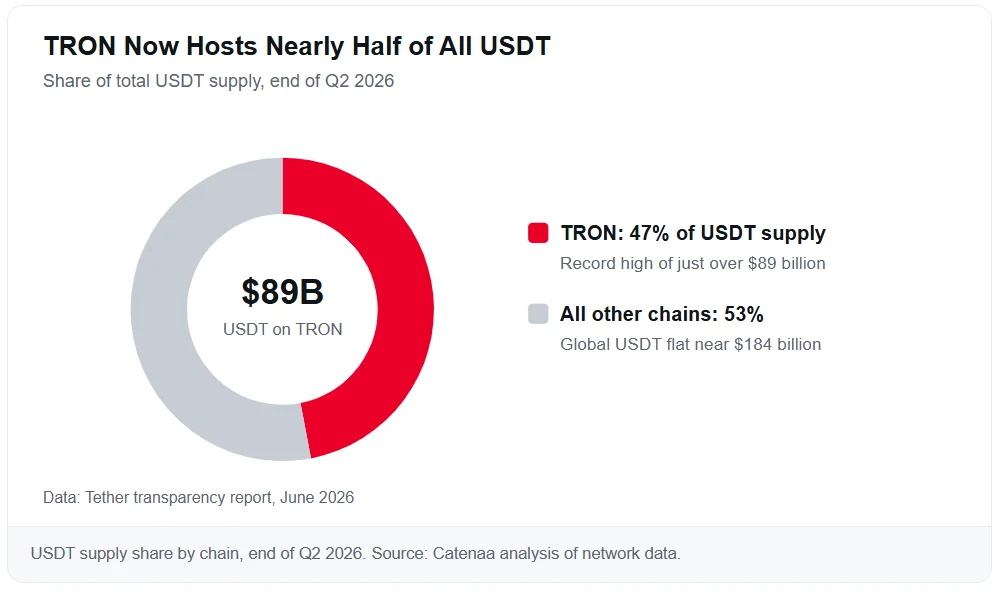
USDT supply on TRON hit a record $89 billion, about 47% of all USDT, while the global total stayed flat.
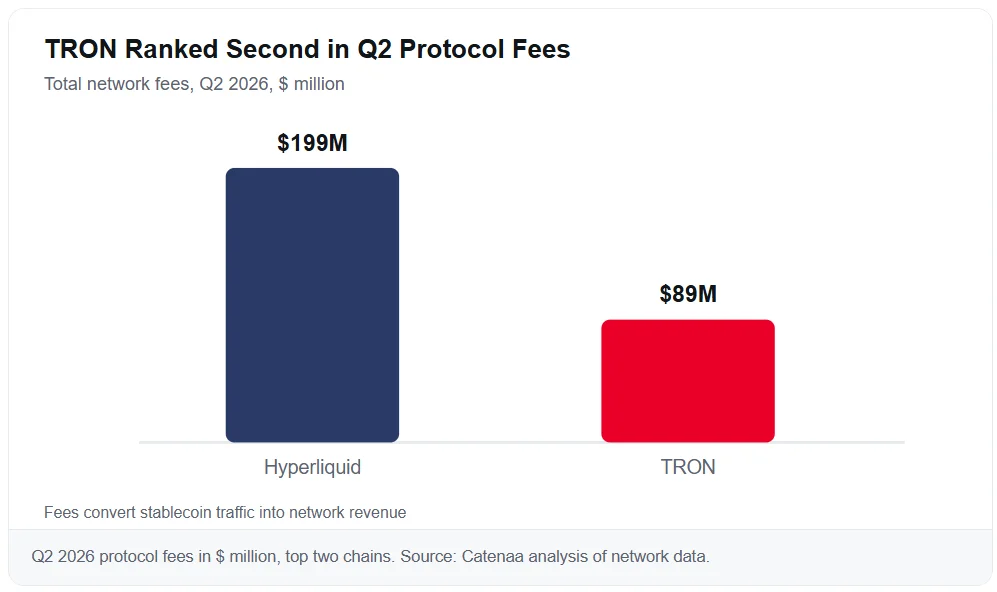
Protocol fees reached $89 million in Q2 2026, second only to Hyperliquid’s $199 million.
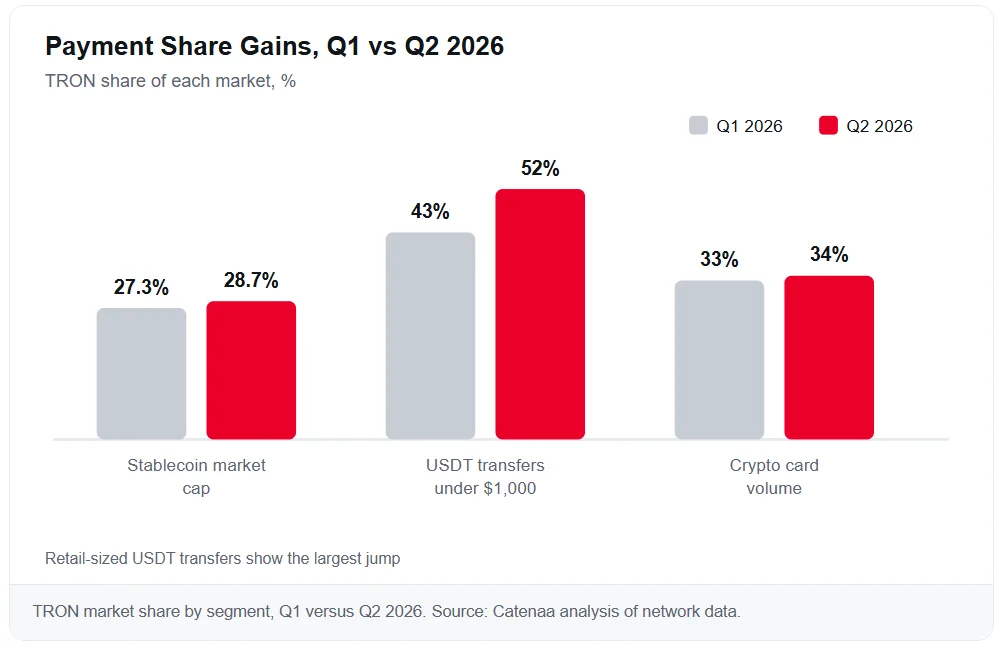
Retail-sized USDT transfers on TRON jumped to a 52% market share, and 93% of stablecoin volume moved peer-to-peer.
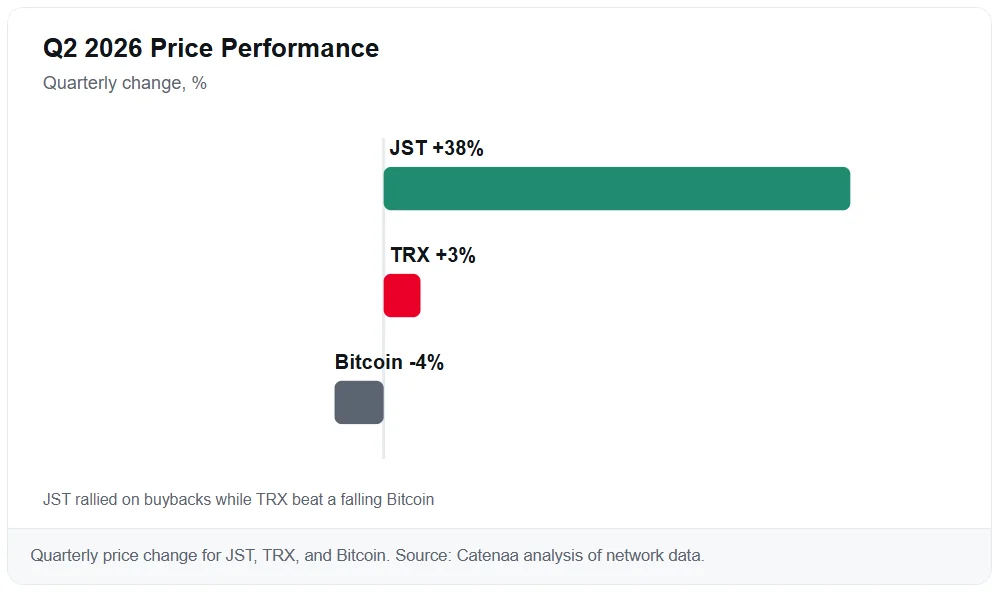
DeFi softened as TVL slipped to $4.5 billion and JustLend loans fell 37%, yet JST rallied 38% on buybacks.
Hamilton Lane, Bitnomial, and Hyperlane deals widened institutional and cross-chain reach.
TRON Q2 2026 results show a network turning stablecoin scale into hard revenue. TRON Q2 2026 data also shows USDT supply on the network reached a record $89 billion. As a result, the chain now holds about 47% of all USDT in circulation. Protocol fees hit $89 million, second only to Hyperliquid. No other chain came close.
Stablecoin Engine Gains Share in a Flat Market
Global USDT supply barely moved in the second quarter. Tether’s total liabilities stayed near $184 billion, according to its transparency data. Even so, TRON’s slice of the whole stablecoin market climbed from 27.3% to 28.7%. In other words, the network grew by taking share rather than riding a rising tide.
Retail behaviour tells the same story. The chain’s share of USDT transfers under $1,000 jumped from 43% to 52% among chains with native issuance. Moreover, roughly 93% of stablecoin transfer volume on the network moved peer-to-peer. Solana ranked second on that measure at just 68%. These numbers frame TRON as a rail for payments, not a trading venue.
Daily activity backed the thesis. The network averaged 3.5 million daily active users, up from 3.2 million in the first quarter. Only Solana posted a higher figure at 3.8 million. For context, the average across major chains sits near 1.1 million.
Fees Convert Dominance Into Revenue
Payments scale now pays. The proof sits in the fee data. TRON generated $89 million in fees during the quarter, trailing only Hyperliquid’s $199 million. That works out to roughly $25 in quarterly fees per average daily user. Few consumer platforms in crypto turn usage into cash so reliably.
Card spending added another leg. Crypto payment card volumes across the industry grew from $2.0 billion to $2.4 billion quarter over quarter. Within that pool, TRON’s share edged up from 33% to 34%, the highest of any chain. As a result, the network now anchors both peer transfers and daily card spending.
DeFi Cools While Token Buybacks Bite
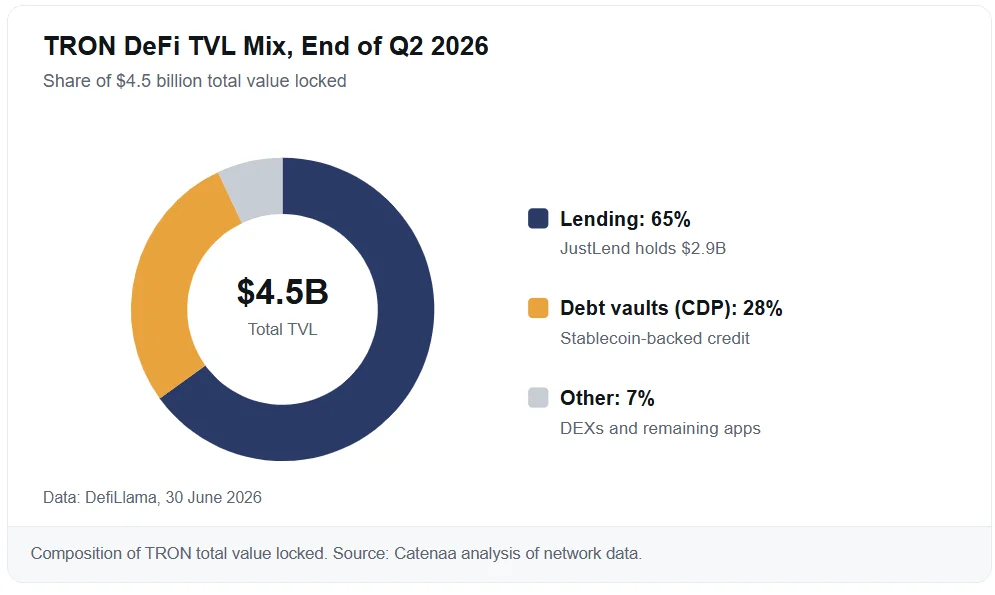
The DeFi picture looked softer. Total value locked slipped to $4.5 billion from $4.6 billion, based on DefiLlama data. Lending and debt vaults still account for 93% of that total. JustLend, the largest lending market, saw active loans drop to $126 million from $200 million. That is a 37% slide.
Token prices moved the other way. JST rallied 38% during the quarter as JustLend’s buyback and burn program absorbed supply. The protocol has repurchased about $21 million of JST since launching that effort. Meanwhile, SunSwap spot volumes rose slightly to $5.8 billion, though Sunperp perp volumes fell to $12 billion. The split suggests token supply math, not usage growth, drove the rally.
Product upgrades helped spot markets. SunSwap released its V4 design in March, pooling all liquidity inside one contract. The change cuts energy costs on complex trades. By June, V4 already handled about 30% of SunSwap volume.
Institutions and AI Agents Move In
Big institutions moved in on several fronts. Hamilton Lane’s tokenized private credit fund, HLSCOPE, launched on the network through Securitize in June. The deal marked the first Securitize-issued asset on the chain. Days later, Bitnomial listed TRX for spot trading on its CFTC-regulated U.S. exchange. Furthermore, an April integration with Hyperlane connected the network to more than 150 chains. Those links carry data and commands, not just tokens.
AI payments emerged as a fresh theme too. B.AI launched financial rails for AI agents on the network in April. In addition, deBridge shipped an MCP server that gives agents direct cross-chain execution. TRON also joined the Agentic AI Foundation alongside Stripe and GoDaddy. Together, these moves set the chain up as a rail for machine-to-machine trade.
Price Holds Up as Liquidity Thins
TRX held its ground as well. The token gained 3% while Bitcoin fell 4%. That beat most large assets. Trading cooled, however, with exchange volumes dropping to $29 billion from $36 billion. Spot trades totalled $21 billion across 70 venues, while perp volumes reached $8.3 billion.
Liquidity thinned at the margin. Daily order book depth within 1% of mid price fell from 6 million TRX to 5 million TRX. Depth briefly dipped to 3.5 million in late May before recovering. Binance still leads that market, handling 58% of TRX perp volume.
The Bottom Line
The bigger takeaway sits in the mix of numbers. Fee income now rivals chains that hold far more DeFi money. Therefore, the network’s value flows more from payments than from bets. If institutions and AI agents keep arriving, that fee base could prove durable.
Risks still sit in plain view. Fee income depends heavily on Tether, a single issuer. Active loans nearly halved, so loan demand looks weak. Also, new rules could reshape the stablecoin business at any time. For now, though, the quarter confirmed one thing clearly. The world’s busiest stablecoin rail has learned how to get paid.
The main TRON Q2 2026 lesson is that stablecoin scale now matters as much as DeFi liquidity.