

April 22, 2026 – Messari’s State of TRON Q1 2026 report reveals a network bucking the bear market trend with record USDT dominance, surging user activity, and a pivot toward AI and institutional finance.

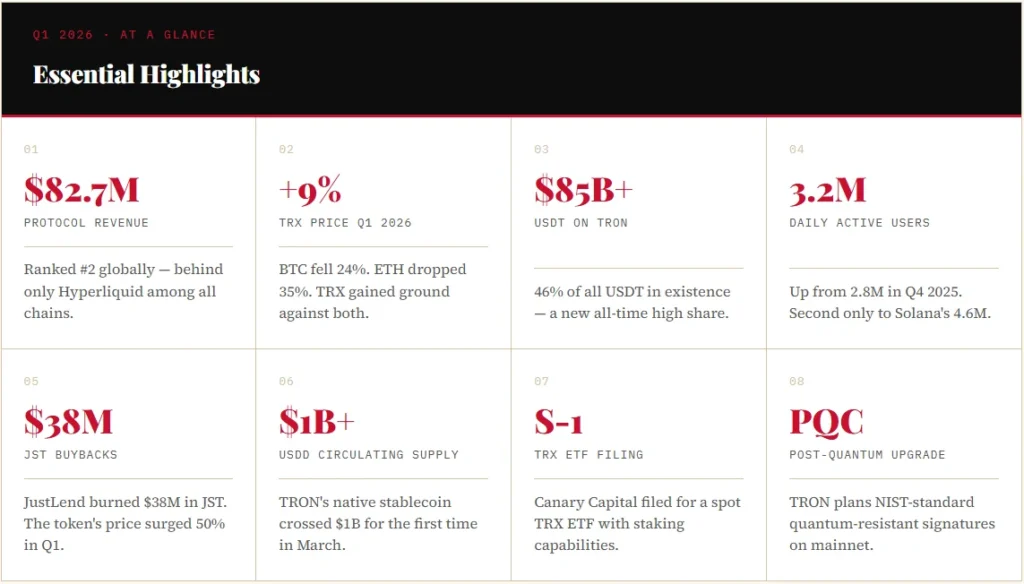
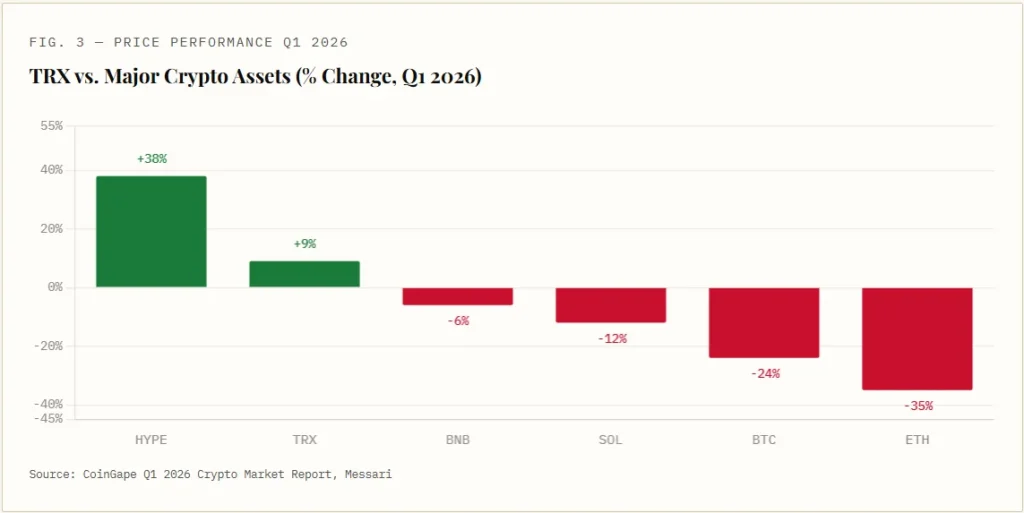
Q1 2026 was a brutal quarter for crypto. Bitcoin dropped 24%, while Ethereum fell 35%. Altogether, the total market cap shed $600 billion. Against that backdrop, however, TRON quietly posted one of its strongest quarterly performances on record, and almost nobody was talking about it.
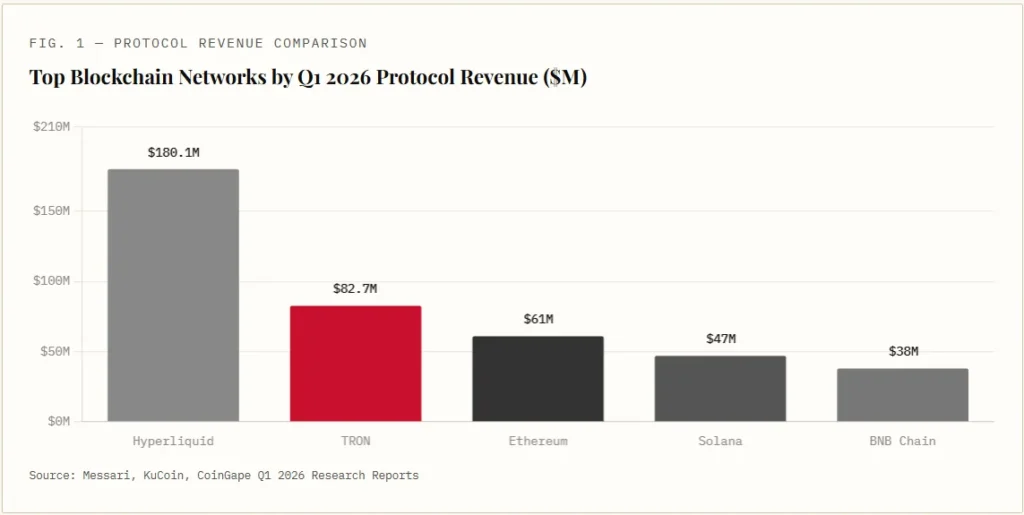
According to Messari’s State of TRON Q1 2026 report, the network generated $82.69 million in protocol revenue. Only Hyperliquid, the perpetual futures exchange, earned more. As a result, among general-purpose blockchains, TRON stood alone at the top.
Stablecoin Dominance Reaches a New Peak
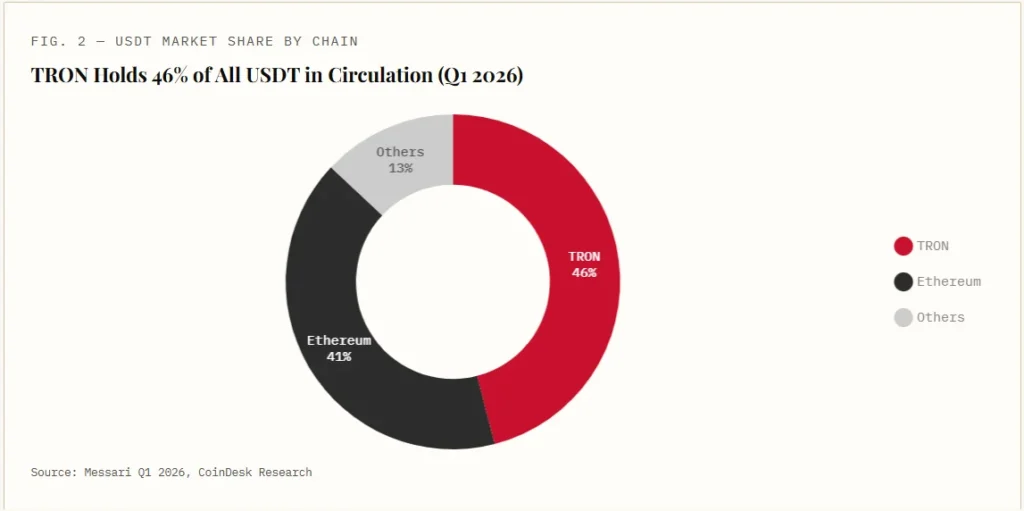
TRON’s engine is USDT. By March 2026, the network hosted over $85 billion in USDT supply, equivalent to 46% of all USDT in existence, a majority share.
Notably, that growth came despite a shrinking global USDT market cap. Total USDT fell 1.6% to $184 billion in Q1, yet TRON’s slice of the pie grew anyway. Furthermore, the network controls 27.3% of the entire stablecoin market across all assets.
TRON hosts more USDT than any other blockchain. Its 46% share of global USDT supply grew, even as the total USDT market contracted.”
Crucially, this dominance extends beyond large transactions. TRON also leads USDT transfers in the $1,000–$100,000 range, the sweet spot for retail remittances and cross-border payments. Consequently, low fees and fast finality make it the preferred rail for everyday users in emerging markets.
TRX Bucks the Market, Up 9% as BTC Fell
TRX is one of the few major tokens that gained ground in Q1. Specifically, the token rose 9% while Bitcoin dropped 24% and Ethereum lost 35%. Only Hyperliquid’s HYPE token outperformed TRX among tracked assets, per CoinGape’s Q1 2026 market report.
This price resilience reflects real utility. TRON’s fee revenue grew in tandem with user growth; each additional user generates further TRX burns, which in turn reduces the circulating supply. As a result, the network’s deflationary model supports price stability even in a down market.
DeFi: JustLend Holds Firm, USDD Breaks $1B
TRON’s DeFi ecosystem remained stable throughout the quarter. Total value locked (TVL) held near $5 billion, while JustLend, the dominant lending protocol, maintained $3.3 billion in TVL and kept active loans consistently above $200 million per month.
Beyond lending, JustLend also continued its deflationary flywheel. The protocol executed $38 million in JST token buybacks and burns as of early Q2 2026. Consequently, JST’s price surged 50% in Q1 alone, making JustLend one of the few DeFi protocols actively rewarding holders through revenue-linked burns.
Meanwhile, USDD, TRON’s native algorithmic stablecoin, crossed $1 billion in circulating supply in March 2026. This milestone adds a third major stablecoin layer to a network already synonymous with USDT.
User Growth: 3.2M Daily Active Users, 373M Accounts
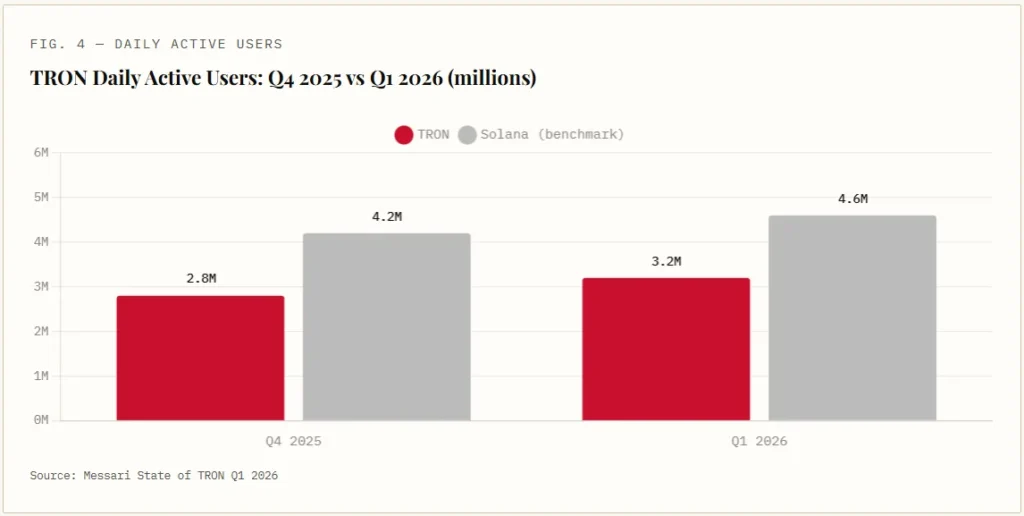
Daily active users averaged 3.2 million in Q1, up from 2.8 million in Q4 2025. Among benchmarked chains, only Solana recorded higher activity at 4.6 million. In addition, TRON’s total registered accounts now exceed 373 million addresses, a scale comparable to major global fintech platforms.
On top of that, the network processed an average of 10.7 million daily transactions, each costing a fraction of a cent. Together, this combination of volume and ultra-low cost is precisely what drives TRON’s stablecoin settlement use case.
Institutional Expansion: ETFs, RWAs, and Quantum Security
Q1 also marked a notable shift toward institutional credibility. Three developments, in particular, stand out:
Canary Capital filed an S-1 for a spot TRON ETF with staking capabilities. If approved, it would be the first regulated TRX product for U.S. institutional investors, a significant legitimacy signal.
Similarly, Securitize integrated with TRON, bringing tokenized real-world assets, including funds backed by BlackRock and VanEck, to its 373 million accounts. This positions TRON as a settlement layer for traditional finance assets, not just crypto-native ones.
Furthermore, Anchorage Digital, the only U.S. federally chartered crypto bank, added TRON custody support in March 2026. That opens the door to regulated institutional TRX holdings at scale.
On the technical side, founder Justin Sun announced a post-quantum cryptography upgrade. TRON aims to become the first major public blockchain to implement NIST-standard post-quantum signatures on mainnet, a forward-looking security move that addresses long-term threats from quantum computing.
What This Means for Q2 and Beyond
TRON enters Q2 2026 with clear structural advantages. Its stablecoin moat is deep, its revenue is real rather than speculative, and its institutional pipeline continues to build at a steady pace.
Nevertheless, the risks are also real. Smaller USDT transfer volumes in the under-$1,000 segment suggest emerging competition for micro-transactions. Moreover, new “stablecoin chains” are entering the market, and regulatory scrutiny of USDT itself could ultimately disrupt the entire model.
Even so, the Q1 2026 scorecard is hard to argue with. TRON earned more protocol revenue than Ethereum, its token rose while the broader market fell, and it is steadily positioning itself at the intersection of stablecoins, AI, and institutional finance.
“TRON is one of the most profitable blockchain networks in crypto. Its stablecoin moat is deep, and its pivot toward AI and institutional finance is only beginning.”