

May 03, 2026 – The stablecoin giant strengthened its balance sheet amid volatile markets. Its $141B U.S. Treasury position now ranks it among the world’s top sovereign debt holders.
In Summary
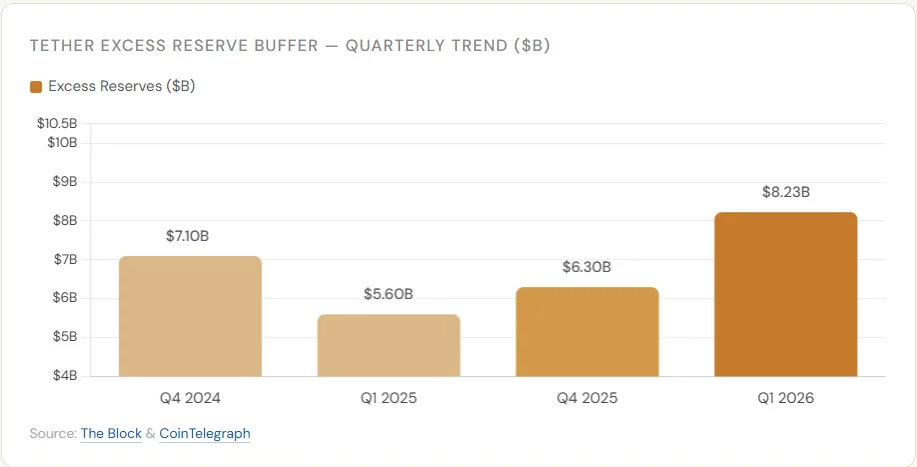
Tether posted $1.04B in Q1 2026 net profit, verified by independent auditor BDO.
The excess reserve buffer hit a record $8.23B, up 47% year-over-year from $5.6B in Q1 2025.
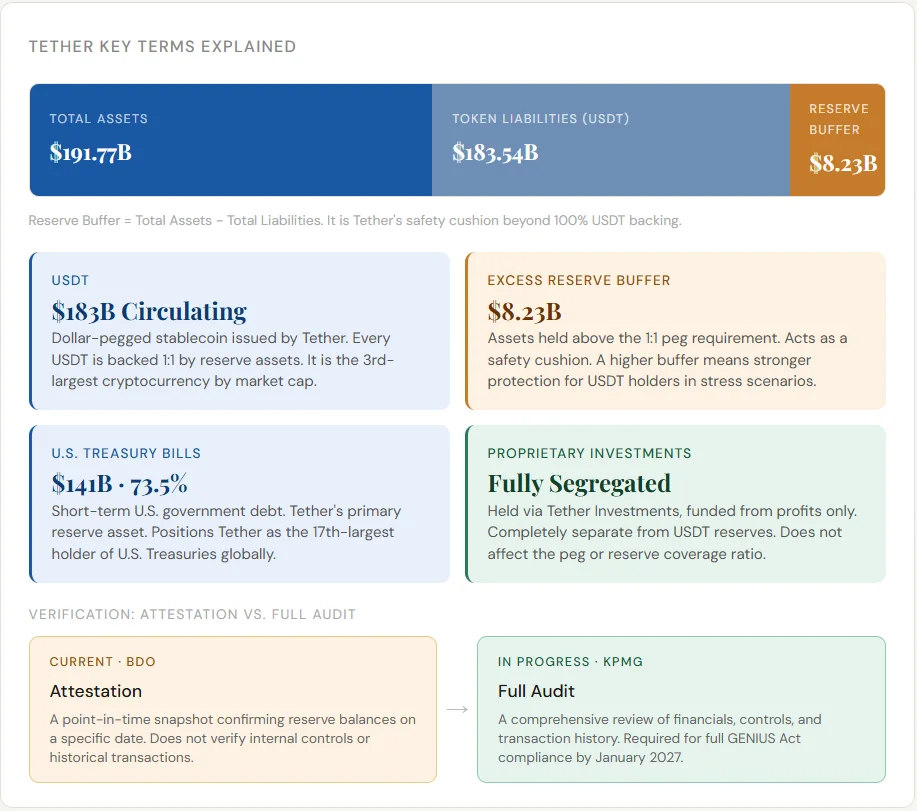
Total assets reached $191.77B against $183.54B in liabilities; $141B is held in U.S. Treasury bills.
USDT user base hit a new all-time high of 570 million, with circulation stable at ~$183B.
A formal KPMG audit commenced in March 2026, ahead of the GENIUS Act’s January 2027 deadline.

Tether opened 2026 with a dominant financial showing. The world’s largest stablecoin issuer reported $1.04 billion in net profit in Q1. This came despite sharp volatility in global crypto and equity markets. The attestation was prepared by BDO, a global independent accounting firm.
The firm’s excess reserve buffer climbed to a record $8.23 billion. That figure marks a 47% year-over-year increase. In Q1 2025, the buffer stood at just $5.6 billion. The surge signals growing financial resilience at the top of the stablecoin market.
Understanding the Numbers: Tether Terminology
Reserve Buffer: Rapid and Sustained Growth
Tether’s excess reserves measure assets held beyond what is needed to back every USDT. A larger buffer means more protection for users. According to CoinDesk, the buffer rose from $6.3 billion at the end of 2025 to $8.23 billion by March 31. That is a $1.93 billion increase in a single quarter.
Where Is the Money? A $191B Reserve Breakdown
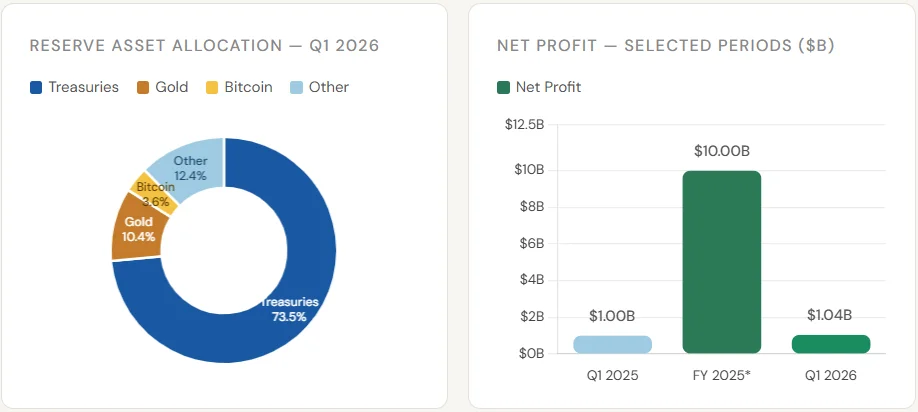
Tether’s total assets reached $191.77 billion as of March 31. Total liabilities were $183.54 billion. Crypto.news reports that $141 billion of those assets sit in U.S. Treasury bills. That makes Tether the 17th-largest holder of U.S. government debt globally alongside sovereign nations such as Saudi Arabia and South Korea.
Beyond Treasuries, Tether holds $20 billion in physical gold and $7 billion in Bitcoin. These positions act as macroeconomic hedges. The remaining ~$23.8 billion is held in repurchase agreements, money market funds, and other liquid instruments.
USDT Circulation Stays Firm. User Base Hits ATH.
USDT’s total token-related liabilities stood at approximately $183 billion on March 31. In April, USDT supply increased by over 5 billion tokens. The stablecoin now serves 570 million users, a fresh all-time high. USDT remains the third-largest cryptocurrency by market cap. Its combined dominance with Circle’s USDC represents 87% of the stablecoin market, per CoinTelegraph. The U.S. Treasury projects the dollar-backed stablecoin market could reach $2 trillion by 2028.
“Our responsibility is to make sure USDT works without compromise. That means building a system that behaves the same way in any market condition.”
— Paolo Ardoino, CEO, Tether
Regulatory Pressure Mounts and Tether Responds
The GENIUS Act was signed into U.S. law in July 2025. It takes full effect by January 18, 2027. It requires stablecoin issuers to hold fully verified 1:1 reserves. Attestations alone may not satisfy regulators. Crypto.news confirmed that Tether commenced a formal KPMG audit in March 2026. This is the first Big Four engagement in Tether’s history. In Europe, Tether has been delisted from several exchanges under MiCA regulations. Competitor Circle holds an e-money licence and remains better positioned in the EU.
Bottom Line: Fortress Balance Sheet, Finite Runway
Tether’s Q1 2026 results are striking. Its reserve buffer is at a record high. Its profit engine, fueled by interest income on Treasuries, continues to fire. With U.S. rates remaining elevated, the tailwind persists. However, full regulatory compliance demands a verified audit. The January 2027 deadline provides a finite window. As BTCTimes notes, whether Tether can prove its resilience to regulators will define its next chapter.




