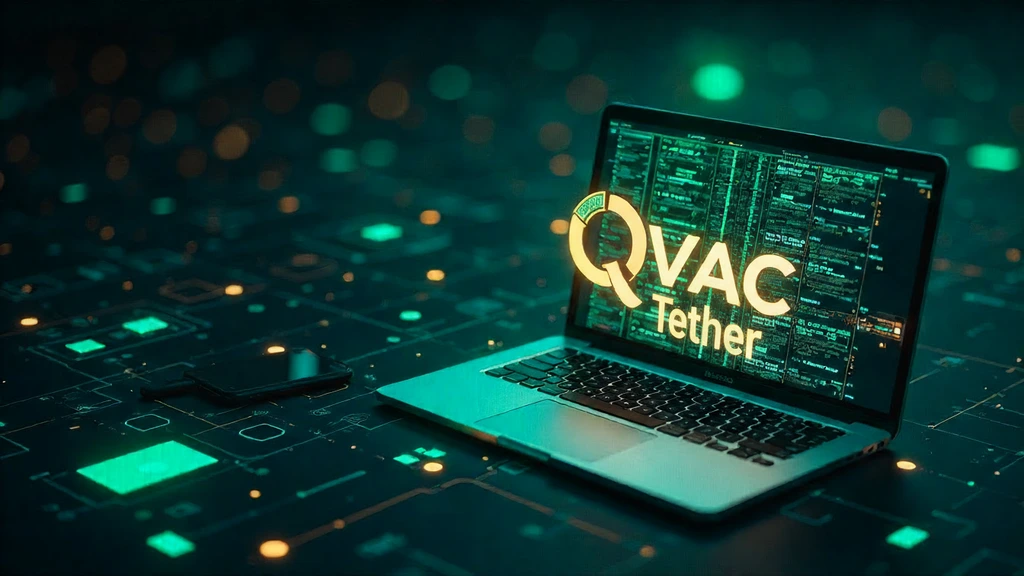


Catenaa, Thursday, October 30, 2025- Tether Data unveiled QVAC Genesis I, a 41-billion-token synthetic dataset, alongside QVAC Workbench, a local AI application designed to run entirely on consumer devices last week.
The platform aims to decentralize AI, giving researchers and users an alternative to models controlled by tech giants such as OpenAI and Google.
The dataset targets STEM-focused AI models, validated on benchmarks in math, physics, biology, and medicine.
QVAC Workbench allows AI computation to occur fully on smartphones or desktop computers, preserving data privacy and user ownership. A delegated inference feature enables heavy processing on connected desktops while keeping data local.
Tether positions the initiative as a step toward a broader ecosystem integrating Bitcoin and its USDT stablecoin, enabling autonomous AI agents to transact and interact via blockchain networks.
CEO Paolo Ardoino emphasized that QVAC seeks to “open the door to infinite intelligence” by providing AI that evolves independently of centralized servers.
The synthetic dataset is generated and validated from educational and scientific materials rather than public internet content, with a focus on reasoning and problem-solving.
The launch underscores Tether’s ambitions beyond finance, expanding its role into AI development and decentralized technology infrastructure.
While the platform promises open, private, and scalable AI access, experts caution that synthetic datasets may amplify biases inherent in their source models.
Tether claims QVAC offers a competitive alternative for researchers and developers seeking independence from corporate-controlled AI systems.