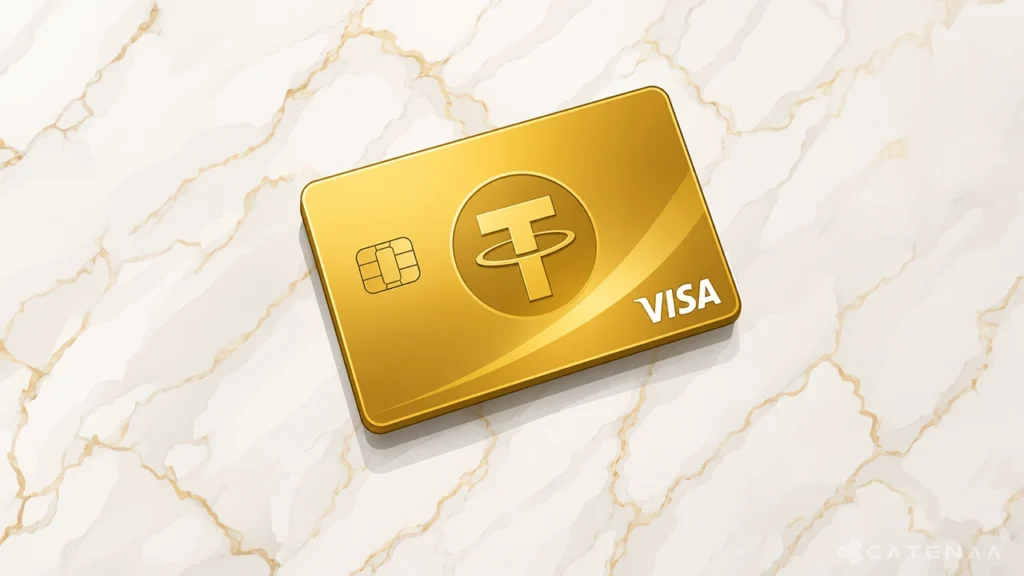


Catenaa, Thursday, June 11, 2026-Tether and digital asset platform Fasset have launched what they describe as the world’s first gold-backed neobanking Visa card, allowing users to spend fiat currencies while earning rewards in tokenized gold.
The initiative combines traditional payment infrastructure with blockchain-based gold ownership, creating a system that turns everyday purchases into opportunities for accumulating digital gold.
Under the program, eligible transactions earn cashback of up to 6% paid in Tether Gold (XAUT), the company’s gold-backed digital asset.
To support the launch, Tether has committed up to $1 million worth of XAUT to fund the rewards ecosystem.
The card operates on the Visa network and can be used at merchants globally wherever Visa payments are accepted.
The launch reflects growing efforts across the digital asset sector to connect tokenized real-world assets with mainstream consumer payment systems.
Historically, gold has served primarily as a store of value rather than a practical payment instrument.
The new card seeks to bridge that gap by integrating tokenized gold directly into everyday spending activities.
According to Tether, users can convert XAUT into USDT and then into local fiat currency almost instantly when making purchases.
The card also includes an automatic round-up feature that invests spare change from transactions into XAUT.
For example, a purchase totaling $9.60 could be rounded up to $10, with the remaining 40 cents automatically allocated toward tokenized gold accumulation.
The mechanism effectively transforms routine spending into a digital gold savings strategy.
The launch arrives as tokenized gold becomes one of the fastest-growing segments within the broader real-world asset sector.
The global tokenized gold market now exceeds $5.3 billion in value.
Tether Gold remains the largest product in the category, accounting for more than $2.6 billion of total market capitalization.
Each XAUT token represents ownership of one troy ounce of physical gold held in London Good Delivery bars.
Demand for gold-backed digital assets has accelerated during 2026 as investors seek alternatives to volatile fiat currencies and traditional cryptocurrencies.
Analysts noted that tokenized gold combines the stability traditionally associated with precious metals and the transferability offered by blockchain technology.
The partnership primarily targets users across Asia, Africa and other emerging markets where currency volatility remains a persistent challenge.
Fasset processes approximately $32 billion in annualized transaction volume and specializes in digital asset infrastructure connected to real-world assets.
According to the company, roughly 95% of its activity relates to tokenized real-world asset products.
The platform also operates as a major digital asset off-ramp provider, allowing users to convert cryptocurrencies and tokenized assets into local currencies.
That infrastructure plays a crucial role in enabling seamless conversion between digital gold and everyday spending.
Industry observers said emerging markets may prove particularly receptive to gold-backed digital financial products due to longstanding cultural preferences for gold ownership.
The card represents another example of stablecoins and tokenized assets moving beyond trading and investment applications into consumer finance.
Over the past year, several major payment providers, banks and fintech firms have expanded efforts to integrate blockchain-based assets into traditional payment systems.
Visa, Mastercard and Stripe are all exploring stablecoin-related settlement infrastructure as financial institutions seek faster and cheaper cross-border payment mechanisms.
Tokenized gold may represent a parallel trend focused on wealth preservation rather than purely transactional use cases.
Unlike stablecoins linked to national currencies, gold-backed assets offer exposure to precious metals while retaining digital transferability.
The launch comes amid intensifying competition across the tokenized real-world asset sector.
Financial institutions increasingly view tokenization as one of blockchain technology’s most commercially viable applications.
Gold, government bonds, money market funds and other traditional assets are rapidly moving onto blockchain networks.
Analysts estimate tokenized real-world assets could grow into a multi-trillion-dollar market over the next decade as financial infrastructure becomes increasingly digital.
Tether’s move positions XAUT not only as a store of value but also as a practical consumer finance product.
The partnership highlights how blockchain firms are increasingly blending traditional finance with digital asset innovation.
Rather than asking consumers to choose between conventional payment systems and digital assets, companies are building products that combine both worlds.
The success of the gold-backed Visa card may ultimately depend on whether users embrace tokenized gold as both a savings vehicle and a rewards asset.
If adoption accelerates, the launch could mark an important step toward making tokenized commodities a routine part of everyday financial life.




