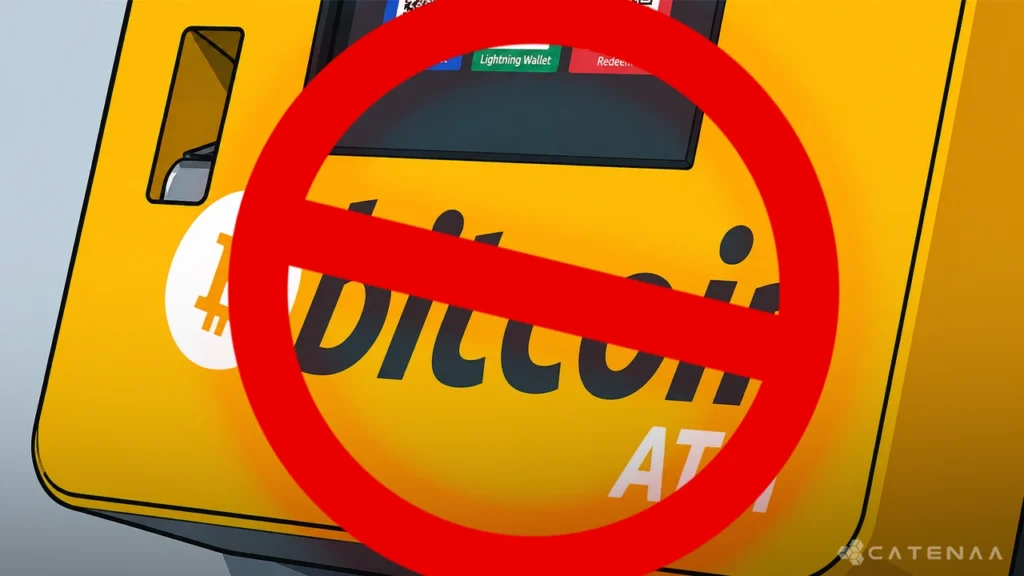


Catenaa, Thursday, April 30, 2026- Tennessee has banned cryptocurrency ATMs statewide after Governor Bill Lee signed a law on April 13 targeting fraud risks, making it a criminal offense to operate or host such machines, with enforcement set to begin July 1.
The measure places Tennessee among a small group of states taking the toughest stance against crypto kiosks. Lawmakers moved with rare unity, passing the bill without opposition. The law bars installation and operation of what it defines as virtual currency kiosks across retail spaces, including gas stations and shopping centers. Violations carry misdemeanor charges, with penalties that can include jail time and fines.
The move follows a growing wave of state-level action against crypto kiosks across the US. Indiana enacted a similar ban earlier this year, becoming the first to do so. Across the country, regulators have introduced licensing rules, transaction caps, and consumer safeguards. Reports indicate at least 30 states have proposed legislation tied to crypto kiosks in 2026, reflecting rising concern among policymakers.
The ban signals a shift from regulation to prohibition in certain jurisdictions. Crypto ATMs have served as an access point for cash-based users entering digital markets. Their removal could limit access, especially for unbanked populations. At the same time, authorities see the move as necessary to disrupt fraud networks that rely on fast, irreversible transactions.
Law enforcement agencies have long flagged these kiosks as tools used in scams. Data from the Federal Bureau of Investigation shows losses tied to crypto kiosks reached hundreds of millions of dollars in 2025, with older individuals among the most affected. Analysts say fraud schemes often involve impersonation tactics that pressure victims into urgent payments.
Tennessee’s decision reflects rising urgency among state leaders to curb financial scams linked to digital assets. More states may consider similar steps if fraud trends persist.
Crypto ATMs emerged in the early 2010s as a simple way for users to buy digital assets with cash. They expanded rapidly, appearing in everyday retail locations across the US. While the machines function like standard payment terminals, their design allows quick transfers to external wallets, making transactions difficult to reverse. Over time, criminal networks adapted to exploit this feature. Victims are often instructed to deposit cash and send funds under false pretenses, including fake legal threats or impersonation of officials. Federal data shows these scams have grown steadily, prompting regulators to act. While many states introduced safeguards, outright bans remained rare until recently. Tennessee’s move marks a stronger intervention as authorities seek to reduce exposure to fraud.