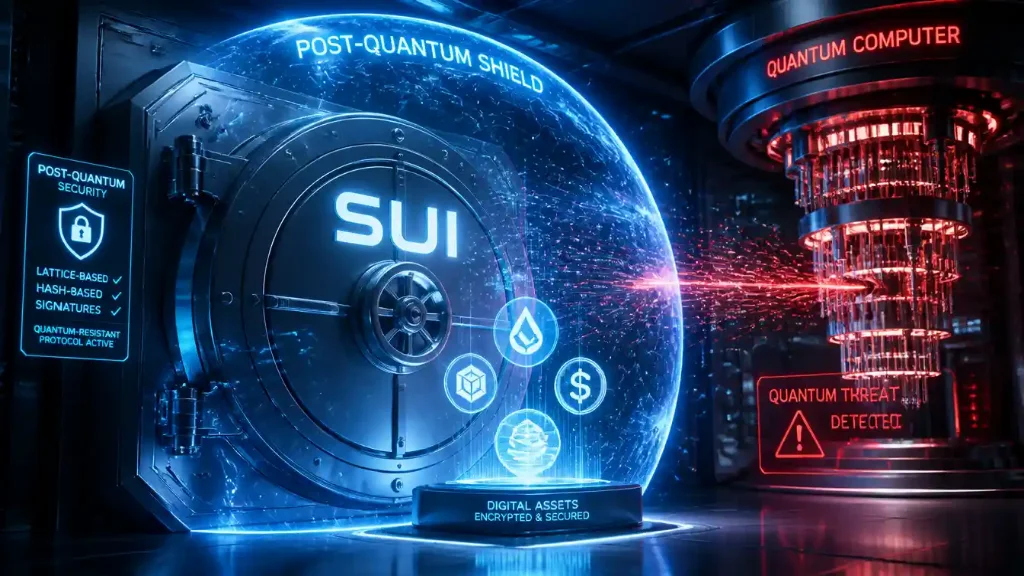


Catenaa, Wednesday, August 12, 2026- Sui is preparing quantum-resistant accounts that could protect digital assets from future quantum computers while allowing users to retain their existing recovery phrases.
The blockchain plans to integrate two post-quantum signature systems standardized by the US National Institute of Standards and Technology.
The move addresses a long-term security problem facing blockchain networks. Most cryptocurrencies depend on cryptographic systems that could potentially be defeated by sufficiently powerful quantum computers.
Blockchain assets present an unusual risk because public keys can remain permanently visible after transactions. Attackers could collect that information now and attempt to exploit it years later when quantum technology becomes powerful enough.
This potential strategy is commonly described as “harvest now, forge later.”
Sui plans to introduce ML-DSA-65 as a native signature option for ordinary accounts. The technology follows NIST’s FIPS 204 post-quantum digital signature standard.
A second system, SLH-DSA-SHA2-128s, will operate through Move smart contracts and is intended for high-value vaults.
Using two different cryptographic approaches reduces dependence on a single post-quantum technology. A future weakness discovered in one system would therefore not automatically compromise the other.
The upgrade is also designed to avoid one of the biggest problems facing blockchain migrations: moving assets from existing addresses.
Sui users will be able to derive quantum-safe keys from recovery phrases they already possess. The network’s address-alias system could also allow an existing account to change its authorization key without transferring its assets elsewhere.
That could make migration considerably easier if quantum-resistant security eventually becomes necessary.
However, stronger protection carries a technical cost. Post-quantum public keys and signatures are considerably larger than those currently used by Sui, increasing transaction sizes.
Sui is treating quantum protection as an optional addition rather than forcing users or developers to migrate immediately.
The network expects quantum-safe vaults to reach mainnet during 2026.
Native ML-DSA-65 accounts are targeted for testnet before the end of the year, followed by mainnet account authentication in the first quarter of 2027.
The development reflects a wider shift across the cryptocurrency industry toward preparing for quantum computing before machines capable of threatening current blockchain cryptography actually emerge.
For blockchain networks, the challenge is particularly difficult because security upgrades may eventually need to protect assets created years before quantum-resistant standards became necessary.
Sui’s approach attempts to solve that problem early by building an upgrade path into existing accounts rather than waiting for quantum computing to become an immediate threat.




