


July 31, 2026 – The Strategy Bitcoin loss was mostly non-cash. However, it reveals growing exposure to Bitcoin prices and financing costs.
In Summary
Strategy recorded an $8.32 billion digital asset loss, including $8.31 billion of unrealised losses.
Net loss reached $8.22 billion, while revenue increased 6.9% to $122.4 million.
Bitcoin holdings reached 846,000 coins at June 30, then fell to 843,775 after limited sales.
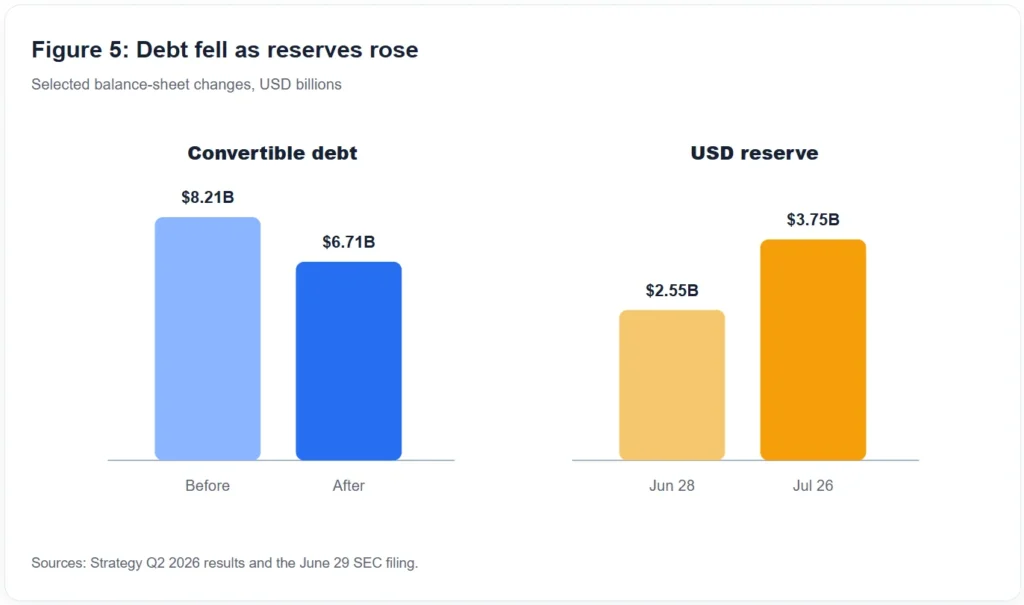
The company raised capital, reduced convertible debt, and expanded its dollar reserve.
Accounting rules now send Bitcoin price changes directly through reported earnings.
A fair-value shock drove the loss
Strategy reported an $8.22 billion net loss for the second quarter of 2026. The result reflects Bitcoin’s sharp quarter-end decline, not a comparable cash outflow. Still, the loss exposes how deeply earnings now depend on one volatile asset.
The quarterly loss came mainly from Bitcoin remeasurement. Strategy recorded an $8.32 billion digital asset loss during the quarter. Only $0.9 million represented a realized loss. Therefore, almost the entire charge was non-cash at quarter-end.
New accounting rules explain the scale. FASB requires qualifying crypto assets to be measured at fair value each reporting period. Companies must recognize value changes in net income. Consequently, Strategy’s income statement now moves with Bitcoin’s quarterly closing price.
This treatment improves balance-sheet transparency. However, it also creates extreme earnings volatility. A falling quarter-end price can produce billions in losses. A rising price can reverse that pattern rapidly.
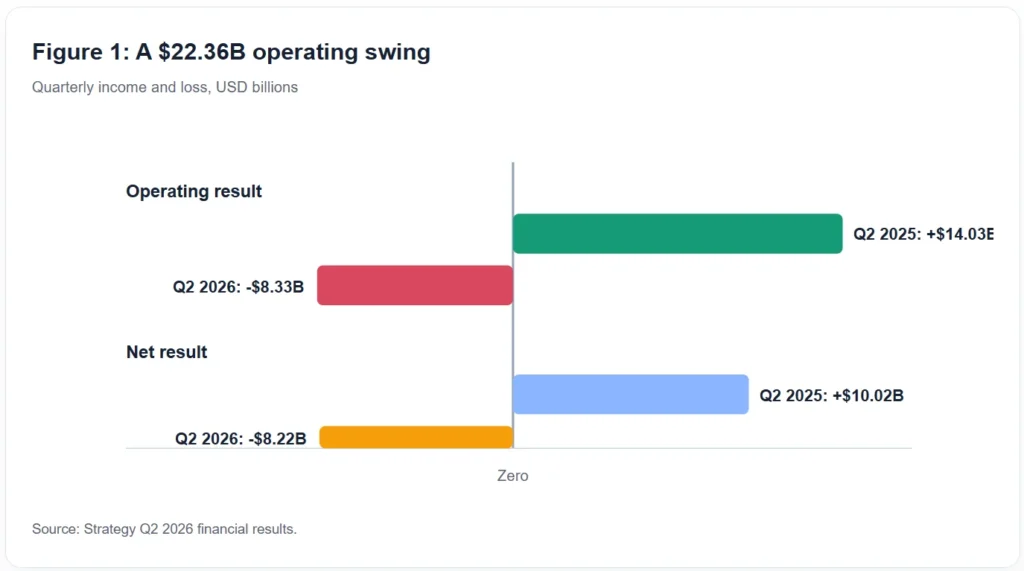
The year-on-year comparison shows that effect. Strategy posted $14.03 billion of operating income in the second quarter of 2025. One year later, it reported an $8.33 billion operating loss. That represents a $22.36 billion swing.
The software business remains too small
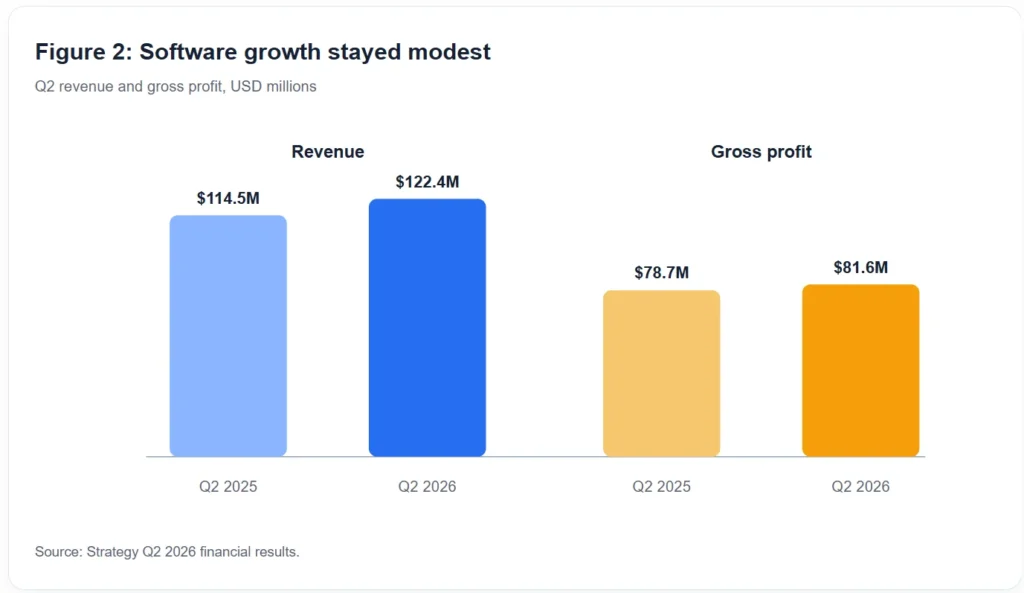
Strategy’s operating software business improved, but it could not offset the Bitcoin decline. Revenue rose 6.9% to $122.4 million. Gross profit increased to $81.6 million from $78.7 million.
However, gross margin slipped to 66.6% from 68.8%. More importantly, quarterly revenue equalled only 1.5% of the digital asset loss. The company’s reported performance now depends far more on Bitcoin than on software demand.
This creates a valuation challenge. Investors must separate recurring software cash flows from non-cash Bitcoin remeasurement. They must also assess capital costs, preferred dividends, debt claims, and potential dilution.
Bitcoin exposure kept expanding
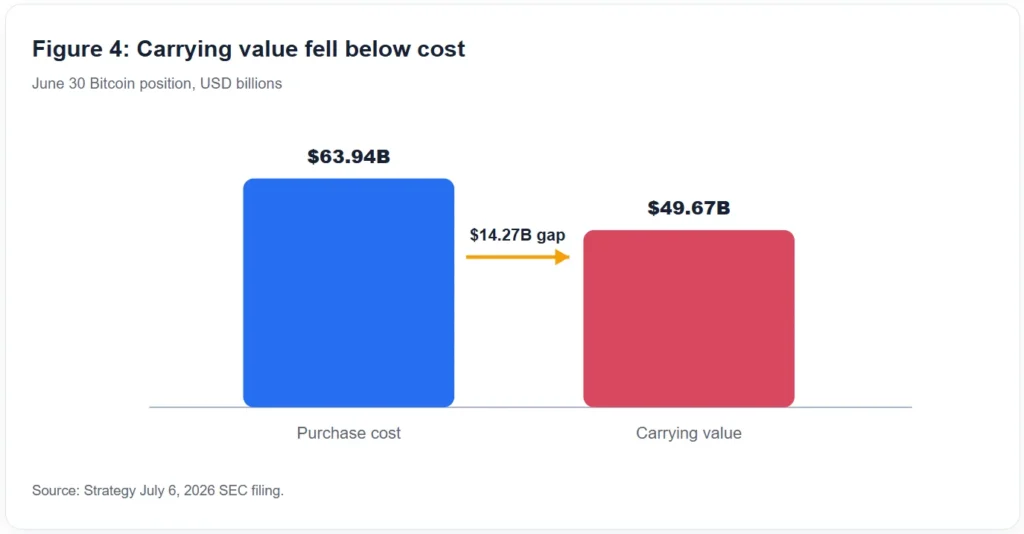
Strategy held 846,000 Bitcoin at June 30. Their aggregate purchase cost reached $63.94 billion. The carrying value stood at $49.67 billion. Therefore, the balance-sheet value sat $14.27 billion below cost.
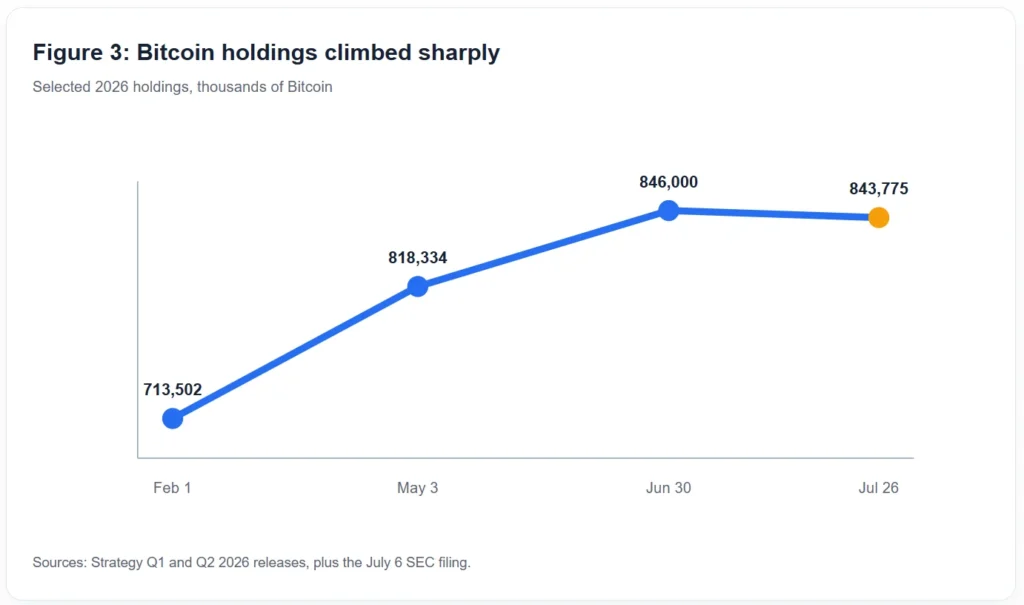
Holdings later declined to 843,775 Bitcoin after limited sales. The company used sale proceeds to support preferred distributions and replenish dollar reserves. That step marks an important shift from a pure accumulation narrative.
Even so, Strategy still reported a 4.5% year-to-date BTC Yield by July 26. Management also reported a $1.95 billion BTC Dollar Gain. These measures track Bitcoin per diluted share, not accounting profit or cash returns.
Capital strength offsets some pressure
Management also strengthened liquidity during the quarter. Strategy reduced convertible debt from $8.21 billion to $6.71 billion. It repurchased $1.50 billion of notes for about $1.38 billion.
The dollar reserve later increased to $3.75 billion. Management says that amount covers more than 2.1 years of preferred dividends and interest. This buffer reduces immediate refinancing pressure during weaker Bitcoin markets.
However, preferred dividends reached $400.7 million during the quarter. That compares with $49.1 million one year earlier. The larger burden increases the importance of stable capital-market access.
Common shareholders sit behind debt and preferred securities. Therefore, rising senior claims can weaken their residual exposure, even when total Bitcoin holdings increase. This distinction matters during downturns. The asset base may fall while fixed obligations continue.
What investors should watch next
The headline loss does not mean Strategy spent $8.22 billion in cash. Yet the result is not meaningless. It shows the sensitivity of equity value to Bitcoin prices, financing costs, and senior claims.
Investors should track three variables. First, Bitcoin must remain above the company’s effective capital hurdle over time. Second, new issuance must increase Bitcoin per diluted share. Third, liquidity must cover dividends without forcing material Bitcoin sales.
Strategy remains the largest corporate Bitcoin holder. Therefore, its results offer a real-time stress test for Bitcoin treasury finance. The second quarter showed both sides of that model. Scale can magnify gains, but it can also magnify accounting losses and funding pressure.




