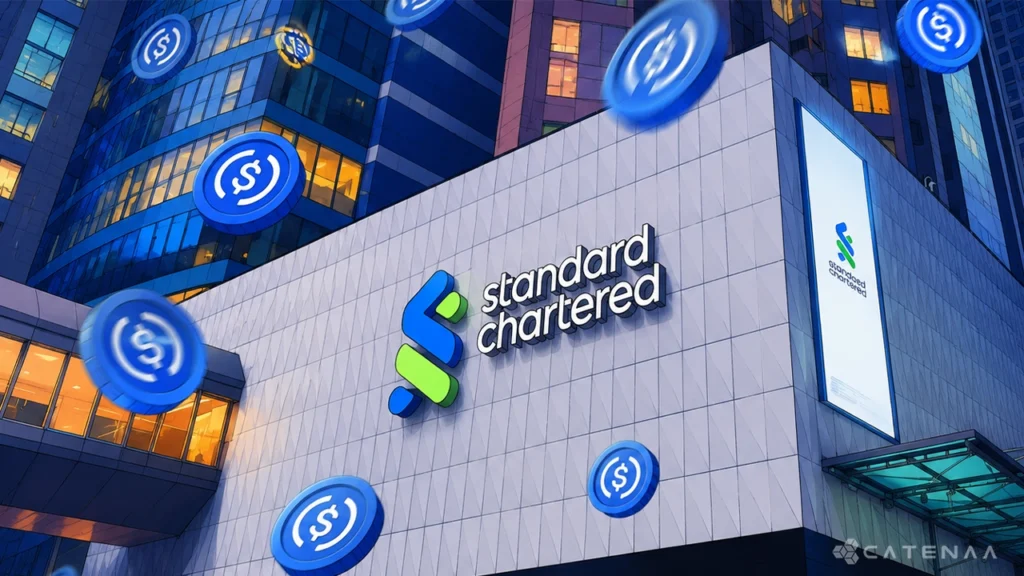


Catenaa, Thursday, July 09, 2026-Standard Chartered has become the first Global Systemically Important Bank (G-SIB) to provide institutional clients with direct access to mint and redeem USDC, strengthening the role of regulated stablecoins within traditional banking and accelerating institutional adoption of blockchain-based financial infrastructure.
The new service enables corporate and institutional customers to create and redeem USDC directly through Standard Chartered without opening separate accounts with Circle, the issuer of the dollar-backed stablecoin.
Initially launching through the bank’s operations in the Dubai International Financial Centre (DIFC), the platform is expected to expand into additional jurisdictions as regulatory approvals are obtained.
The initiative positions Standard Chartered among the first major international banks to integrate regulated stablecoin services directly into its core institutional banking offering.
As one of the world’s designated Global Systemically Important Banks, Standard Chartered operates under heightened international regulatory oversight because of its importance to global financial stability.
Its entry into stablecoin infrastructure represents another step toward the convergence of conventional banking and blockchain-based financial services.
Rather than requiring institutions to establish direct relationships with stablecoin issuers, the new model allows clients to access USDC through existing banking relationships using a unified onboarding process.
The approach simplifies operational workflows while maintaining traditional banking standards for compliance, governance and risk management.
The service is designed primarily for institutional use cases rather than retail payments.
Standard Chartered said clients will initially use the platform for on-chain settlement, treasury management and liquidity operations across blockchain networks.
Future phases are expected to introduce payment functionality as the bank expands its stablecoin capabilities.
By linking conventional banking infrastructure with public blockchain networks, the service aims to improve transaction speed, settlement efficiency and cross-border capital movement.
The rollout in Dubai represents the first phase of a broader international strategy.
Standard Chartered intends to extend the service into additional financial centres as regulators approve stablecoin-related banking activities.
Dubai has emerged as one of the world’s most active digital asset jurisdictions, supported by a regulatory framework that has attracted banks, exchanges and blockchain companies seeking to expand institutional services.
The location provides an important testing ground before wider international deployment.
The launch comes amid accelerating institutional interest in stablecoins following greater regulatory clarity in several major markets.
Banks, asset managers and payment companies are increasingly developing infrastructure that enables customers to move seamlessly between traditional fiat currencies and blockchain-based digital assets.
Industry analysts expect regulated financial institutions to play an expanding role in stablecoin issuance, custody and settlement as tokenized finance continues to grow.
The announcement also provided a boost to Circle, the issuer of USDC.
Circle’s shares rose more than 9% following the news, recovering some recent losses after investor concerns emerged over competition from newly announced stablecoin initiatives.
The partnership strengthens Circle’s position among institutional financial providers while expanding the reach of USDC into the global banking system.
USDC is the world’s second-largest dollar-backed stablecoin and is widely used for digital payments, trading, tokenized asset settlement and decentralized finance applications. Standard Chartered is one of approximately 30 Global Systemically Important Banks designated by international regulators because of its critical role in the global financial system. The integration of stablecoin services into major commercial banks reflects a broader shift toward tokenized finance, where blockchain-based settlement assets increasingly complement traditional banking infrastructure. As regulatory frameworks mature in key jurisdictions, large financial institutions are rapidly developing products that bridge conventional finance with digital asset markets, positioning stablecoins as an emerging component of institutional payment and treasury operations.




