

May 06, 2026 – SC Ventures becomes the first external shareholder in crypto market maker GSR. The deal targets tokenization and institutional-grade digital asset infrastructure.
In Summary
SC Ventures invests in GSR at a valuation exceeding $1 billion.
SC Ventures becomes GSR’s first external shareholder since its founding in 2013.
GSR is in talks to raise up to $150 million from additional strategic investors.
The deal focuses on tokenization and regulated institutional crypto infrastructure.
Standard Chartered is also seeking to acquire Zodia Custody and launch a $250M digital asset fund.
Standard Chartered’s venture arm, SC Ventures, has invested in crypto market maker GSR. The deal values GSR at over $1 billion. This marks a significant milestone for the 12-year-old firm. It is GSR’s first external strategic investment since its founding in 2013.
GSR was founded by former Goldman Sachs traders over a decade ago. Today, it operates across spot, derivatives, and structured product markets. The firm serves exchanges, token issuers, and institutions globally. It claims more than 300 liquidity partners and over $1 trillion in total trades since inception.
Why This Deal Matters
The investment is more than a simple equity stake. Bloomberg confirmed the valuation exceeds $1 billion. Both firms describe it as a broader strategic partnership. The goal is to build a regulated, scalable infrastructure. This infrastructure links traditional banking with digital asset markets.
“Institutional digital asset markets are maturing rapidly. Firms that combine deep capital markets expertise with trusted banking infrastructure will lead.” Xin Song, CEO of GSR
SC Ventures CEO Alex Manson added to the vision. He stated that the next phase of digital asset growth depends on the strength of the infrastructure. This investment reinforces SC Ventures’ focus on building institutional ecosystems. The goal is to support deeper liquidity and more resilient market activity.
The deal builds on an existing collaboration between the two firms. GSR recently invested in Libeara, a tokenization platform backed by SC Ventures. Libeara has already supported over $1 billion in tokenized real-world assets. This existing relationship made the equity investment a natural next step.
GSR’s Expanding Footprint
GSR has been on an aggressive growth path in 2026. In March, it acquired token advisory firms Autonomous and Architech for $57 million. This move significantly expanded its tokenization services division. GSR can now offer end-to-end support for token launches.
The firm also launched its first exchange-traded fund on NASDAQ. The fund, BESO, is an actively managed multi-asset crypto fund. It covers Bitcoin, Ethereum, and Solana, with staking enabled. GSR also filed with the SEC for a Digital Asset Treasury Companies ETF.
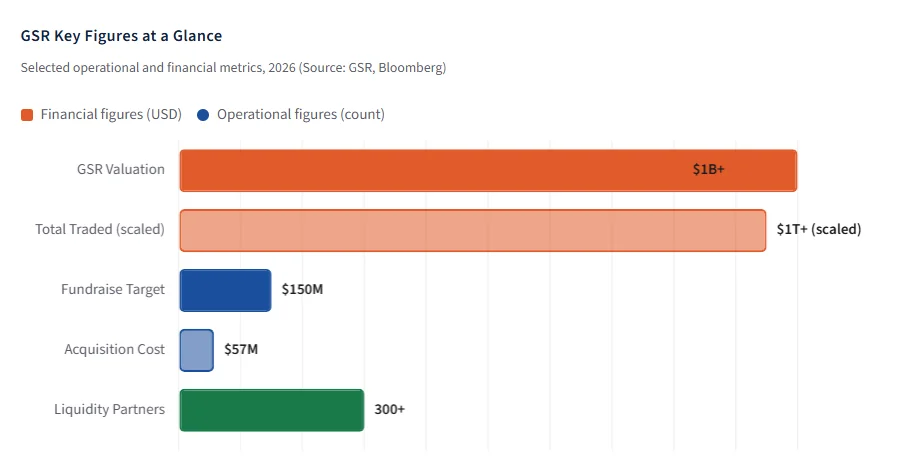
GSR is now raising up to $150 million from additional strategic investors. SC Ventures is the anchor backer. Other strategic investors are currently in discussions. The final round size and valuation may adjust as more partners commit.
Standard Chartered’s Crypto Build-Out
This deal does not exist in isolation. Standard Chartered has been building a crypto empire for several years. The bank now operates across custody, spot trading, stablecoins, and prime brokerage. Each investment adds a new layer to this growing ecosystem.
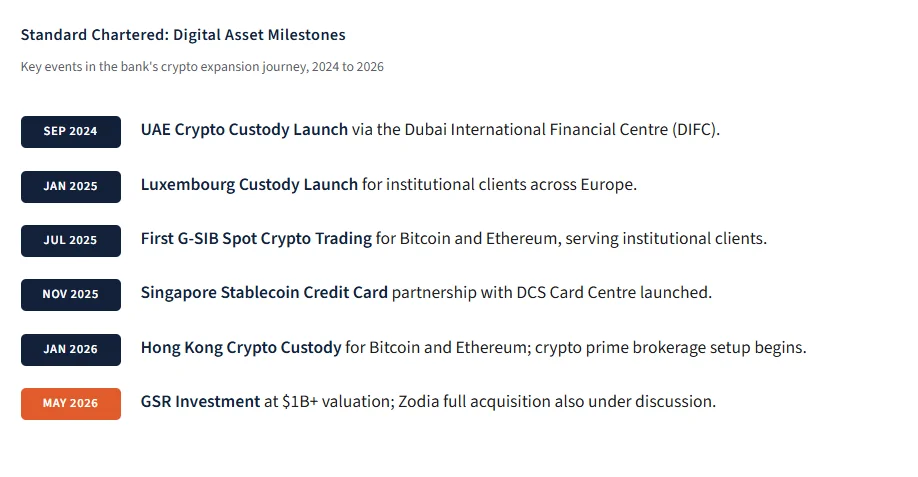
SC Ventures also recently invested in Keyrock, another crypto market maker. Bloomberg reports that SC Ventures is planning to launch a $250 million digital asset fund in 2026. The bank is also reportedly seeking to acquire Zodia Custody outright. Zodia is a crypto custodian that it co-founded with Northern Trust in 2020.
The Tokenization Opportunity
Both firms are betting heavily on tokenization. GSR plans to expand a capital markets services model. This covers token design, pre-issuance strategy, listing support, and post-listing market making. Very few firms offer this kind of end-to-end support today.
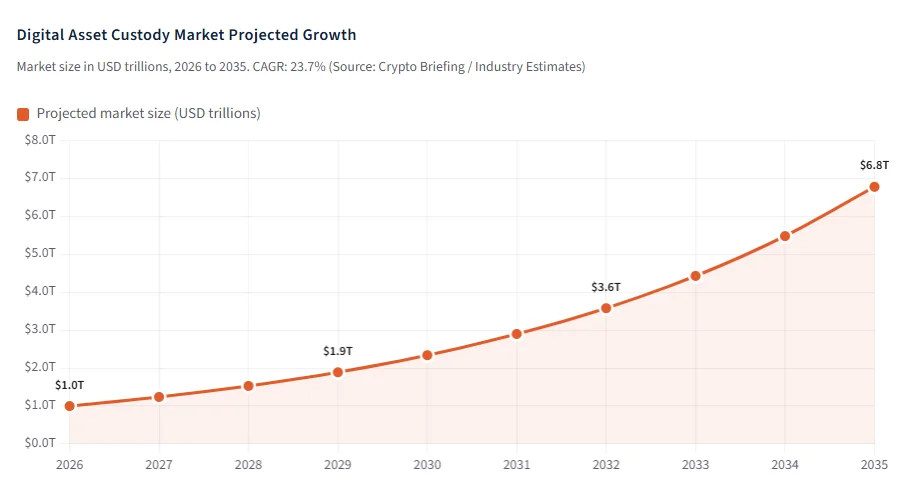
The numbers behind tokenization are compelling. The digital asset custody market is expected to grow from $1 trillion in 2026 to $7 trillion by 2035. This represents a compound annual growth rate of 23.7%. Growing institutional participation and clearer regulation are driving this expansion.
Broader Institutional Momentum
The GSR deal reflects a structural shift across global finance. Traditional banks are entering digital assets through strategic partnerships and acquisitions. About 73% of institutional investors now have active or planned digital asset allocations. This data comes from the EY-Parthenon 2026 institutional survey.
BNY Mellon, State Street, and Morgan Stanley have all expanded crypto operations in 2026. Standard Chartered is now competing directly with these firms. Its strategy focuses on infrastructure rather than simply holding tokens. This approach mirrors what savvy institutional players do in any emerging market.
Standard Chartered became the first global systemically important bank to offer spot crypto trading in 2025. This gave it a structural advantage. The GSR deal deepens that moat further. It adds liquidity infrastructure to an already growing crypto stack.
What Comes Next
GSR is exploring both organic and inorganic expansion. A spokesperson described the active pursuit of capital markets opportunities for both institutions and crypto-native firms. The $150 million fundraising round remains open. More strategic investors are expected to join SC Ventures at the table.
For Standard Chartered, the pace of activity signals ambition at scale. The bank is simultaneously pursuing the GSR stake, a potential Zodia acquisition, a $250 million fund launch, and a crypto prime brokerage. All of this is happening in a regulatory environment that is finally turning favorable for institutional crypto activity.
The deal may be a signal that the next phase of crypto growth belongs to institutions. Not retail speculation, but regulated infrastructure. Not token launches, but deep liquidity. The firms that build the rails today are likely to control the market tomorrow.