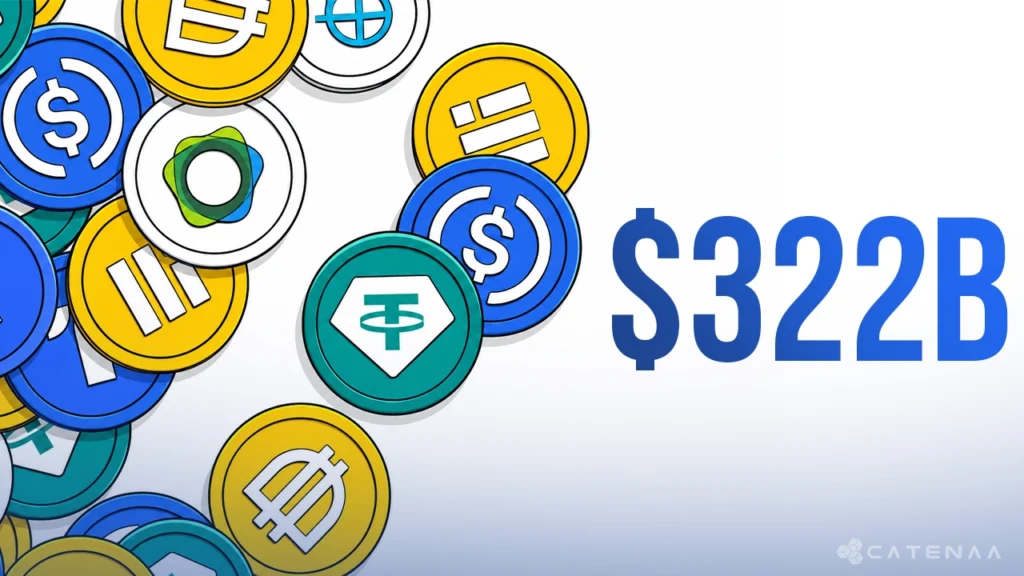


Catenaa, Monday, June 01, 2026- The global stablecoin market has surged to a record $322 billion, deepening the transformation of blockchain-based digital dollars from a crypto trading tool into a core layer of global financial infrastructure.
The rapid growth is intensifying pressure on traditional banks, which increasingly view stablecoins as a direct threat to deposits, payment systems and cross-border financial dominance.
At the same time, major financial institutions are accelerating development of tokenized deposit systems and blockchain settlement networks capable of processing trillions of dollars annually.
Stablecoins are cryptocurrencies pegged to fiat currencies, primarily the US dollar, and are widely used for trading, remittances and cross-border payments.
The market remains dominated by Tether’s USDT and Circle’s USDC, which together control more than 80% of total stablecoin supply.
Ethereum and Tron continue handling most stablecoin transaction activity, though newer blockchain networks increasingly compete for institutional settlement flows.
Major firms including Western Union and Payoneer recently expanded stablecoin payment systems as blockchain-based transfers increasingly challenge traditional correspondent banking infrastructure.
Meanwhile, banks are developing their own blockchain alternatives through tokenized deposits, which digitally represent traditional bank liabilities on distributed ledger systems.
JPMorgan’s Kinexys network alone reportedly processes more than $1 trillion annually in blockchain-based institutional transactions.
The battle between stablecoins and tokenized bank deposits increasingly represents a struggle over the future architecture of global digital money.
Stablecoins offer instant settlement, global accessibility and open blockchain interoperability, making them attractive for remittances, decentralized finance and emerging market payments.
Banks however fear that large-scale stablecoin adoption could drain deposits away from regulated financial institutions and weaken traditional payment revenue streams.
To counter the threat, financial institutions are building private blockchain settlement systems that preserve customer banking relationships while delivering blockchain efficiencies.
Analysts said the competition may eventually produce a layered financial system where stablecoins, tokenized bank deposits and central bank digital currencies coexist for different economic functions.
Financial researchers said stablecoins are no longer a niche crypto product but a growing component of global dollar infrastructure.
Some analysts warned however that privately issued digital dollars may create financial stability risks if confidence weakens during periods of market stress.
Supporters argued that new US regulatory frameworks such as the GENIUS Act create stronger reserve requirements and oversight structures that reduce systemic concerns.
Others noted that the biggest long-term challenge for banks may be interoperability because many tokenized deposit systems currently operate within isolated private networks.
Stablecoins emerged originally as a tool for crypto traders seeking dollar exposure without leaving blockchain markets.
The sector later expanded rapidly into remittances, decentralized finance and institutional settlement systems.
Global regulators meanwhile intensified efforts to create legal frameworks governing reserve backing, reporting standards and issuer oversight.
The broader financial industry increasingly views blockchain settlement systems as unavoidable infrastructure for future payments, treasury operations and cross-border commerce.